dailynewsnblog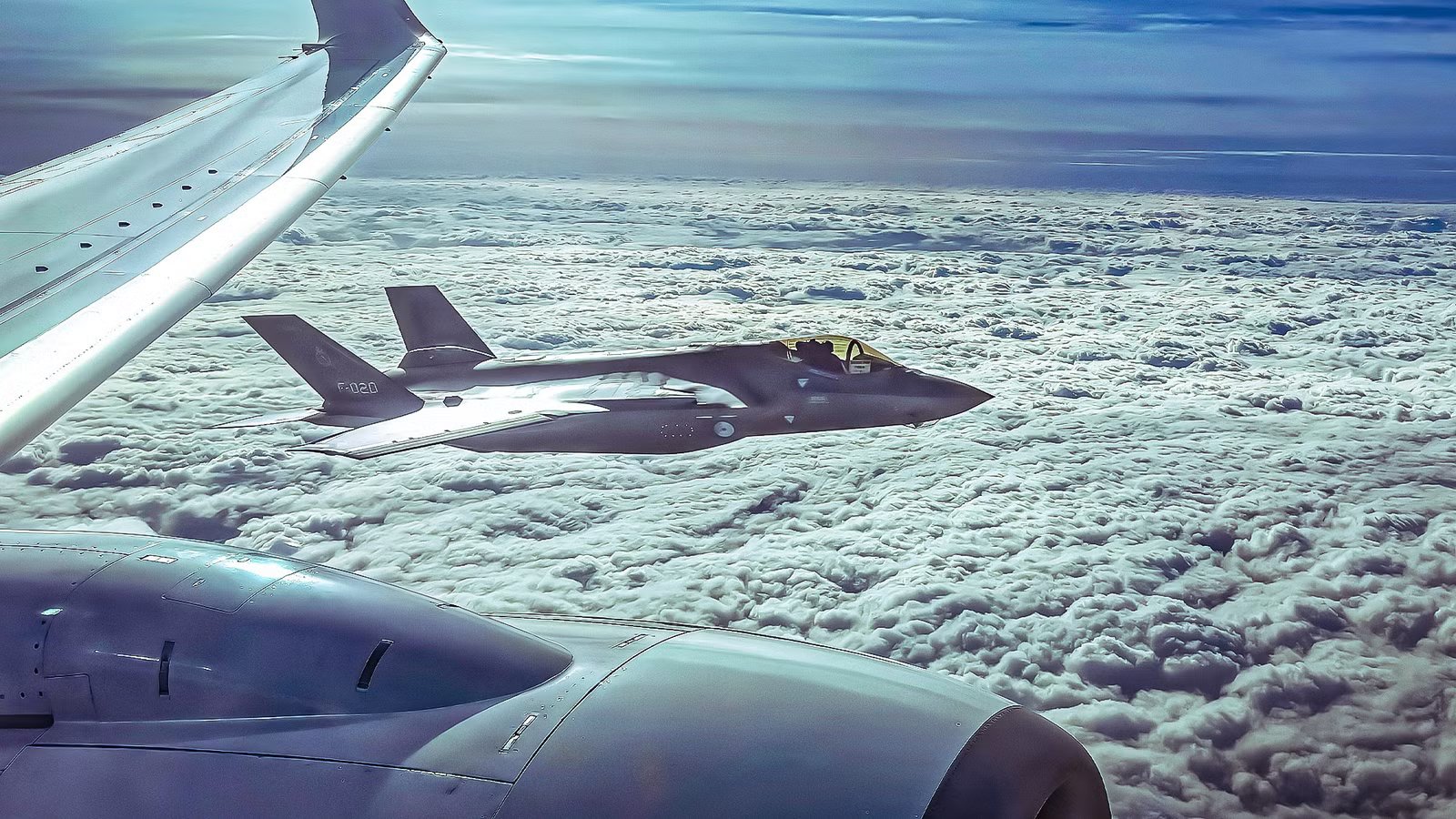
The “silent language” between military fighters and civilian pilots is not improvised. It is a globally standardized system defined by ICAO procedures that determines, often within seconds, whether an interception ends safely or escalates. According to official FAA guidance, ICAO manuals (Annex 2, Appendix 2: Interception of civil aircraft), and recent NORAD data showing over 20 intercept-worthy tracks in a single Temporary Flight Restriction (TFR) zone between January 20 and March 10, 2025, we will decode the exact signals, such as wing rocking, breakaway turns, and even flare deployment, that govern these encounters. The viral cockpit footage circulating on Reddit, showing a civilian aircraft intercepted en route to India, offers a rare real-world glimpse into a process most passengers never see, but that pilots train extensively for.
Based on pilot training materials, including the FAA’s Aeronautical Information Manual and technical breakdowns from sources like Boldmethod and Gleim, these intercepts follow a rigid procedure. We will see why intercepts happen even on approved flight plans, how fighters position themselves, the meaning behind every visual signal, what civilian pilots are trained to do, why flares are sometimes used, and how these procedures play out globally. NORAD’s increasing intercept activity near sensitive zones, such as Palm Beach, highlights how often these procedures are triggered, even in calm domestic airspace.
The Viral Intercept & The Reality Behind “Routine” Military Encounters

The now-viral footage shared via Reddit (available below) shows a small piston Piper Archer aircraft cruising steadily across the Arabian Sea from Oman to India as multiple fighter jets move into close formation. There is no aggressive maneuvering, no visible panic, but only precision. To passengers unfamiliar with aviation protocols, it appears tense and even shocking. But to pilots, it is instantly recognizable as a standard intercept.
Reports linked to the footage suggest the intercepting aircraft may have been carrier-based F/A-18s, which can be tasked with air defense missions globally. Crucially, the intercepted aircraft was reportedly flying on an approved flight plan, which has sparked widespread confusion. So why would a compliant aircraft attract military attention?
The answer lies in how modern airspace is monitored. As outlined in this ABC11 report, intercepts are often triggered not by malicious intent but by uncertainty, such as lost radio contact, transponder malfunction, missed instructions, entry into restricted airspace, or proximity to an active combat zone, as was the case with the aircraft in the footage. In these cases, the military’s role is not punitive, but investigative.
This context is critical, particularly for private pilots flying across the US. According to Military.com, NORAD tracked more than 20 aircraft of interest within a single TFR zone between January and March 2025. In just nine days, five intercepts occurred, and some involved flare deployment. These are not rare anomalies but routine operations in a security-conscious aviation environment.
The Geometry And Physics Of An Intercept: Precision At The Edge Of Flight

Before any signal is exchanged, the intercept begins with geometry. Fighter pilots are trained to approach in a way that maximizes visibility while minimizing risk. According to ICAO procedures outlined by Gleim, the intercepting aircraft positions itself slightly above, slightly ahead, and typically to the left of the civilian aircraft.
This positioning is deliberate. It ensures the fighter is clearly visible from the cockpit, particularly from the captain’s seat, while establishing visual authority. It is not an aggressive posture, but it is unmistakable.
What makes this phase remarkable is the aerodynamic challenge involved. Fighter jets such as the F-16, F-15, or F/A-18 are designed for high-speed maneuvering, not slow formation flight. Matching the speed of a light aircraft or even a commercial jet requires exceptional control. As detailed in Popular Mechanics, military pilots regularly train for this scenario, flying at the very edge of their aircraft’s performance envelope, sometimes just above stall speed. But sometimes, when the speed is too slow, as in the case of the ultralight aircraft, law enforcement helicopters must be deployed instead, as outlined by the FAA.
This is where the intercept becomes more than a procedure; it becomes a skill. The fighter pilot must maintain precise positioning, avoid wake turbulence, and remain close enough for visual signals to be unmistakable, all while operating an aircraft not designed for such slow, delicate flight.

Joke WiFi Name On Wizz Air Flight To Israel Triggers Fighter Jet Response
Prank Wi-Fi hotspot name on a Wizz flight to Israel sparked a fighter jet escort before landing safely, highlighting strict aviation security protocol
The Silent Language Itself: Every Signal That Matters

Once the fighter establishes position, the interaction shifts into its most critical phase: communication without words. ICAO has standardized a complete visual language that governs every aspect of the encounter, ensuring that pilots from different countries and training backgrounds can understand each other instantly.
|
Interceptor Action |
Meaning |
Civilian Pilot Response |
|
Approaches from the rear, positions above and left, may flash lights at night |
You have been intercepted |
Rock wings; at night, flash navigation lights |
|
Rocks wings (or rocks body if a helicopter) |
Follow me |
Rock wings and follow |
|
Initiates slow, level turn |
Fly this direction |
Match heading and continue |
|
Abrupt turn across nose; may release flares |
Warning—comply immediately |
Turn immediately and follow |
|
Circles airport, lowers gear, overflies runway |
Land here |
Lower gear and prepare to land |
|
Sharp climbing breakaway |
You may proceed |
Resume normal flight |
|
Civilian flashes lights regularly |
Unable to comply |
Maintain signaling |
|
Civilian flashes lights irregularly |
Distress |
Expect assistance |
At the heart of this system is the wing rock. When the fighter rocks its wings, it is issuing the most fundamental instruction: “Follow me.” The civilian pilot must respond in kind, rocking their wings to acknowledge. This simple exchange initiates the entire process.
Please note that, in the case of a helicopter interceptor, the helicopter will bank from side to side to indicate that you should follow it. What stands out in real-world footage is how calm this interaction appears. The intercepted aircraft does not maneuver unpredictably. It does not attempt to evade or question the instruction. Instead, it follows a script that has been drilled into pilots worldwide.
Predictability, Escalation, And The Moment Flares Appear

If the intercept has a single governing principle, it is predictability. The FAA’s guidance, as emphasized by Boldmethod, is explicit: the intercepted pilot must avoid sudden changes in altitude, heading, or speed unless instructed. Stability is interpreted as compliance; unpredictability introduces risk. In practical terms, this means resisting instinct. Even experienced pilots may feel the urge to maneuver when a fast-moving fighter suddenly appears off the wing, but training overrides instinct. Holding a steady course becomes the clearest signal that the situation is understood and under control.
This discipline becomes even more critical when radio communication has broken down. Many intercepts are triggered precisely because a pilot has stopped responding to air traffic control, whether due to equipment failure, frequency confusion, or simple workload saturation. In that silence, the intercepting fighter becomes the only reliable means of communication. The absence of radio contact elevates the importance of visual cues, turning what might otherwise be routine signals into the primary means of coordination between two aircraft traveling at vastly different speeds.
If those visual signals are not acknowledged, the interaction begins to escalate — but in a structured, methodical way. The fighter pilot will close the distance slightly, adjust position to ensure visibility, and repeat signals more emphatically. Only after these steps fail does the most dramatic tool in the intercept playbook come into view: flares.
As reported by KATV, flares are used purely as visual warnings. They are not weapons, and they are not aimed at the aircraft. Instead, they are discharged ahead of the intercepted plane, burning brightly and moving rapidly across the pilot’s field of view. Their purpose is singular: to break through any distraction, confusion, or inattention that prevents the pilot from responding.
In daylight, flares appear as brilliant streaks of light, impossible to miss even in peripheral vision. At night, they are even more striking: brief, intense bursts that illuminate the surrounding sky. For a pilot dealing with instrument issues or radio failures, the sudden appearance of flares is an unmistakable cue that the situation has escalated.
The data underscores how often this step becomes necessary. According to Military.com, multiple intercepts near Palm Beach in early 2025 involved flare deployment, including several within a concentrated nine-day period. They were routine enforcement scenarios where initial communication attempts failed. Even at this stage, the tone of the intercept remains controlled. There is no aggression in the maneuvering, no attempt to intimidate beyond what is necessary to regain attention. Each step, from wing rocking to repositioning to flare deployment, is designed to increase clarity, not tension. The fighter pilot is acting as a communicator, using increasingly visible signals to ensure the message is received.
Meanwhile, the flares represent the final layer of a communication process built on redundancy, ensuring that even without radios, instructions can still be delivered and understood.

Air Canada Intercept: Stolen Aeroplan Miles Trigger NORAD Fighter Jet Response
US and Canadian fighters escorted the Boeing 777-300ER to Montreal.
Ending The Intercept: Breakaways, Compliance, And Misconceptions

It’s worth noting that not every intercept results in a diversion or landing. In many cases, once the intercepting pilot has visually confirmed the aircraft’s identity and intent, and often after resolving a communication lapse, the interaction concludes in midair. The signal that ends this exchange is not verbal, but aerodynamic: a decisive breakaway maneuver that marks a clean and unmistakable separation between the two aircraft.
According to ICAO procedures outlined by Gleim, this involves a sharp climbing turn, typically greater than 90 degrees, executed in a manner highly visible from the intercepting cockpit. The geometry of the maneuver matters as much as its execution. It must be abrupt enough to remove any doubt that the escort phase has ended, while also ensuring safe spacing as the fighter departs.
From the civilian cockpit, the meaning is immediate and intuitive: normal flight may resume. There is no requirement for acknowledgment, no secondary signal to confirm understanding. The clarity of the maneuver itself is sufficient, and in many ways, that simplicity is intentional. In a high-workload environment, eliminating ambiguity is more valuable than adding additional layers of communication.
An intercept is a verification process triggered by uncertainty. The breakaway, therefore, confirms that the uncertainty has been resolved. The system has identified a question, answered it, and stepped back, allowing the flight to continue uninterrupted.
A Global System In An Increasingly Complex Sky

What makes this entire system remarkable is its universality. Whether the intercept occurs over the United States, Europe, or in the Indian Ocean, the same signals apply. The same choreography unfolds. The same expectations govern both sides.
This consistency is the result of decades of coordination under ICAO, ensuring that pilots worldwide share a common language, even when radios fail. It is a system designed for efficiency and clarity under pressure. And it is becoming more relevant. As airspace grows more congested and security concerns intensify, intercepts are becoming more frequent.
For passengers, the sight of a fighter jet pulling alongside an airliner may seem dramatic. But behind that moment lies a system defined by discipline, training, and precision. Every movement has meaning. Every signal has a purpose. What the viral video ultimately reveals is not danger, but control—a silent language that ensures even the most uncertain encounters end safely.