dailynewsnblog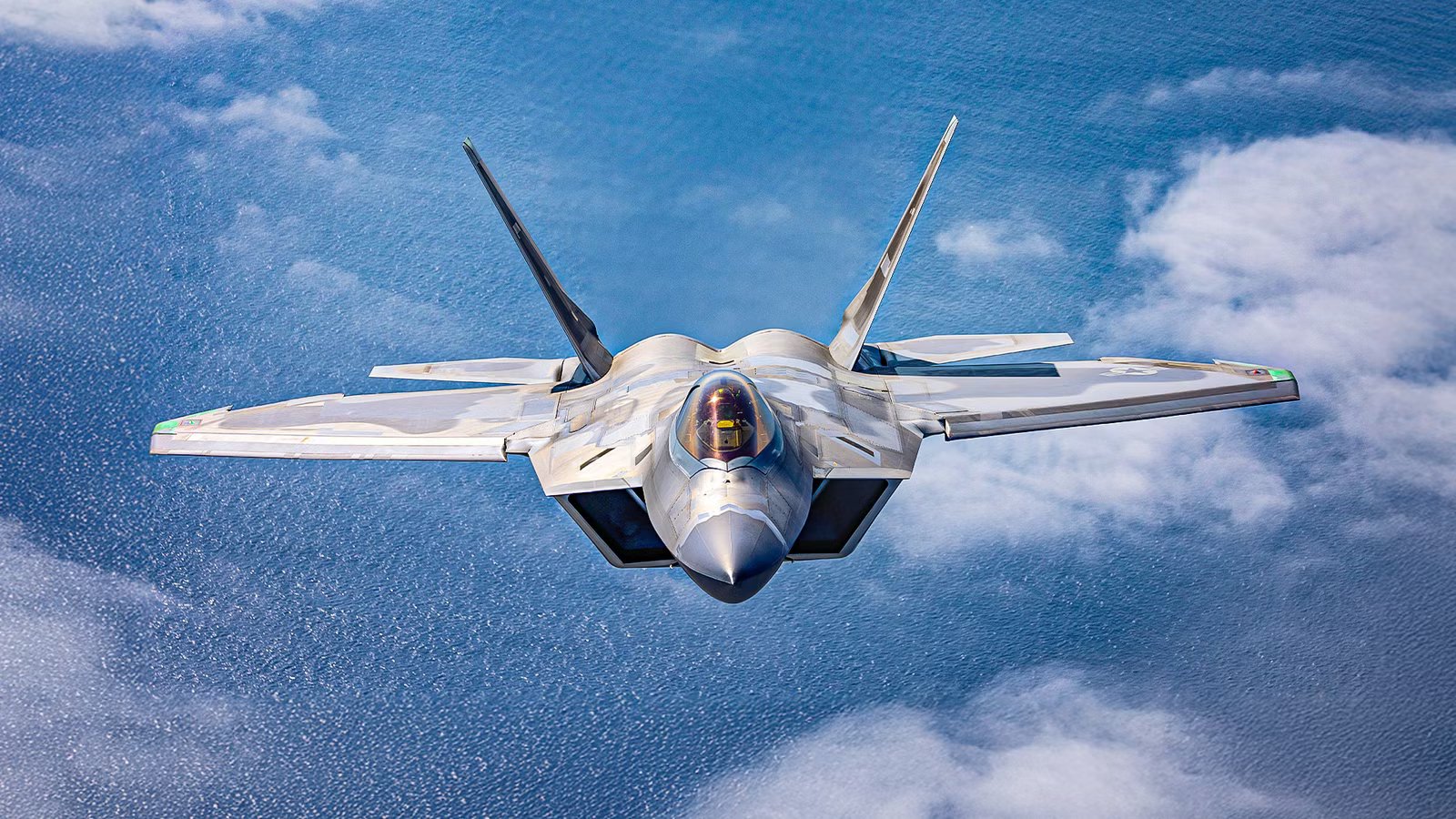
Energy is life for a fighter pilot in the heat of combat against another warplane, and in a dogfight, altitude is potential energy. In modern air combat, altitude is like a battery: the more you have, the more options you have to win. Jets like Sukhoi’s Su-27 Flanker can rocket to 50,000 feet in just over a minute, while the Lockheed Martin F-22 Raptor can spin in a climb to engage its enemy from the stratosphere.
These aircraft can all fly at twice the speed of sound or more, and some can even avoid radar thanks to fifth-generation stealth technology. However, in many ways, speed-to-altitude and vertical energy are the ultimate measures of an aircraft’s freedom of movement and, therefore, lethality in the air.
5
Sukhoi Su-27 Flanker
59,000 feet per minute climb rate

The Flanker was the fighter that began the race for dominance in the contest of vertical air speed and maneuverability. While the other jets on this list are its descendants or rivals, the Su-27 was the aircraft that pioneered how a large, heavy air superiority fighter could still fly with the agility of a lightweight acrobatic jet. In the 1980s, it set 27 world records, including climbing to almost 50,000 feet in just 70 seconds.
The Su-27 was the first aircraft to successfully complete the Pugachev’s Cobra maneuver. In this dogfighting technique, the Flanker must pull its nose up to a 120-degree angle of attack without stalling out or losing control. In a vertical climb, the pilot pitches the aircraft toward an enemy while still maintaining upward momentum and gains an astronomical energy advantage in the dogfight.
|
Fighter Jet |
Rate of Climb (feet per minute) |
Rate of Climb (meters per second) |
Thrust-to-Weight Ratio |
|---|---|---|---|
|
Sukhoi Su-57 Felon |
71,000 |
361 |
1.15 to 1.34 |
|
Mikoyan-Gurevich MiG-35 Fulcrum-F |
65,000 |
330 |
1.10 |
|
Lockheed Martin F-22 Raptor |
62,000 |
315 |
1.25 |
|
|
60,000 |
305 |
1.25 |
|
Sukhoi Su-27 Flanker |
59,000 |
300 |
1.10 |
 Boeing
The Flanker was designed with a blended wing-body that actually generates lift from the fuselage itself, not just the wings, allowing it to soar upward on just its aerodynamics during a climb better than the F-15. It also has a massive internal fuel capacity to avoid the drag of external fuel tanks and rocket to altitude without the performance penalty that often slows down other jets carrying drop tanks.
The Flanker is the baseline that all modern Russian supermaneuverable jets are built upon. It doesn’t use the high-tech thrust-vectoring nozzles of the Su-57 or MiG-35. Instead, it relies on its instability. The plane is naturally unstable and is held in flight by its complex fly-by-wire system. It wants to turn and climb, a feature that has only become more mature with the advent of superior technology in the Flanker’s successors.
4
Boeing F-15EX Eagle II
60,000 feet per minute climb rate

Originally conceived and designed in the 1970s by McDonnell Douglas under the philosophy of ‘not a pound for air-to-ground,’ the F-15 boasts the most successful combat record of any air superiority fighter jet. The Eagle takes a different approach to how it achieves an incredible vertical speed, owing to the fact that it comes from an older generation of fighter jet design than other entries on this list.
In true American Style, the F-15EX can be described as a heavyweight muscle car in contrast to the Super agile fighter jets that dominate this ranking. It is built on an airframe that was literally designed to break world records. In the 1970s, a stripped-down F-15 dubbed the ‘Streak Eagle’ famously reached 30,000 meters in just over 3 minutes, beating the climb records of the Apollo moon rockets.
The F-15EX echoed that heritage in testing by using two massive GE F110-129 engines, which produce 29,000 lbs of thrust each, and reach nearly Mach 3, according to one test pilot. It is cleared for Mach 2.5 in regular service, making it significantly faster in a straight line than the F-22 or Su-57, which are restricted due to their delicate stealth coatings.
One disadvantage is that the F-15EX does not have thrust-vectoring nozzles. That means that the Eagle is not quite as maneuverable as its more advanced peers. The F-15EX is unique in an aerial engagement because it is designed to carry a massive load of up to 22 air-to-air missiles. In a modern fight, the F-15EX is meant to fly behind the stealthy F-22s. It uses its high rate of climb to reach high-altitude, where it can rain down long-range missiles on targets identified by the stealth jets.

Here’s Why Air Forces Are Expanding Their Stealth Fighter Programs
The global race for the ultimate stealth jet.
3
Lockheed Martin F-22 Raptor
62,000 feet per minute climb rate

Despite not making the top spot on this list for climb rate, the Raptor boasts the best thrust-to-weight ratio of any jet in this ranking. Its ratio of 1.25 means that it can accelerate in a 90-degree vertical climb, unlike almost any other jet ever made, and can even break the sound barrier with its nose pointed straight up to space. Adding to that are 2D thrust vectoring engine nozzles specifically designed to give the pilot full control at its maximum ceiling, where the air is too thin for traditional flaps and rudders to work well.
The F-22 Raptor changed the game because it proved that a stealth aircraft, previously thought of as unwieldy or sluggish because of the boxy shape, could actually out-maneuver every other plane in the sky. Its F119 engines feature 2D thrust-vectoring nozzles that work in sync with the flight computer. Even if the wings have zero lift, the engines push the tail around, allowing the pilot to pull off incredible maneuvers even after stalling.
The Raptor made impossible maneuvers, like the Power Loop or the J-Turn, safe and repeatable for active duty pilots, not just test pilots. This also made a new kind of stop-and-start dogfighting style possible, only because of the entirely new technology. Other jets like the Su-27 could perform the Cobra maneuver before the F-22, but they were not stealthy. Add to that its superior performance at altitude, and you are left with the world’s apex predator of air power.

How Fighter Jets Have Evolved Over The Last Decade
A closer look at the arms race for the smartest warbirds.
2
Mikoyan-Gurevich MiG-35 Fulcrum-F
65,000 feet per minute climb rate

While the F-22 and Su-57 get the headlines for stealth, the MiG-35 was designed to be the ultimate energy-fighter. It was intended from day one to be a jet that uses a lightweight frame and massive engine power to dominate the ‘speed-to-altitude’ category and rule the skies in a vertical fight. The MiG-35 is an evolution of the MiG-29, which is renowned for its thrust-to-weight ratio and climb speed. The new Fulcrum-F was stripped of weight and equipped with RD-33MK engines that have nearly 10% higher power.
The MiG-35 may not be a stealthy warplane, but unlike the F-22, it features 3D thrust-vectoring nozzles to give it incredible supermaneuverability like the Raptor. These nozzles can move independently in any direction, which allows the MiG-35 to perform ‘ helicopter-like’ maneuvers, such as spinning in a flat circle while moving forward or ‘hovering’ on its tail at near-zero airspeed. The Fulcrum-F differs from fifth-generation fighters, which act like snipers in air-to-air combat, and is instead a point-defense interceptor.
The MiG-35’s high climb rate is designed for scramble scenarios, similar to quick reaction alert squadrons in NATO joint air forces. It can take off from a short runway and reach a high-altitude bomber or drone in seconds. The MiG-35 proved that super-maneuverability wasn’t just for billion-dollar stealth jets. It brought the post-stall technology to a smaller, more affordable 4.5-generation platform, and it sacrifices the long-range fuel and stealth of a fifth-generation jet for raw, explosive climbing speed.

How The F-35 Lightning II Stacks Up Against The Sukhoi Su-57 Felon In 2026
Stealth, speed, and strategy: Unraveling the secrets of the F-35 and Su-57 showdown.
1
Sukhoi Su-57 Felon
71,000 feet per minute climb rate

The Su-57 is the absolute peak of Russian fighter jet design. It follows the same engineering philosophy of the F-22 by combining stealth technology with supermaneuverability, but true to Russian form, the first fifth-generation fighter made by Sukhoi takes performance to an extreme level. Unlike the F-15EX or Su-27, the Su-57 even uses 3D thrust-vectoring nozzles. The unique engines allow the jet to point its nose straight up even at low airspeeds where wings lose their lift.
The Su-57 fleet recently began upgrades to the Izdeliye 177 engine with improved supercruise capability and better thrust-to-weight ratios compared to the earlier AL-41F1 engines. With these engines, its TWR exceeds 1.34, allowing it to accelerate while in a vertical 90-degree climb even with a full internal weapons bay. In a vertical climb, the Su-57 can muscle its way through maneuvers that would cause other jets to stall, giving it a massive advantage in gaining an altitude ‘perch’ during a dogfight.
However, the Felon cannot use this performance too frequently without compromising other features of its design, specifically stealthiness. Rapidly climbing at high Mach numbers creates immense thermal and structural stress. Since the Su-57 uses sensitive stealth coatings and composite materials, pilots are often limited in preserving the skin of the aircraft. The new engines aim to improve this area as well with a serrated exhaust nozzle, which is designed to reduce the infrared and radar signature and improve the aircraft’s overall stealth profile.