dailynewsnblog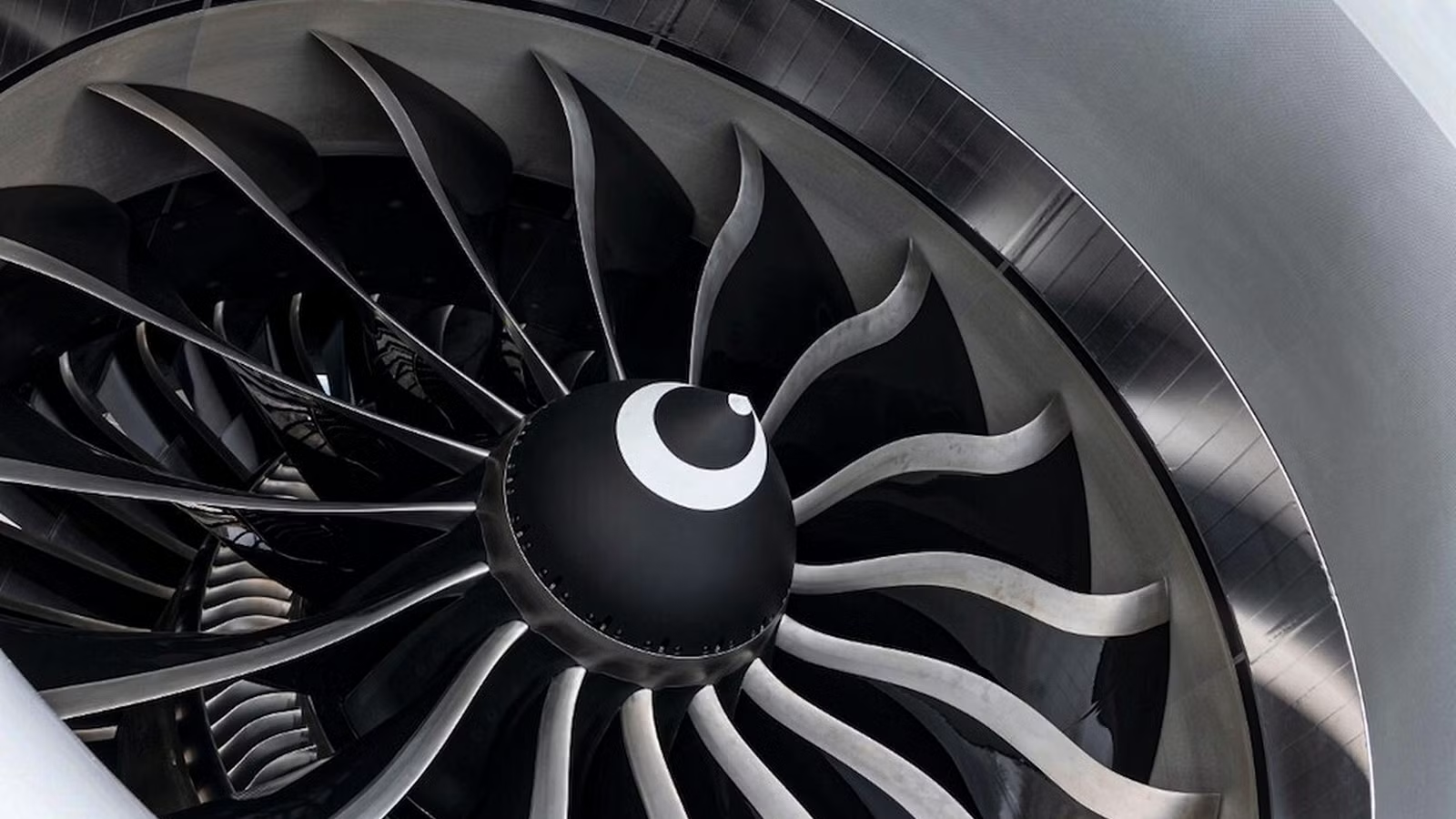
As  Boeing works towards getting the largest twin-engine jet in the world certified to enter service next year, engine manufacturer GE Aerospace is currently working on solving a reliability issue identified in January. The GE9X powerplant for the aircraft, much like the jet itself, is the world’s largest and most powerful engine designed for a commercial aircraft.
With that being said, the design of the engine and its ability to deliver unprecedented levels of power when operating can also be attributed to the latest discovery of a crack on the engine’s mid-seal. The seal is located between the turbine stages, with the function of ensuring airflow stability throughout the engine, which subsequently affects the power delivery and operational efficiency.
A Crack On The Engine’s Mid Seal

According to FlightGlobal, the issue was first discovered earlier this year, in January, when a Boeing 777-9 test aircraft was taken to the workshop as part of a routine visit, and a crack was identified. Furthermore, upon inspecting and evaluating the engine itself, producer GE confirmed that there was a crack in the GE9X engine’s mid seal and cited it as a potential durability issue.
The mid seal is an important component within the engine system, which is located between the turbine stages of the engine, ensuring a stable air flow throughout. The crack found could potentially be the result of the component reacting to the operational environment. Given that it is located within the core of the world’s largest and most powerful commercial jet engine, the component would be experiencing higher temperatures and pressures than it would on any other engine.
While this is a setback, it is also not uncommon for new designs to often go through various minor upgrades and changes over the years, as a reaction to any unforeseen developments that could be encountered during operations. Additionally, it is worth keeping in mind that even though the engine does not currently fly commercially, the current design was certified in 2020.
What Does This Mean For The Engine & Aircraft?

As stated above, the engine manufacturer has discovered the root cause of the issue, and since then, GE Aerospace, during their 2026 first quarter earnings call in April, confirmed that a fix is currently being worked on. Per the transcript of the earnings call, the CEO himself confirmed that a component modification is currently being finalized, and the details of this have been transparently communicated with both Boeing and the Federal Aviation Administration.
It was also stated that the manufacturer is currently modifying its own tooling while increasing production from certain suppliers for the part that requires modification. The modification will, of course, require regulatory green light, but once the fix has been approved, it can be implemented on all future GE9X engines being produced. The units that are already produced will probably have to undergo a retrofit. As for the impact on the certification timeline of the 777-9, GE Aerospace CEO H. Lawrence Culp said:
“As Boeing has said, we believe we’re on track with the certification plan that has been communicated to customers. No change to the schedule.”
The GE9X Is The World’s Most Powerful Engine

The GE9X is a power plant that began testing in 2016 and is the sole engine option for the upcoming Boeing 777X family. With the engine’s front fan designed with a diameter of 134 inches (11.2 feet / 3.4 meters), it is physically the largest turbofan in the world. Indeed, the engine is even larger than the fuselage of a Boeing 737.
In this case, the massive size of the engine and its front fan is directly linked to the powerplant’s ability to offer a higher bypass ratio than other engines, which subsequently delivers more power while operating with better fuel efficiency. Per GE’s data, the table below details the engine’s technical specifications.
GE9X Technical Specifications | |
|---|---|
Fan diameter | 134 inches (11.2 feet / 3.4 meters) |
Number of fan blades | 16 blades designed using advanced composite materials |
Thrust | Rated at 110,000 lbs | Maximum of up to 134,000 lbs. |
Bypass ratio | 10:1 |
Marketed efficiency | 5% lower fuel consumption than any other twin-aisle aircraft and 10% lower than that of the previous generation 777 aircraft. |
Compared to these figures, when considering the smaller engines that power the latest generation of widebody jets in the market, the stark difference in engine power becomes clear. The Rolls-Royce Trent 1000 or the GEnx-1B that power the Boeing 787 family can only produce thrust of up to 78,000 lbs and 76,100 lbs respectively, while the Rolls-Royce Trent XWB-97 on the Airbus A350-1000 can deliver power of up to 97,000 lbs.
Not The First Hurdle For The Powerplant

While the engine received FAA certification in 2020, it was originally planned to be certified in 2018. With that being said, in the past six years, the engine program has faced a few challenges along the way. Some of these challenges were other durability issues, such as the finding in 2019, where the high-pressure compressor’s stator vanes within the engine were wearing out at a faster rate than expected.
Beyond that, in 2022, an abnormal temperature alert from the aircraft’s engine resulted in a temporary suspension of flight testing of the 777-9 for a duration of two months. Furthermore, in 2024, Boeing had to ground its entire test fleet of 777-9s, after discovering a failure within the engine’s thrust links. These linkages essentially transfer thrust from the engine to the airframes, and to counteract the associated vibrations, the aircraft manufacturer had to make structural changes, resulting in a five-month grounding.
Despite these issues, it is worth keeping in mind that the GE9X is still in fact a new engine that is certified, but yet to enter commercial service. It is common for various hurdles to be experienced by new technologies and designs, especially when the product is made out of new or advanced composite materials. These can often develop unexpected long-term reactions when exposed to high levels of temperature, pressure, and other operational aspects.
Powering Upcoming The 777X Family

The 777X is designed to be the next generation of Boeing’s popular Boeing 777 aircraft family, which is one of the most popular widebody jets in aviation history. The GE9X will be the exclusive engine option for all three variants of the aircraft family. While the aircraft type should have entered commercial service back in 2020, the 777X is not yet certified due to a series of certification delays and quality-control challenges that Boeing faced in relation to the 737 MAX groundings.
The most popular variant of the 777X series is the largest variant, the Boeing 777-9, followed by the freighter variant, the Boeing 777-8F, and then the smaller passenger variant, the Boeing 777-8. The 777-9 is set to be the largest twin-engine passenger jet, capable of operating high-capacity flights over long-haul routes. Per data published by Boeing, the table below details the technical specifications of the three 777X variants.
Boeing 777X Variants | 777-9 | 777-8 | 777-8F | |
|---|---|---|---|---|
Capacity | 426 (Two-class configuration) | 395 (Two-class configuration) | 224,000 lbs (112 tons) | |
Range | 7,285 nautical miles (13,500 km) | 8,745 nautical miles (16,190 km) | 4,410 nautical miles (8,167 km) | |
Engine | GE9X | |||
Wingspan | Tips Folded | 212 feet, 9 inches (64.9 meters) | ||
Tips Extended | 235 feet, 5 inches (71.8 meters) | |||
Fuselage Length | 251 feet, 9 inches (76.7 meters) | 232 feet, 6 inches (70.9 meters) | ||
The first of the 777-9 is expected to be delivered to launch customer Lufthansa in 2027, and as stated above, GE Aerospace does not expect the durability issue regarding the engine mid seal to negatively impact the delivery of the aircraft. With the 777X having an order backlog of over 600 aircraft, the type remains important for operators such as  Lufthansa and
  Emirates, as it represents not only fleet growth, but also important fleet replacement for these customers.
GE9X-Powered Planes Will Replace Older Quadjets

To understand why the 777X required a new and bespoke engine, it is important to understand the role the 777X will play upon entering the market, especially the 777-9 variant. The 777X was designed not only to replace older generation 777s, but also to replace some of the largest aircraft in the world, such as the Boeing 747, and, until such time a larger aircraft is built, even the Airbus A380.
With that in focus, Boeing also had to ensure the replacement design is in tune with the current market trends and suitable for the market where sustainability is becoming increasingly important. Therefore, new widebody aircraft should ideally be twin-engine designs. As such, the 777-9 is the result of marrying a high-capacity widebody fuselage with two newly developed engines that deliver more power than any other aircraft engines that is currently available in the market.
While the airframe falls short of the A380’s capacity, the 777-9 does offer comparable capacity to that of the Boeing 747-8, while also delivering better operational efficiency and fuel savings due to the aircraft being a twin-engine design. While the aircraft’s design will certainly play a role when it comes to the jet’s fuel efficiency and economics, it will be the powerful GE9X engines that contribute the most towards the 777X being an efficient jet.