dailynewsnblog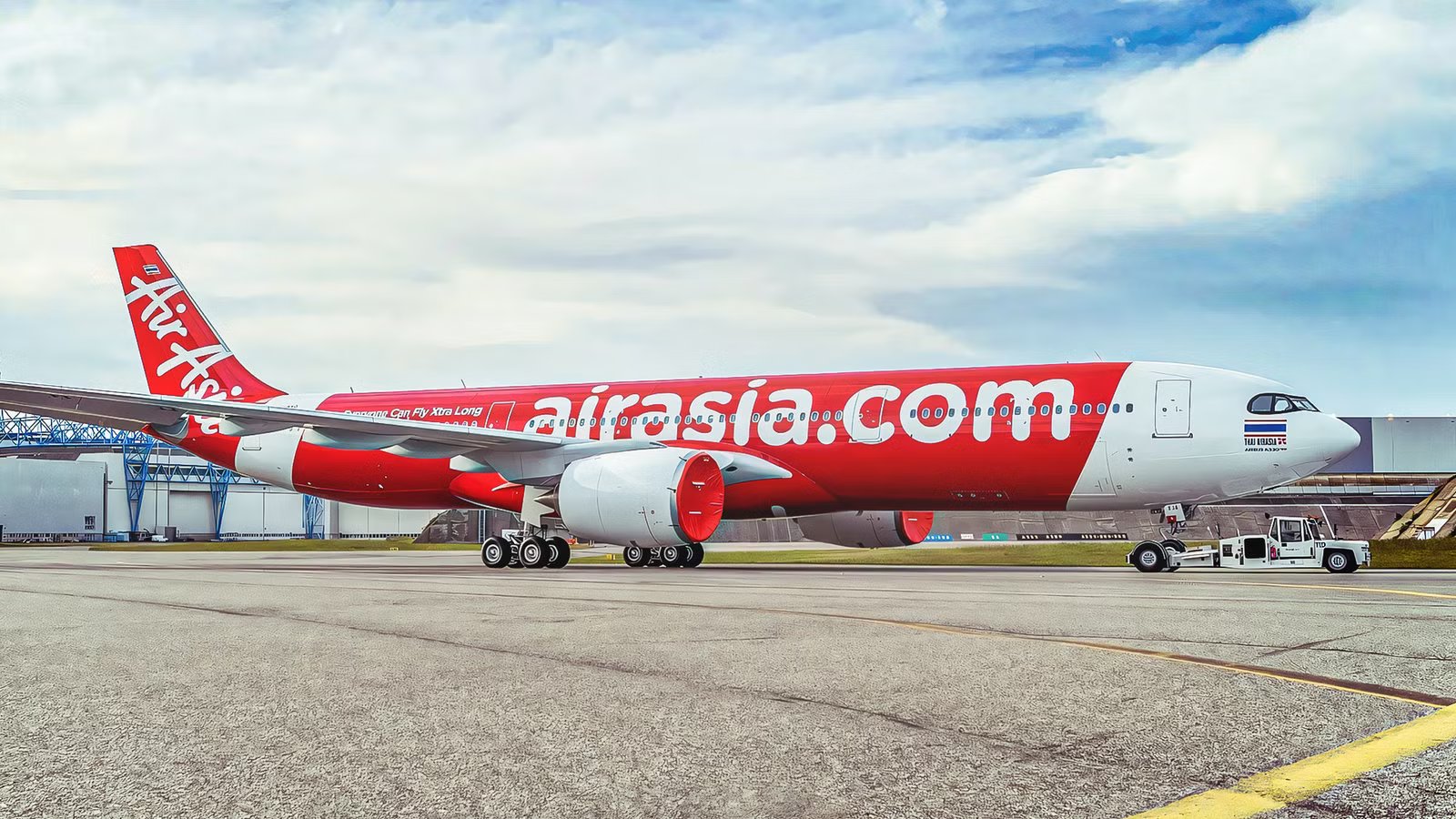
In mid-2026, Airbus was hit with a major decision from one of its long-standing customers. AirAsia X and Airbus reached a mutual agreement to remove the remaining 15 Airbus A330-900aircraft from the manufacturer’s backlog. The decision unravels a long-shelved widebody expansion plan that had previously been framed as the future of budget travel across the Asia-Pacific region. Now formally striking these twin-aisle flagships from its future alignment, the airline group has reached an undeniable conclusion: the economic realities of flying massive, multi-aisle jets on long-distance budget routes no longer make structural sense in a volatile global market.
It is the poster for the demise of the low-cost widebody long-haul experiment that AirAsia X itself helped pioneer two decades ago. Instead of attempting to fill nearly 400 seats on capital-intensive widebody frames, the broader AirAsia Group is deciding to go all in on an aggressive single-aisle strategy. The long-range narrowbody evolution is led by a massive commitment to 50 Airbus A321XLR aircraft, alongside an additional 20 conversion options, valued at an estimated $12.25 billion.
The End Of Long-Haul Low-Cost?

The removal of the 15 Airbus A330neo jets from the Airbus ledger in mid-2026 caps off several years of strategic revisions, deferrals, and corporate restructuring. For over a decade, the narrative of ultra-low-cost carriers revolved around democratization through volume. Airlines believed that by flying massive widebodies configured with high-density seating, the lower per-seat costs would offset the staggering capital risk of operating transoceanic routes. AirAsia X pioneered this very philosophy, using its historic fleet to stretch the budget model from Southeast Asia into Australia, North Asia, and the Middle East.
However, the economic challenges of the current decade led to a deep re-evaluation of asset productivity. High fuel prices and intense currency fluctuations exposed the extreme vulnerability of high-capacity budget flying. Legacy full-service flag carriers can rely on premium business class cabins to absorb operational shockwaves and generate high-yield margins, but a budget carrier relies entirely on volume and stable passenger demand. When those elements waver, an unfilled widebody becomes an immense financial burden that is often too heavy for an airline to carry. The mutual agreement to erase the A330neo order is really an explicit recognition that building a network around large aircraft leaves a low-cost carrier heavily exposed to market volatility.
The restructuring does not mean the carrier is shrinking away from global ambitions; rather, it is altering the mechanism of its growth. The era of trying to force secondary market demand to fill a twin-aisle jet is over. The AirAsia group is now freeing up its balance sheet to embrace a nimbler operational architecture, moving away from its traditional method of dominating the skies with sheer size to securing sustainable, recurring profits on a route-by-route basis.
Defeating The Nature Of Low-Cost

The fundamental flaw of the long-haul low-cost widebody model comes down to load factors and how these are actually achieved. A twin-aisle aircraft like the A330-900 is very expensive to operate and carries immense daily fixed costs for a low-cost carrier. To turn a profit with low-tier budget ticket pricing, an airline must consistently operate at near-total capacity, as falling even a few percentage points short of a 90% load factor on a 380-seat widebody can instantly transform a routine long-haul flight into a severe financial loss.
Large twin-aisle aircraft introduce severe scheduling inflexibility into an airline network that thrives on its ability to flex. Thinner international routes or secondary city pairs typically lack the baseline daily traffic needed to sustain a large widebody aircraft. If an airline attempts to mitigate this by reducing flight frequencies to two or three times a week, it destroys its appeal to travelers who prioritize flexibility. Widebody operations demand and thrive on high-density hubs, which means that low-cost airlines are inevitably led into expensive hub-and-spoke networks that add unnecessary operational friction and undermine the point-to-point simplicity of the low-cost philosophy.
Ultimately, the commercial risk of operating these oversized frames across massive distances proved too great to sustain. When fuel costs remain persistently elevated, the penalty for flying empty seats escalates exponentially. By shifting away from this high-risk model, operators can protect their operational margins against unexpected market drops.
Catch what other flight trackers miss
Emergency squawks, holds, NOTAMs — live signals, no signup.
Open tracker
Catch what other flight trackers miss
Emergency squawks, holds, NOTAMs — live signals, no signup.
Open tracker
No Time To Wait

To replace the raw capacity of the canceled widebodies, the AirAsia group is adopting an incredibly aggressive single-aisle strategy. The center of gravity for this transition is a massive firm order for 50 Airbus A321XLR aircraft, coupled with 20 additional conversion options. This single contract carries an estimated market value of $12.25 billion, a complete structural reallocation of capital. Rather than betting on widebody hulls, the group is placing its multi-billion-dollar wager on the highly advanced efficiencies of the single-aisle NEO family.
Next-generation single-aisle platforms deliver up to a 30% reduction in per-seat fuel burn when compared directly against previous-generation widebody aircraft. This dramatic drop in fuel consumption substantially alters the break-even calculation for long flights. A smaller cabin configuration of roughly 236 seats in a single-class layout means the overall trip cost drops drastically, allowing the airline to safely enter markets that would never support a larger widebody aircraft and bringing that lost flexibility back to the fleet.
Waiting is not what the group plans to do and is already moving from theoretical order books to actual flight operations. The group took formal delivery of its first Airbus A321LR narrowbody in May 2026, marking the immediate operational deployment of this new strategy. With a second long-range narrowbody arriving shortly thereafter, the fleet is actively capitalizing on a rapid transformation that matches capacity directly to current demand.
The Real Gamechanger

The promise of the Airbus A321XLR centers around its advertised maximum range of 4,700 nautical miles (5,409 miles / 8,704 km) and what this could potentially open up for AirAsia. In manufacturer brochures, this range is illustrated with broad, sweeping arcs that connect major Southeast Asian hubs directly to Western Europe and deep into Africa. However, operational flight planners need to design routes using real-world numbers rather than theoretical maximums. To account for winter jet streams, unexpected headwinds, air traffic control deviations, and fuel reserve mandates, operators will be compressing the practical, day-to-day radius of the aircraft to roughly 4,000 nautical miles (4,603 miles / 7,408 km).
Even with this slightly more realistic 4,000-nautical-mile operational cushion, the aircraft completely changes how low-cost carriers approach thin international markets. Instead of sending passengers into a hub-and-spoke setup, this single-aisle capability allows point-to-point flights from cities like Kuala Lumpur or Bangkok straight to secondary destinations that cannot sustain a larger widebody. This matches capacity to exact market sizes, creating highly efficient routes without the multi-million-dollar capital penalties of an empty twin-aisle aircraft.
By using a single stopover in the Middle East, these narrowbodies can easily cover almost any city in Europe and Africa, providing a low-risk mechanism to scale up international networks. This allows AirAsia to establish a presence in markets the airline could have only dreamed about just a few years ago. Airlines like Wizz Air in Europe have already expanded route networks well into the Middle East and beyond, so AirAsia will be seeking to follow suit.
Sending Out The Old A320s

Transforming an airline network is not just about bringing in next-generation platforms. Making these massive changes requires purging legacy assets that weigh down profit margins. To pave the way for this narrowbody future, the wider AirAsia Group is actively retiring 12 to 14 of its oldest Airbus A320 classic single-aisle jets. These older frames have reached an average operating age of 16 to 17 years, so at this point in an airliner’s life cycle, heavy structural maintenance inspections and deteriorating fuel efficiency combine to drastically erode daily profitability.
Phasing out these older platforms allows the carrier to dramatically clean up its balance sheet and streamline its engineering operations. The arrival of the first Airbus A321LR units in mid-2026 created an immediate upgrade path and set the airline up for what appears to be a rapid fleet transition from older, lower-range, and lower-capacity jets to modern, more capable options.
The airline’s replacement plan ensures that every single aircraft in the pattern is running at peak utilization, something that is vital to any low-cost operation. Now maintaining a highly unified, fresh fleet layout, the carrier can keep maintenance costs flat while maximizing the flying time of each asset across both domestic and medium-haul sectors, a recipe for growth and economic success in a market that is already incredibly competitive.
The Best Way Is Low-Cost?

The decision to completely back out of the remaining widebody orders and double down on advanced single-aisle airframes is not limited to AirAsia; it is an idea shared by many other carriers undertaking structural realignment across the global airline industry. Major low-cost and hybrid operators worldwide are reaching the exact same conclusion regarding long-haul economics, with carriers like  IndiGo in India,
  Iberia in Spain, and JetSmart in South America actively restructuring their route maps around the unique operational economics of the long-range narrowbody jet.
The industry-wide alignment backs up the consensus that the long-haul budget widebody model was an evolutionary stepping stone rather than a permanent destination. For two decades, flying twin-aisle aircraft was the only technical way to achieve the range required for intercontinental travel. Today, advanced aerodynamics and highly efficient engine options deliver that identical reach without forcing airlines to take on massive passenger capacity risks.
These highly efficient platforms will continue to deploy more over the next few years, and the traditional hub-and-spoke networks of legacy airlines will face increasing pressure from nimble, point-to-point operators. Growing an airline in this age means building a network that prioritizes high asset utilization and low trip costs over sheer aircraft size. Budget carriers are laying a resilient foundation for the future of commercial flight, one in which the low-cost model may well become even stronger.