dailynewsnblog
The United States is in the middle of one of the most significant airport infrastructure overhauls in its history. After decades of incremental upgrades, a convergence of factors, including aging terminals, surging passenger demand, and new federal funding, has triggered a nationwide wave of expansion and modernization projects. Airports that once struggled with congestion, outdated layouts, and limited capacity are now being redesigned to meet the demands of a rapidly evolving aviation system.
At the center of this transformation is a combination of federal investment and local capital programs. The Federal Aviation Administration (FAA) has emphasized that maintaining safety and efficiency across the National Airspace System requires not only modern air traffic control systems but also physical infrastructure capable of handling growing traffic volumes.
The result is a construction boom that spans major hubs and mid-sized airports alike. From entirely new terminals to expanded concourses and reconfigured airfields, these projects aim to improve passenger flow, increase capacity, and integrate new technologies. At the same time, recently completed projects at key airports demonstrate how quickly the landscape is changing. Understanding this wave of development requires examining both the projects currently underway and those that have recently come online. Together, they reveal how the United States is reshaping its aviation infrastructure for the coming decades.
The Federal Push Behind Airport Modernization

The current airport expansion cycle is not occurring in isolation. It is the product of deliberate federal policy aimed at addressing long-standing infrastructure gaps. For years, US airports have faced criticism for lagging behind international counterparts in terms of design, efficiency, and passenger experience. The FAA has identified infrastructure modernization as a critical component of maintaining system-wide efficiency. Its 2026 budget emphasizes investments in safety, communications systems, and long-term operational improvements across the national airspace. These investments are closely tied to airport construction, as outdated terminals and airfield layouts can create bottlenecks that ripple through the entire network.
The FAA’s Airport Construction Impact Report further illustrates the scale and complexity of ongoing projects. Multiphase expansions, such as terminal ramp extensions and taxiway reconfigurations, are designed not only to increase capacity but also to improve aircraft movement and reduce delays. However, these projects often entail temporary disruptions, including reduced arrival and departure rates during construction. For example, the runway rehabilitation project at  Newark Liberty International Airport (EWR) last summer significantly reduced capacity as operations were reduced to only one of the airport’s parallel runways.
Federal funding has played a decisive role in accelerating these efforts. The Infrastructure Investment and Jobs Act provides a sustained funding stream that allows airports to undertake large-scale projects that might otherwise be delayed or scaled back. These grants are targeted at aging facilities, with an emphasis on improving accessibility, sustainability, and operational efficiency. This coordinated approach reflects a broader recognition that airport infrastructure is a national asset. Improvements at one major hub can have cascading benefits across the entire system, reducing delays and increasing reliability for airlines and passengers alike.
Mega-Hub Projects Redefining Capacity

At the largest hubs, 2026 construction is directly affecting national airspace capacity, not just local operations. The Federal Aviation Administration’s Q1 2026 Airport Construction Impact Report identifies major hubs in Atlanta, Newark, Chicago, and San Francisco as critical pressure points where construction reduces throughput and forces system-wide adjustments. One of the clearest examples is  San Francisco International Airport (SFO), where a major rehabilitation project is underway through 2026 to improve lighting for runway 10R/28L. The closure of this runway and the accompanying new safety restrictions have significantly reduced arrival capacity, with maximum rates dropping from about 54 to 36 aircraft per hour. As a result, roughly a quarter of inbound flights are expected to experience delays of at least 30 minutes during peak periods.
At EWR, a combination of runway work, taxiway upgrades, and air traffic control constraints has led the FAA to impose strict caps on hourly operations through October 2026. Flights are limited to around 72 movements per hour under normal conditions, with even lower limits during active construction windows. These caps are not theoretical. They directly reduce airline schedules and ripple across the Northeast corridor.
Similarly,  Chicago O’Hare International Airport (ORD) is undergoing many projects, including various runway projects and an entirely new Terminal D. The airport is operating under a federally mandated schedule reduction in 2026, cutting hundreds of daily flights during peak construction periods. This reflects a broader FAA strategy of actively managing demand when infrastructure cannot safely support full capacity. Even the world’s busiest airport,
  Hartsfield-Jackson Atlanta International Airport (ATL), is undergoing phased construction that temporarily reduces capacity while taxiways and runway systems are upgraded.
Lastly, at  New York JFK Airport(JFK), a sweeping, multi-terminal redevelopment program is underway, including the construction of a new Terminal 1 and the expansion of Terminal 6. While much of the work is landside and terminal-focused, it still affects aircraft operations through gate reassignments, taxiway congestion, and phased construction zones. The key takeaway is that mega-hub expansion in 2026 is not just about building more space. It is about carefully managing temporary capacity losses to deliver long-term gains in throughput, safety, and resilience. The FAA’s data shows that these projects can reduce capacity by double-digit percentages in the short term, but they are essential to preventing even greater congestion in the future.

United Airlines Delays Start Of 6 Routes From Chicago O’Hare
United Airlines has postponed the launch of these routes due to FAA restrictions.
Mid-Sized Airports Expanding For Growth

While major hubs face the most visible disruptions, 2026 construction at mid-sized airports is playing a quieter but strategically important role. The FAA report highlights that these airports are expanding capacity with fewer operational penalties, helping redistribute traffic across the national system. For example, Sacramento International Airport (SMF) is undergoing terminal and airfield improvements designed to support increased passenger volumes and airline service. These upgrades include gate expansions and apron reconfigurations, which improve aircraft movement efficiency without requiring large-scale runway closures.
At John Glenn Columbus International Airport (CMH), a major $2B terminal redevelopment project is advancing in 2026, replacing older facilities with a more efficient layout that reduces congestion and improves passenger flow. Projects like this are specifically designed to attract new routes and relieve pressure on larger hubs. The FAA also notes that many mid-sized airports are focusing on taxiway and runway geometry improvements rather than full reconstructions. These include new high-speed taxiway exits and improved ramp layouts, which can increase operational efficiency without significantly reducing capacity during construction.
Unlike mega-hubs, these airports can often schedule construction during off-peak hours or in phases that avoid major disruptions. This flexibility allows them to continue normal operations while still expanding infrastructure. The broader impact is structural. As mid-sized airports expand, airlines gain more options for point-to-point routes that bypass congested hubs like EWR or ORD. This shift helps balance the national airspace system, reducing delays and improving reliability across regions. In 2026, these airports are not just growing independently. They are becoming integral to a more distributed and resilient aviation network, complementing the large-scale transformations underway at the nation’s busiest hubs.
Recently Completed Projects

In addition to ongoing construction, several major airport projects have recently been completed, offering a glimpse of what the future of air travel in the US will look like. At Portland International Airport(PDX), a multi-billion-dollar terminal redevelopment has transformed the airport’s core facilities (pictured above). The project, nearing final completion in 2026, nearly doubles the size of the main terminal and introduces new passenger amenities, improved circulation, and expanded capacity. The redesign emphasizes open spaces and a nature-inspired aesthetic while significantly enhancing operational efficiency.
 Pittsburgh International Airport (PIT) has also unveiled a major new terminal as part of a $1.7 billion modernization program. This project replaces older facilities with a more efficient layout, reducing walking distances and improving passenger flow. The new terminal is designed to support future growth while addressing long-standing operational challenges.
In New York,  LaGuardia Airport (LGA) has undergone a comprehensive redevelopment, replacing outdated terminals with modern facilities. The new Terminal B and Terminal C have redefined the airport’s reputation, introducing improved gate layouts, enhanced amenities, and a more efficient passenger experience. Once considered one of the least desirable airports in the country, LaGuardia now serves as a benchmark for large-scale airport transformation.
Similarly, EWR opened its new Terminal A in 2023, a $2.7 billion project that features a modern design, expanded gate capacity, and improved passenger flow. The terminal incorporates a common-use system that allows airlines to operate more flexibly, improving overall efficiency. These completed projects demonstrate the tangible results of recent investment. They also highlight a broader trend toward passenger-centric design, where efficiency, comfort, and accessibility are central considerations.
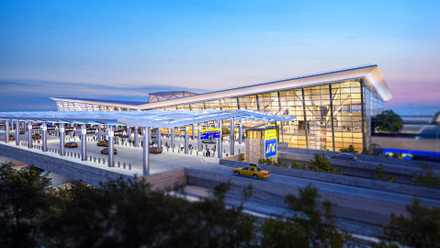
Insanely Modern: Inside New York-JFK’s New Terminal 1 & Its 22 Widebody Gates
A closer look at the wonderful new terminal coming to JFK Airport.
Operational Challenges Of Building While Flying

Despite the long-term benefits of airport expansion, the process of construction itself presents significant operational challenges. Airports must continue to function as critical transportation hubs even as major portions of their infrastructure are being rebuilt. The FAA’s construction impact assessments reveal how these projects will affect capacity and scheduling. Runway closures, taxiway reconfigurations, and terminal renovations can all lead to reduced operational rates, particularly during peak travel periods.
Coordination between airports, airlines, and federal agencies is essential to managing these disruptions. Construction schedules are carefully planned to minimize impact, often focusing on off-peak periods or phased approaches that allow parts of the airport to remain operational. These challenges underscore the complexity of modern airport projects. Unlike many infrastructure developments, airports cannot simply shut down during construction. Instead, they must adapt continuously, ensuring that safety and efficiency are maintained even as major upgrades are underway. With the busy summer travel months only weeks away, these planning efforts will face the true test.
Big Takeaways

The country is undergoing a profound transformation of its airport infrastructure. Driven by federal investment, rising demand, and the need for modernization, airports across the country are being rebuilt to meet the challenges of the 21st century. From large-scale rehabilitation at major hubs to expansive upgrades at mid-sized airports, these projects reflect a comprehensive effort to improve capacity, efficiency, and passenger experience.
At the same time, the process of rebuilding presents its own challenges. Airports must balance construction with ongoing operations, requiring careful coordination and temporary compromises. Ultimately, these investments are about more than infrastructure. They represent a commitment to maintaining the United States’ position as a global aviation leader. By modernizing its airports, the country is not only addressing current needs but also preparing for future growth, technological change, and evolving passenger expectations.