dailynewsnblog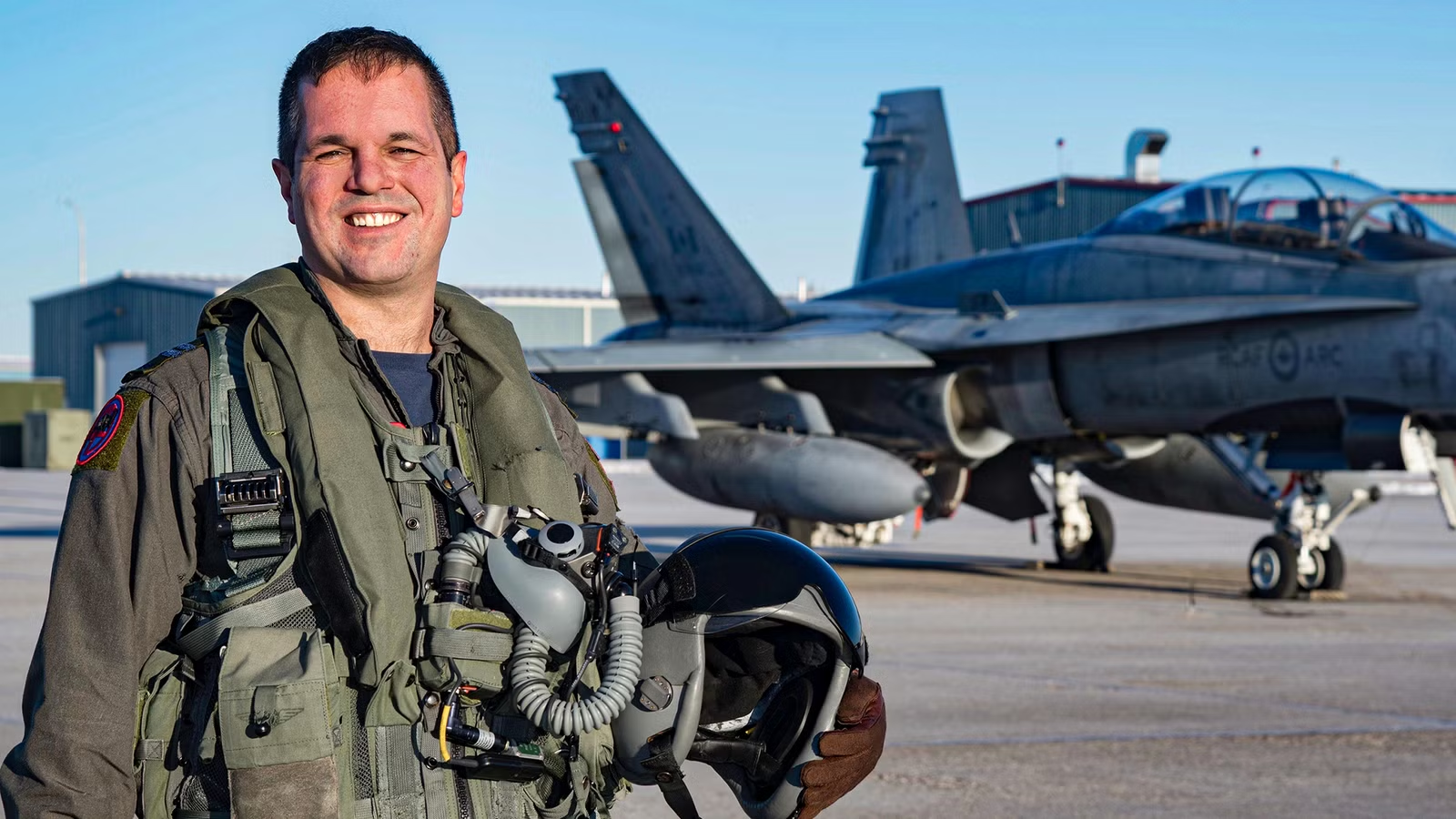
Like many air forces, the Royal Canadian Air Force is experiencing major issues with retaining trained pilots and attracting new pilots. The problem is a complicated one and difficult to solve, as simple pay increases are not enough. The tale is as old as air forces themselves, dating all the way back to the First World War.
In the longer term, air forces, like the United States Air Force, are looking for ways to reduce their need for pilots with autonomous systems and crewed-uncrewed teaming. However, in the short and medium term, Canada needs to keep its ageing CF-18 Hornets crewed and flying and transition to the next-generation CF-35 (F-35A) and possibly a derivative of the Saab Gripen.
Canadian Air Force Pilot Pay

Like other Western air forces, Canadian Air Force pilots are commissioned officers and are paid under standardized public-sector pay scales. Pay is set mostly by rank and duration of service. There is combat and deployment pay, but those are not unique to pilots. The most common rank for operational and junior military pilots is Captain. In USD, those at the starting Pay Increment (PI 1) are paid around $77,600 annually, with salaries rising to $105,100 (PI 9-10) and up to around $155,3000 at higher increments (PI 15+).
Majors are mid-senior pilots. These come with a starting Pay Increment of $128,300 annually, topping out at $160,800 in top Pay Increments 10/11. Lieutenant-Colonels occupy senior/command roles. They start out with a base pay of $159,200, rising to a maximum of around $166,400. Higher ranks, like Colonel, generally move away from combat mission flying.
It’s important to keep in mind that these figures do not include additional pay from bonuses, allowances, and other benefits. As discussed below, having a standardized payment system for officers across the service branches creates retention issues. As trained pilots, they are in high demand in the private sector, and the military generally struggles to find the flexibility to offer the needed incentives.
Problematic Pay Restructuring

In response to a 2018 report on the pilot shortage of trained Canadian Air Force pilots, the RCAF rolled out changes in 2021 aimed at retaining pilots. In 2025, CBC News reported on the new system and its unexpected flaws. It wrote that “the new pilot pay system is tailored to the individual’s experience and is meant to keep wages in line with commercial airline rates, but it has had unexpected, unintended consequences, according to the internal report.”
That internal report stated that “the new pay scale initially resulted in some captain pilots earning eight per cent more, which subsequently resulted in an overall increase in compensation for all pilots. The potential for a captain to make more than a major results in some pilots refusing promotions.” This led to a “cluster of grievances” that were ongoing.
There was also criticism that the implemented pay restructuring deviated from the best practices of allied countries like the US, UK, and Australia. Some also said that it wasn’t realistic to pay military pilots as much as their commercial counterparts. It would also be odd to effectively couple military pilot pay with the Air Line Pilots Association. It was reported that Air Canada had agreed with the union to a 42% pay increase.
Boosting Pilot Pay Ahead Of F-35 Transition

In August 2025, the Canadian government announced a major increase in pensionable pay retroactively applied to April 1, 2025. The measure was designed to address the ongoing severe recruitment and retention problems in the Canadian Armed Forces. It included a 20% increase for the lowest rank (including Privates, Aviators, Sailors, Pay Increment 1). Most members from Pay Increment 2 up to Lieutenant-Colonel, including pilots, were granted a 13% boost. A smaller 8% was provided to those colonels and above.
This comes ahead of Canada gearing up to bring the first of its CF-35 (F-35A) fighter jets into service. The first Canadian CF-35s are expected to fly in 2026, but will be held back in the US for training. Initial deliveries physically arriving in Canada are expected to arrive in 2028, ahead of the type achieving operational readiness around 2032.
Select Royal Canadian Air Force Fleet Sizes (Per RCAF) | |
|---|---|
CF-18 Hornet/ex-Australian F/A-18s | 95 |
CP-140 Aurora (P-3 Orion) | 14 (to be replaced by P-8) |
CC-130 Hercules/Super Hercules | 29 |
CC-330 Husky (being converted to MRTT role) | 3 (9 planned) |
Canada is currently reviewing its plan to purchase 88 F-35s, mostly due to geopolitical reasons. However, it has already contracted the first 16 F-35s, so it may opt for a mixed fleet. It is considering the less-capable Swedish Saab Gripen as an alternative, as it is the only competitor claiming it can make the aircraft NORAD-compliant. The Eurofighter Consortium and Dassault Rafale previously backed out, saying it was infeasible for their jets to be NORAD-compliant.
The US Air Force Pilots With The Highest Salaries In 2026
Discover the highest-paid US Air Force pilots in 2026, including ranks, bonuses, and total salaries for top-earning military aviators.
The Cost Of Training Pilots

It is phenomenally expensive to train fast jet fighter pilots, and this is not even counting the cost of training the maintainers and other aspects. While many articles like to focus on the flyaway costs of fighter jets, those costs are misleading and only a minority of the real costs of acquiring a functional fighter jet capability. Simple Flying has previously reported that the cost of training an F-35A pilot in 2026 is in the ballpark of $15 million.
This is roughly comparable to the cost of purchasing the engine for the F-35. Adding to that, Western air forces will typically have 1.2 to 1.5 line pilots per fighter jet, so the cost of training just the pilots (and not the support personnel) for the aircraft could be within the order of $23 million. This all makes fighter jet pilots extremely valuable after they have been trained.
However, there is another major issue: public servants just aren’t paid all that much. For example, the Canadian Prime Minister earns a little over $400,000 CAD ($292,000 USD), excluding factors like allowances and pensions. By comparison, the average total Fortune 500 CEO earns around $19 million (mostly stock awards and performance-based incentives). When it comes to pilots, the gap is not nearly as stark, but commercial airline pilots make much more money than their military pilot counterparts. This contributes to retention issues.
The Canadian Air Force, Like Others, Is Understrengthened

While out of date now, CBC News reported in 2018 that the Royal Canadian Air Force was short around 275 pilots and needed more mechanics, sensor operators, and other trained personnel. Brig.-Gen. Eric Kenny, director general of air readiness, said at the time that the Canadian Air Force is authorized to have 1,580 pilots, but Kenny said in an interview that the Air Force is short by around 17%, or about 275 pilots.
For comparison, the US Air Force has around 13,000 pilots, with the Navy and Marines contributing 10,000 more. The Royal Air Force has around 1,500 (around 1,000 more in the Royal Navy and British Army). In 2014, the British Government said it had 1,760 trained regular pilots in the RAF, 550 in the Army, and 530 in the Navy. The Russian Air Force is thought to have around 4,000 to 5,000, with the Chinese PLA also being within that ballpark.
Air Force pilot shortages are something affecting most air forces: the US Air Force has been struggling with retention and attracting new pilots, as has the RAF. In 2025, it was reported that the RAF had a 30% shortfall in pilots at the Flight Lieutenant and Squadron Leader ranks, while, in 2021, it was reported that the Indian Air Force stood at 3,834 pilots, short 405 pilots of its sanctioned strength of 4,239. Russia is likely understrengthened, but doesn’t disclose such face-losing information.
Is It True That US Air Force Pilots With The Highest Ranks Earn Less Than Commercial Pilots?
This is certainly a fascinating financial question.
Pilot Shortages Date Back A Long Time

To some extent, trained and qualified fighter pilots are more valuable than the aircraft they fly. This has always been true: in the First World War, the first fighter planes were typically flown by wealthy hobbists, as they were the ones who happened to know how to fly the novel flying machines. It took time to train pilots to fly the aircraft and for them to actually have a good chance of surviving. It was easy to build the aircraft, although not for the United States, as the US was technologically behind at that time due to the unrelenting Wright Brothers lawsuits.
In the Battle of Britain, the RAF lacked pilots more than it lacked Spitfires, leading it to rely heavily on Polish, New Zealand, and other pilots. The ‘Great Turkey Shoot’ of the Battle of the Philippine Sea was mostly attributable to Japan having run out of experienced pilots. Japan just couldn’t quickly replace them, leading it to pivot to kamikaze attacks, which could be (and were) carried out with inexperienced pilots.
Modern fighter jets have little in common with the piston-engined fighters of the World Wars. However, the dynamic has remained the same, even if air forces are squeezed at both ends. Today, flying supercomputers masquerading as fighter jets cost orders of magnitude more to purchase and longer to make than the flying tractors of the Second World War. At the same time, pilots cost millions of dollars and years to train. Today, Ukraine’s biggest issue is not the availability of F-16 fighter jets, but its lack of pilots to fly them.