dailynewsnblog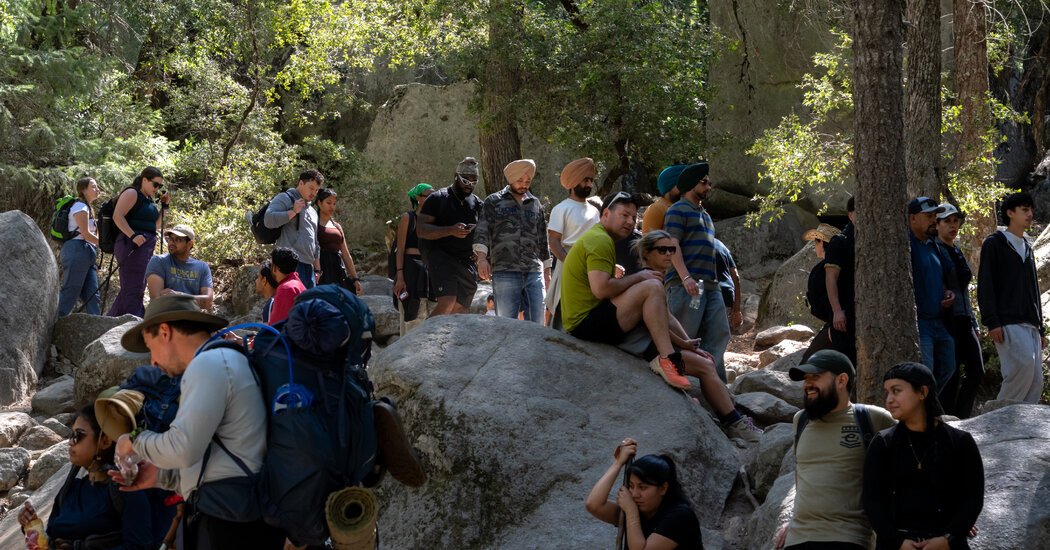
At the base of Yosemite Falls, where white waters roared down a granite cliff, a couple jockeyed through dense crowds to try to take the perfect waterfall selfie. A family of five traded off resting in the single available seat on a wooden bench. A tourist tripped over a toddler, who fell and began wailing.
There was one spectacle at Yosemite National Park this weekend not in the glossy brochures: the visitors themselves.
The crown jewel of the nation’s park system, Yosemite is even more crowded than usual this year, after a decision by the Trump administration to do away with summer reservations here and at other popular parks.
In the first half of 2026, visitors to and employees of California’s regal wilderness park reported hourslong traffic jams, waits at entrance stations and long lines just to purchase a bite to eat.
Employees of Yosemite and organizations that support it say that the hordes of visitors are demoralizing staff and damaging the park, as well as its reputation. Many visitors are determined to make the most of their visit, even with long waits. But some travelers have abandoned their plans altogether and driven out of the park’s gates after being turned away from every at-capacity major attraction.
”This is a far cry from the awe-inspiring sights Yosemite is known for,” the state’s two U.S. senators, the Democrats Adam Schiff and Alex Padilla, wrote in a letter last week to the administration criticizing the cancellation of Yosemite’s reservation system.
July is already the busiest month across national parks. And at Yosemite, it’s shaping up to be chaotic.
On Friday morning, so many people had already arrived at Yosemite Valley, known for its sprawling meadows and towering palace of granite rock faces, that by 7 a.m. drivers were circling lot after lot as they tried to find a spot.
“The traffic is terrible in the park,” said Lakshmi Duddukuru, 41, who spent 45 minutes of her first trip to Yosemite searching for a parking space. She spoke as she scaled the steep Mist Trail, where throngs of hikers were ascending in a slowly snaking line.
Yosemite offers free shuttles to transport visitors between popular destinations, but many were too full to pick up any of the dozens of people waiting at the stops. On one bus, a frustrated driver trying to squeeze in more sightseers shouted, “If you’re not touching somebody, you’re not close enough.”
Yosemite Valley helped inspire the creation of the national park system, as it was the first federally protected land to be designated for public use, under an act signed in 1864 by President Abraham Lincoln. Its waterfalls and glacier-carved monoliths, such as Half Dome and El Capitan, have made it one of the country’s most beloved national parks — and most visited.
In 2020, Yosemite began experimenting with a summer reservation system to manage its ever-growing summer crowds. But Yosemite, as well as Arches National Park and Glacier National Park, did away with reservations this year, after President Trump signed an executive order urging parks to rescind restrictions to improve access and help local economies.
Ray McPadden, Yosemite’s superintendent, said that a reservation system should be a last resort. In previous years the park had to turn families away because they hadn’t booked a visit in advance, he said, which was unfair to them and meant a loss of fees that could have gone toward fixing up trails, campgrounds and bathrooms.
Mr. McPadden thinks the park is not overly crowded, except on holidays and Saturdays, he said. He expects a 12 percent increase in visits compared with last year, which would be about 4.7 million visitors, and the second-busiest year in the park’s history.
“No secret: Yosemite is really popular,” he said. “We are having a great summer.”
Some park employees disagree. The union local representing Yosemite staff, NFFE Local 465, said in a statement that the decision to end the reservation system had underminedstaff and was “disheartening and disappointing,” particularly when the park was short-staffed after federal cuts. Gridlock traffic inside lengthens staff members’ commutes and makes it difficult, if not impossible, for them to perform their duties, the local said.
Advocacy organizations point out that Yosemite did not benefit much from fee revenue over the holiday weekend. As part of his overhaul of the National Park Service, President Trump ended free park entry on some days, such as Martin Luther King’s Birthday, while granting free park admission to U.S. residents on Mr. Trump’s birthday, which coincides with Flag Day, as well as July 3, 4 and 5.
They worry that overcrowding encourages people to go off trail, and that guests aren’t as supervised as they once were. The bumper-to-bumper traffic also means that ambulances and other emergency vehicles can be delayed.
The overcrowding “is an environmental disaster for the park, and it’s a safety issue for visitors,” said Mark Rose, the Sierra Nevada program manager for the nonprofit National Parks Conservation Association.
For the most part, however, visitors seemed unfazed by the crowds. The magnificence of Yosemite’s glassy rivers and giant sequoias is difficult to diminish, and tourists said they expected summer crowds when they traveled.
Ms. Duddukuru, who was visiting from Chicago, said that despite the delays the park was “wonderful.” She and her family had to wait 45 minutes to board a shuttle, but then spotted a bear, so the delay felt worth it, she said.
Sasha Rubeiz, 23, said one particularly narrow trail felt a little dicey with so many other hikers, but they were mostly not a bother on her first, “unreal” visit here. She tilted her head up toward soaring pine trees and blue skies.
“I’m looking up more than down,” said Ms. Rubeiz, who lives in Sacramento.
Mr. McPadden said he was working on solutions to some of the crowding issues, including new fencing and boulders to stop people from parking illegally. He said he hoped to install digital signs showing guests which parking lots are already full so they don’t waste time circling.
He would not say whether a reservation system would return next year. “I try to follow the facts, which generally are very, very positive here in the park,” he said.
Brett Birkbeck, a police officer who lives in Huntington Beach, Calif., ate a hot dog and drank red wine out of a plastic cup as he set up camp at dusk under pine trees.
Mr. Birkbeck, 49, said the crowds could not put a damper on his annual summer trip to Yosemite, during which he and his friends hike and grill ribs for a week in one of the most spectacular places on Earth.
“I call it pressing the reset button on the year,” he said.