dailynewsnblog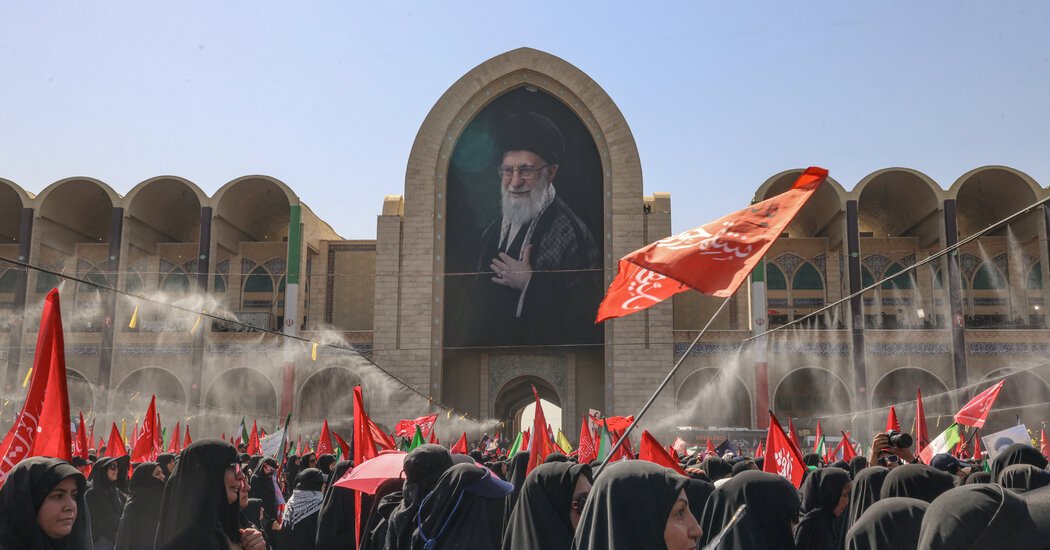
Tens of thousands of mourners, including senior Iranian officials, packed Tehran on Sunday for funeral prayers for the slain supreme leader, Ayatollah Ali Khamenei, as crowds chanted calls for revenge.
Conspicuously absent was his son and successor, Mojtaba Khamenei, who has not been seen in public since succeeding his father, who was killed at the onset of the U.S.-Israeli war on Iran in late February.
His absence has become a point of scrutiny in a political system where public appearances by senior figures often carry symbolic weight and are carefully choreographed to project authority and stability. It has fueled questions about his health and about the country’s internal political dynamics, particularly at a moment of heightened regional tension and uncertainty over Iran’s political future.
The funeral was a show of unity by Iran’s leaders after a period of internal divisions, when senior officials and prominent political figures fought openly and viciously over negotiations with the United States. They traded accusations of delusion, treason and coup plotting, and of disobeying and manipulating the new supreme leader.
Mr. Khamenei has been hiding in a bunker, and access to and communication with him has been limited. He is believed to have been injured in the same strikes that killed his father when Israel and the United States bombed the family’s compound on the first day of the war, Feb. 28.
His brothers were among those in attendance for the second day of mourning, according to footage broadcast on state media.
Ahmad Vahidi, the head of the powerful Islamic Revolutionary Guards Corps, also attended the prayers. He emerged from the Grand Mosalla, a sprawling mosque complex, to mourners, many clad in black, who surged toward him.
“Revenge, revenge,” they chanted, a scene that was observed by New York Times reporters near him. Mr. Vahidi briefly greeted people before security personnel whisked him away.
Still, long before dawn, mourners grieving his father had begun arriving at the Grand Mosalla. Many carried photographs of Mr. Khamenei and held banners calling for his death to be avenged. So many people overflowed the mosque that some prayed outside, standing shoulder to shoulder in the heat of the day — men beside women, children beside parents.
“He stood for the ideas that he believed in, and he was killed for it,” said Mohamed Abdi, who said he flew from Paris for the commemoration. Originally from Abyaneh, some 90 miles southwest of the capital, he said Mr. Khamenei’s killing had transformed him from a mere political and religious leader into a martyr and a national symbol of conviction and strength.
“It is that strength and cause that brought me from Paris to Tehran and made me shed tears today,” he said. “He was someone who did the things that he really believed in.”
For four decades, Mr. Khamenei shaped nearly every major center of power in Iran. Politically, he had final authority over strategic decisions, the military and state institutions. Socially, his government exerted control through restrictions, state media and cultural oversight. Religiously, he occupied the Islamic Republic’s highest office, blending political authority with clerical legitimacy.
He was killed along with several members of his family, including his wife, daughter and granddaughter. On Monday, his body is expected to be carried through Tehran in a public procession likely to draw another huge turnout in the heart of the capital.
On Sunday, for a second straight day, large parts of Tehran were transformed by the ceremonies. Streets were shut down and security forces stood at nearly every major intersection. Volunteers distributed food and water, while stations sprayed mist into the summer heat for people packed into public squares and sidewalks.
For many Iranians, Mr. Khamenei’s legacy is also tied to the government’s repression of dissent. Security forces have repeatedly answered protests with force, including the demonstrations driven by economic frustration that broke out in December in which officials killed thousands of people, according to human rights groups.
The New York Times was granted access to the funeral ceremonies by Iran’s government, which determined the ceremonies that the reporters could attend, accompanied by a translator and a guide who were provided by the government. The views expressed by people interviewed at these events may not be representative of many Iranians, while others may have felt unable to speak freely.
Critics said the supreme leader’s death should not erase the government’s violent and oppressive history, even as supporters gathered to mourn him.
“He was supposed to be the leader of a government defined by the word ‘republic,’ but in practice, his rule had none of the qualities of republicanism,” said Lida, 44, a doctoral student who spoke by phone from Tehran and asked that her last name not be used for fear of retaliation.
She said the scale of the ceremonies felt disconnected from the pressures many Iranians face. Even as authorities handed out food and water and organized elaborate public displays, Iran continues to struggle with electricity shortages and severe drought.
“The resources do exist,” she said, “but they are reserved only for those considered part of the inner circle.”
Sanam Mahoozi contributed reporting.