dailynewsnblog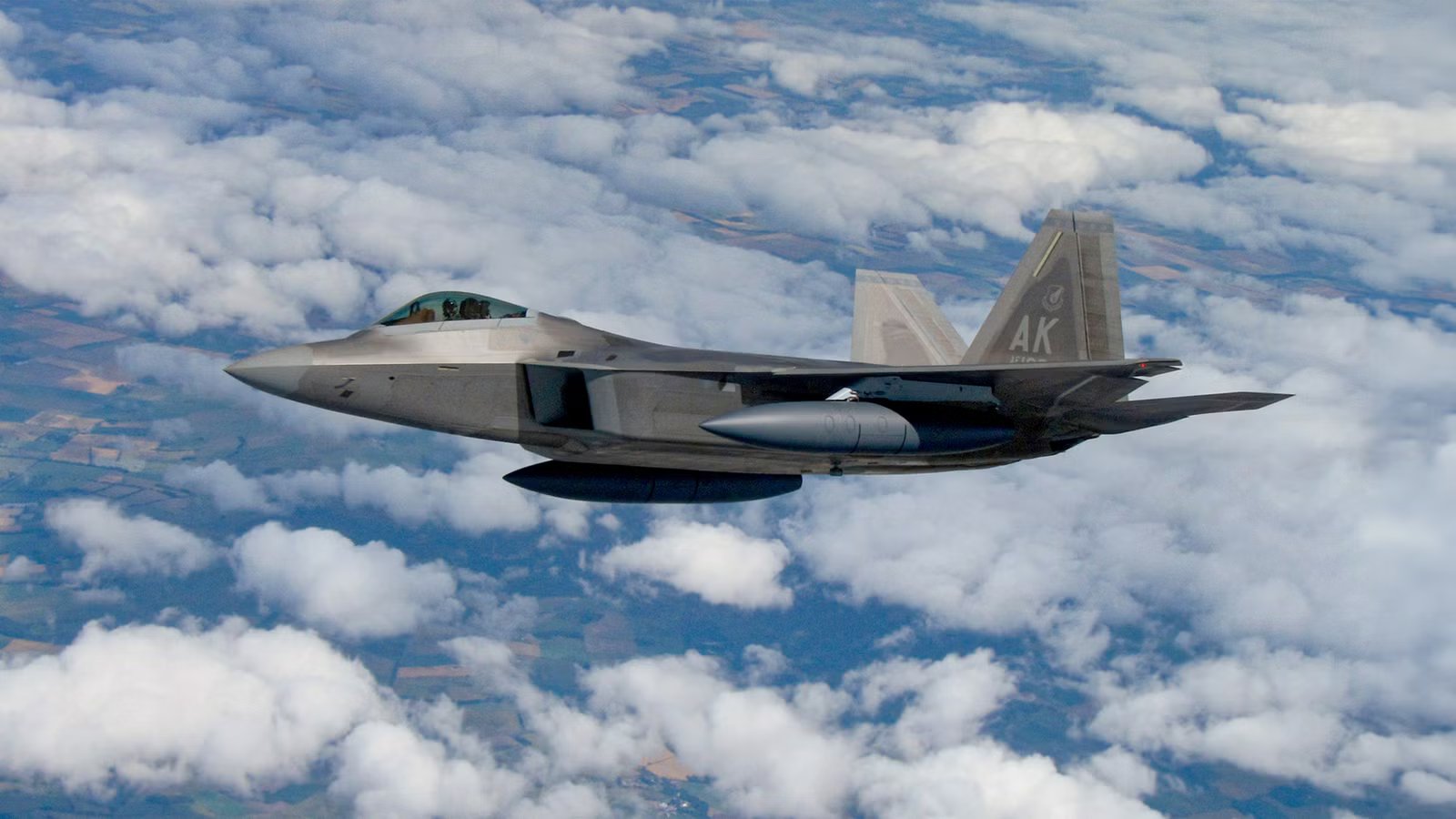
The Lockheed Martin F-22 Raptor first entered service in 2005, although it was developed during the 1990s with its roots in the Cold War of the 1980s. Barring subsequent upgrades since then, the aircraft is a fundamentally 1990s aircraft that made use of the cutting-edge technologies of the period. At the time, the F-22 came with what appeared to be the future of fighter jet nozzles: rectangular and 2D thrust vectoring.
Even so, the F-35 featured a return to circular nozzles, as did the subsequent Russian Su-57 and the Chinese J-20. However, saying stealthy rectangular 2D vectoring nozzles were a one-hit-wonder could appear premature, as the second Chinese J-36 prototype/demonstrator appears to have something similar.
The F-22’s Place In The USAF

The F-22 was engineered around stealth, situational awareness, and being an air dominance fighter jet. It was designed to have an ‘unfair’ advantage over Soviet aircraft like the MiG-29 and Su-27 and to be a generational leap over the F-15 Eagle. The United States Air Force has the bandwidth to operate multiple types of fighter jets, filling different niches. This is something smaller air forces typically struggle with, as the RAF, for example, only has two fighter jet types: the F-35B and Eurofighter Typhoon.
The A-10 is not really a fighter jet, but it does provide ground support and has some overlap. Meanwhile, the F-16 is a light/medium-weight fighter jet that is now a versatile multirole fighter, and its affordability allows the Air Force to make up the numbers. The F-16 is the most common fighter jet in USAF service today, allowing the air force to use a fighter that’s not ‘overkill’ for the mission. Legacy F-15 Eagles are mostly retiring.
However, the F-15E Strike Eagle and F-15EX Eagle II are higher-end and heavier platforms able to carry out strike and air superiority missions. Meanwhile, the F-35 is a higher-end and more numerous stealth fighter. The F-22 Raptor is a dedicated air superiority fighter designed to ensure the Air Force can secure air superiority. It is a highly optimized, high-end aircraft whose performance was prioritized over affordability.
5 Fighter Jets That Defined Air Combat In The Last Decade & Why They’re Already Obsolete
Obsolescence has various forms, all affecting some of the best fighter jets in the world.
The F-22’s Square Exhaust Nozzles

One of the more distinctive features of the Raptor is its rectangular (square) engine nozzles. These are designed as rectangular because that is the shape that helps to reduce the aircraft’s infrared and radar signatures. While the overall stealthy shape of the aircraft may be the most visible aspect of the Raptor’s stealth profile, the engines and engine exhausts are also central. Many online enthusiasts will comment on the radar cross-section of aircraft like the Su-57, J-20, F-35, and F-22.
However, the infrared signature is of similar importance. The Raptor’s exhaust design spreads out the exhaust gases over a wider area, which lowers the exhaust temperature. This helps to hide the hot turbine blades from certain angles. The exhausts also make use of serrated edges and special materials to reduce radar signatures, meaning the exhausts are optimized for lowering both the radar and infrared signatures of the Raptor.
Round nozzles have curved surfaces that can reflect radar signatures back to the emitter, while the square nozzles on the Raptor have faceted, saw-toothed, and subtly curved edges that deflect radar energy away from the source. It is not unheard of for a new generation of aircraft to feature a next-generation solution only for it not to be used again. For instance, on the commercial side, the Boeing 787’s saw-tooth chevrons have do not feature in the upcoming Boeing 777X.
The High Costs Of The F-22’s Exhausts

As stated, the F-22 Raptor was a ‘no expense spared’ gold-plated fighter jet. The exhausts are also complex and expensive, as these incorporate two-dimensional thrust vectoring, numerous moving flaps, and heat-resistant materials, with the complexity adding cost, weight, and a maintenance burden. The F-22 became one of the most expensive fighter jet programs of the US Air Force.
Planners must keep in mind that the Air Force puts almost as much emphasis on its budget and what it can afford to operate as on the capabilities themselves. The F-22 may have been without equal, but its expense also saw the Air Force reduce its purchase to just 187 production aircraft, down from an originally planned 750. The nozzles also come with thrust and weight penalties.
Some estimates suggest the aircraft loses around 10-17% of thrust compared with ideal round nozzles in certain regimes due to non-optimal flow geometry. Other estimates are lower, at around 6% to 8% thrust reduction. The issue is that a jet engine naturally produces a circular column of high-velocity exhaust, and forcing that into a flat, rectangular shape results in a loss of total thrust.
The design also introduces heavy actuators and mechanical plates to move the square flaps up and down. These provide a weight penalty of hundreds of pounds in dead weight at the absolute rear of the airframe.
Why Other Jets Abandoned Square Nozzles

Later designs like the F-35 (also produced by Lockheed), the Chengdu J-20, and the Sukhoi Su-57 all use round nozzles. These decisions were shaped by not only cost, but also the fact that design philosophy had moved on. Designers concluded it was more important to emphasize the airframe to reduce RCS rather than the nozzle shape.
New technologies allow for better engine cooling, and improved coatings reduce infrared emissions. Other considerations included reducing expenses, including the maintenance burden. In 2020, the Aviation Geek quoted Mark Knight, a pilot and an aviation expert, as saying that:
“The Su-57 was going to have F-22-style nozzles developed for it, but once the engineers got started and discovered how expensive it was going to be, the Russian government decided that the improved rear aspect stealth was not worth the extra cost. So, the Su-57 was developed with frontal stealth as a priority. The Chinese did not even consider such designs for their stealth fighters, as front hemisphere stealth was all that they considered important.“
Lockheed Martin F-22 Raptor (per USAF) | |
|---|---|
Role | Air dominance/multirole |
Number in service | Approximately 183 (145 combat coded) |
Thrust | 35,000-pound class (each engine) |
Powerplant | 2x Pratt & Whitney F119-PW-100 turbofan engines |
Maximum takeoff weight | 83,500 pounds (38,000 kilograms) |
Put another way, the Russians and Chinese emphasized frontal stealth for their aircraft. This was partly because the beyond-visual-range engagements had grown since the F-22 was designed in the 1990s. The F-22 was designed for a time when it had been thought that engagements would be closer, and all-aspect stealth would be more important.

From 76 F-22 Raptors To 200 Next-Gen Fighters: How Much Larger America’s Air Superiority Fleet Could Get
A closer look at the future of air power in the US Armed Forces.
The F-35’s Workaround

By the time Lockheed engineers moved onto the F-35, they chose not to copy the older F-22. This was partly because they concluded that most stealth benefits could be achieved with other improvements. These included an S-shaped inlet duct, improved radar-absorbing materials, internal baffles, better airframe shaping (which matters more than the exact nozzle shape), and special coating.
It was also designed around an evolved doctrine that emphasizes long-range sensors, passive detection, electronic warfare, data sharing, and more. This allows the aircraft to be further away during engagements. Another factor was that the F-35 is powered by a single F135 engine. This is the most powerful engine ever produced for a fighter jet, and round, circular nozzles provide better thrust efficiency. There were other big factors.
For example, the F-35B is designed for STOVL operations, and the round nozzle is better adapted for that role. The nozzle shape was non-negotiable for the Marines, and the aircraft was (aspirationally) designed to emphasize parts commonality between variants. While, like the F-22, the F-35 is also very high-end, it needs to be affordable enough and have a low enough maintenance burden for the Air Force to maintain over 1,700 of them. This is around ten times more than the F-22.
Catch what other flight trackers miss
Emergency squawks, holds, NOTAMs — live signals, no signup.
Open tracker
Catch what other flight trackers miss
Emergency squawks, holds, NOTAMs — live signals, no signup.
Open tracker
Upcoming Sixth-Generation Fighters

The next-generation fighter jets and the B-21 are expected to emphasize all-aspect stealth with particular emphasis on the infrared spectrum. Not a lot can be said specifically about the nozzles, as these remain highly classified. The B-21’s exhausts appear flat and embedded, while the Chinese J-36 demonstrator appears to feature 2D thrust vectoring nozzles that resemble the F-22.
Overall, it appears that the next-generation fighter will feature partially buried, flattened, and shielded exhausts. In other words, they appear to be moving away from the optimized circular nozzle of the F-35 and toward an updated evolution of the rationale behind the F-22. But treading here should be taken with caution, as these programs remain secretive, and publicly released artwork could be deliberately misleading.
What is expected for the F-47 is adaptive cycle engines, thrust vectoring (similar to the F-22), and a focus on all aspects of stealth. Thrust vectoring for the F-47 is expected to take on more importance, partly due to the tailless designs. The F-47 is also expected to be a return to the F-22 procurement logic of a ‘gold-plated’ ultra-high-end platform fielded in relatively small numbers. Indeed, the Air Force expects to purchase at least 185 F-47s, which will serve as a one-for-one replacement of the Raptor.