dailynewsnblog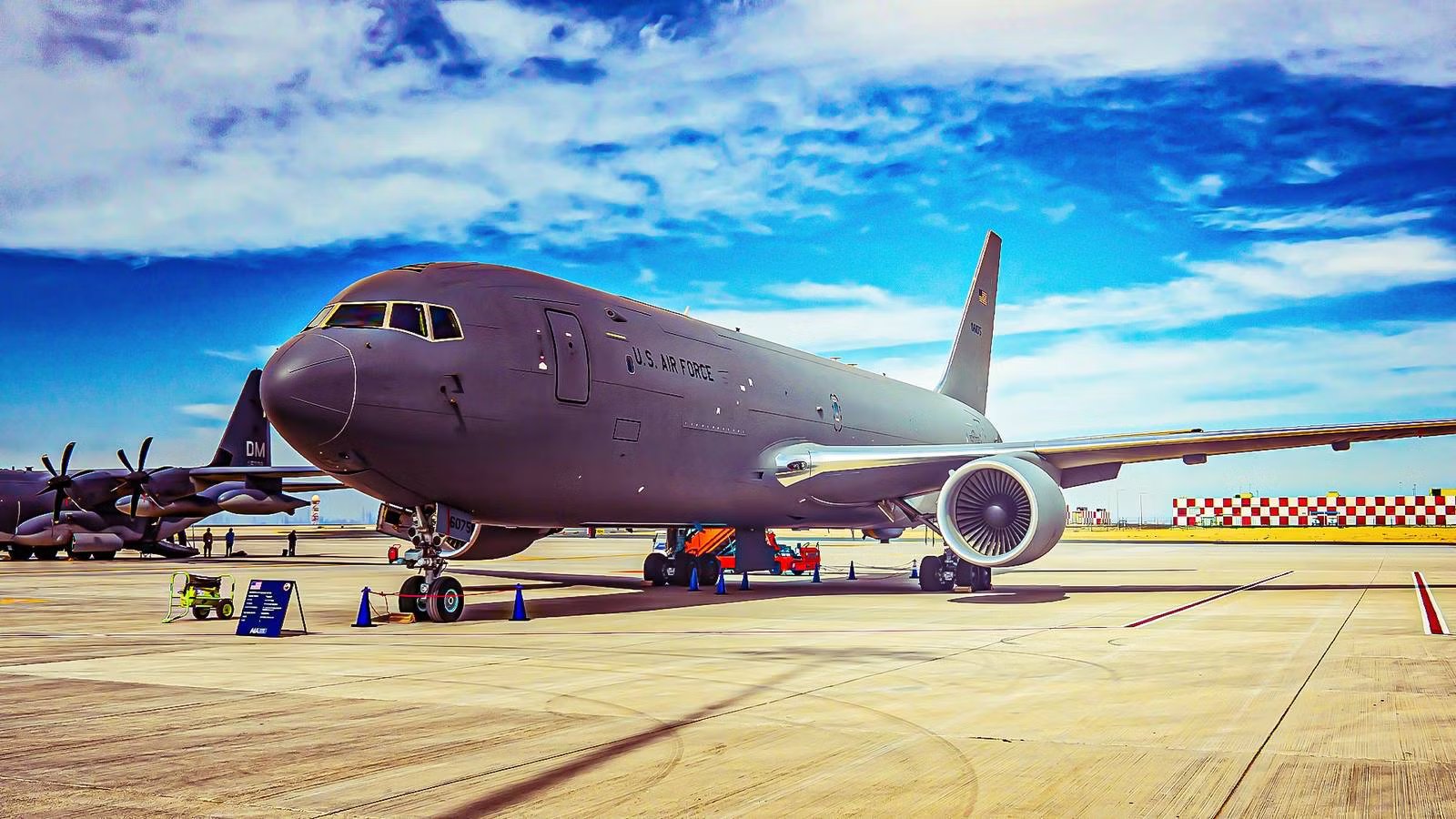
More than a decade after winning the United States Air Force‘s KC-X competition, the  Boeing KC-46 Pegasus has become one of the world’s most capable aerial refueling tankers. It has flown combat support missions across Europe, the Middle East, and the Indo-Pacific, and more than 100 examples have already entered USAF service. Yet despite those achievements, the aircraft still cannot safely refuel every aircraft in the Air Force inventory. For example, the Republic A-10 Thunderbolt II has demonstrated boom refueling with the KC-46 during testing, but the aircraft has remained affected by the KC-46’s boom stiffness issue, which prevented reliable operational compatibility and drove the need for a redesign, and Lockheed MartinF-22 Raptor and Northrop GrummanB-2 Spirit Bomber crews still fly refueling contacts that risk scraping the radar-absorbent skin off two of the most sensitive airframes in the US inventory.
Two entirely unrelated defects, one mechanical and one visual, have quietly produced the same result: a fleet that has now delivered more than 105 tankers and is contracted to grow past 260, but cannot safely refuel every aircraft it was built to support. The real question isn’t whether the KC-46 has problems; every defense reporter has covered that. It’s which specific USAF aircraft remain affected, why two separate fixes keep failing to close the gap on the same calendar, and how much longer that list actually survives.
The A-10’s Mechanical Mismatch With The KC-46 Boom

The clearest case of a KC-46 refueling limitation isn’t a software glitch or a lighting condition. It’s a mechanical mismatch that was built into the boom from day one. According to a Government Accountability Office report, the original boom actuator was designed to require roughly 1,400 pounds (635 kg) of axial force to compress the boom and to hold a stable connection, a standard the Air Force itself approved during the aircraft’s development.
The A-10 Thunderbolt II, however, presents a unique challenge. Even under favorable conditions, the Warthog cannot generate enough forward thrust during aerial refueling to overcome the resistance created by the KC-46’s rigid boom actuator. Fully loaded at altitude, the Warthog can produce closer to 650 pounds (295 kg) of forward push, nowhere near enough to keep the KC-46’s rigid, telescoping boom compressed in position. Older tankers, including the KC-135, avoid this problem because their boom systems provide more mechanical flexibility. The operator can maintain contact even when the receiving aircraft produces relatively little forward pressure. Although the A‑10 Thunderbolt II can physically connect to the KC‑46’s boom and test photos show brief contact, the aircraft remains officially incompatible with the Pegasus under operational conditions.
The planned solution is the Boom Telescope Actuator Redesign, commonly known as BTAR. The modification is intended to reduce the force required to maintain contact and restore compatibility with aircraft such as the A-10. However, the redesign is not expected to begin entering operational service until late fiscal year 2027, with additional hardware and software improvements extending into 2028.
But rather than wait, the Air Force pursued a parallel workaround. As reported in Air & Space Forces Magazine, on April 2, 2026, an A-10 successfully received fuel from a C-130-based tanker using a newly developed probe-and-drogue adapter for the first time in the aircraft’s history.
The adapter fits into the nose where the A-10’s existing air refueling receptacle is located, enabling the Warthog to accept fuel from Lockheed Martin HC-130J and M C-130J tankers whose airspeeds and altitudes are inherently more compatible with A-10 operations. Maintainers can install or remove the adapter in hours, giving units the ability to configure the A-10 for either boom or drogue refueling depending on which assets are available. The probe adapter is a workaround, not a solution to the KC-46 compatibility problem. The Warthog can now get fuel in more scenarios, from more tankers, but it still cannot refuel from the KC-46’s boom, and the KC-46’s probe-and-drogue system does not resolve the airspeed incompatibility between the two aircraft. Several feet away from the boom assembly, however, there is an entirely separate problem, one caused not by physics or airspeed, but by human vision.
A Different Problem With The Same Result

The KC-46’s other major refueling challenge comes from the Remote Vision System, or RVS, the network of cameras, sensors, and displays that replaced the traditional rear-facing boom operator window used on previous tankers. The concept was ambitious.
Instead of relying on a person looking directly through a window, the KC-46 boom operator controls the refueling process from inside the aircraft using high-definition camera feeds and advanced displays. In theory, the system provides better visibility, reduced crew workload, and improved ergonomics. In practice, the original RVS struggled under some of the most difficult conditions encountered during aerial refueling. Bright sunlight, reflections, shadows, and limited depth perception could make judging distance and alignment more difficult than with the traditional optical system. For most receiver aircraft, these limitations created operational inconvenience and increased pilot workload. For stealth aircraft such as the F-22 Raptor, the B-2 Spirit and the Northrop Grumman B-21 Raider , the consequences are far more serious.
A small boom contact that might leave a cosmetic mark on a conventional aircraft can become a major maintenance concern on a low-observable platform. As Simple Flying has previously detailed, the F-22’s radar-absorbent coating is a closely guarded, difficult-to-replicate layer of the airframe, one that isn’t cheaply touched up after a hard contact. A vision system error that would leave a scuff on an F-16 becomes a maintenance and security event on a Raptor or a Spirit.
The key point is that these problems are not connected. Fixing one does nothing to solve the other. BTAR and RVS 2.0 are moving through separate engineering programs, with different contractors, different testing schedules, and different certification requirements.
For the Air Force, that means progress in one area does not automatically reduce the overall list of affected aircraft. The KC-46’s remaining limitations will only disappear when both problems are solved independently.
Two Fixes Running On Two Separate Clocks

Despite sharing the same aircraft and affecting the same refueling mission, the KC-46’s two major limitations are being solved through completely separate engineering efforts. The Boom Telescope Actuator Redesign and the Remote Vision System 2.0 upgrade do not share a development path, a testing schedule, or even the same technical challenges. BTAR is fundamentally a mechanical redesign. Engineers must modify the boom’s actuator system, validate new hardware, and prove that the redesigned mechanism can safely support every receiver aircraft without introducing new reliability issues. The work involves structural testing, flight testing, and certification before the modification can move into fleet-wide implementation.
RVS 2.0, by contrast, is primarily a sensor and human-machine interface upgrade. The challenge is not whether cameras can produce an image, but whether that image provides enough information for a boom operator to make split-second decisions during one of the most precise maneuvers in aviation. RVS 2.0’s target fielding date has slipped repeatedly: 2023, then October 2025, then summer 2027. According to Air & Space Forces Magazine, the system remains the “pacing item” among the KC-46’s Category 1 deficiencies, which numbered five as recently as spring 2025 and have since been narrowed to three, according to a defense-industry analysis.
Completing flight testing is not the same as solving the problem. The harder test, contact testing, in which the boom actually plugs into a receiver rather than simply flying in formation with one, is the phase that determines whether RVS 2.0 fixes the visibility issue at all. As of this writing, that phase has not yet begun. Until both BTAR and RVS 2.0 deliver proven operational performance, tanker crews must continue flying with the existing system, and its shortcomings are documented not only in engineering reports, but in a growing series of costly real-world incidents.
What Happens When The Boom Doesn’t Let Go

The consequences of those unresolved deficiencies become most visible during the final moments of an aerial refueling contact. What engineers describe as “boom stiffness” sounds like a minor mechanical issue. In practice, it can prevent the boom from disconnecting when commanded, turning a routine refueling operation into a serious flight safety event.
The boom must remain connected while both aircraft are moving through turbulent air, but it must also disconnect quickly when commanded. Any problem with that balance can turn a routine refueling operation into a major safety event. In October 2022, a KC-46A from the 305th Air Mobility Wing was refueling a McDonnell Douglas F-15E when its boom nozzle locked inside the Strike Eagle’s receptacle; during an emergency breakaway, the boom kicked upward and struck the tanker’s own tail.
In August 2024, a separate F-15E refueling suffered a bound nozzle that suddenly sent the boom upward into the tanker before it suffered a structural failure and shed pieces of itself, a mishap that, according to a declassified accident investigation report, cost roughly $14.38 million. According to Military Times, on July 8, 2025, a KC‑46A Pegasus was forced to make an emergency landing after its refueling boom was damaged during an aerial refueling mission over the Atlantic Ocean with an F‑22A Raptor. During the breakaway maneuver, a nozzle‑binding event occurred, causing the boom to strike the KC‑46A’s tail before snapping off entirely and falling into the ocean, according to the official release.
Three incidents across roughly three years are not a pattern the Air Force can dismiss as pilot error alone, and it hasn’t. Each mishap has reinforced that the KC-46’s remaining deficiencies are operational problems, not merely engineering nuisances awaiting routine fixes. As investigations accumulated and the timelines for BTAR and RVS 2.0 continued to stretch, concern shifted beyond maintenance hangars and test squadrons to the Pentagon’s acquisition planners and Capitol Hill. The debate was no longer just about when the Pegasus would be fully fixed, but whether the Air Force could afford to retire its legacy tankers before those fixes were proven in service.
Congress Isn’t Ready To Bet Everything On KC-46

Lawmakers have effectively hedged against the KC-46’s remaining limitations rather than waiting for them to disappear. The fiscal 2026 National Defense Authorization Act blocked additional KC-135 retirements, forcing the Air Force to keep older tankers, some pulled back from the Davis-Monthan boneyard, in the rotation specifically because the KC-46 still can’t cover every mission its predecessor can.
The A-10 is the clearest illustration: as Simple Flying has reported, the Stratotanker remains the backbone of American aerial refueling nearly seven decades after its first flight, and one reason is that it’s still the only boom tanker the Warthog can safely plug into. According to the Government Accountability Office, the KC-46 fleet failed to meet its availability and mission-capable rate goals for six consecutive fiscal years, from 2019 through 2025, a run of shortfalls directly tied to these unresolved deficiencies.
None of this stops the Air Force from continuing to buy more KC-46s. But it does mean the list of aircraft this tanker cannot fully or safely refuel won’t shrink until two very specific engineering milestones, one mechanical and one visual, are both cleared. So far, only one of them has even reached its hardest test.
The Milestones That Will Decide The KC-46’s Future

Although Boeing’s June 2026 announcement marked a significant milestone, neither of the KC-46’s remaining fixes has reached the stage that ultimately determines whether it solves the problem in operational service. As reported by Defense News, Gen. David Allvin, then-Air Force Chief of Staff, testified before the House Appropriations Committee on the KC-46’s Remote Vision System.
“It’s operating, it’s just not operating as we would expect it to.”
Contact testing, plugging the redesigned system into an actual receiver in the exact lighting conditions that broke the original system, is the phase that will determine whether the fix actually works. That testing had not begun as of this writing, which means the Air Force’s summer 2027 fielding target still rests on a step nobody has completed yet.
The mechanical side follows a similar script. BTAR isn’t expected to begin entering fleet service until late fiscal year 2027, with further hardware and software refinements planned through 2028, even as the Air Force pursues $3.9 billion in additional fiscal 2027 funding to keep growing the fleet toward its 263-aircraft program of record.
Those upcoming tests will define the KC‑46 far more than any past deficiency ever did. They are the events that will determine whether the Pegasus becomes the fully capable refueling platform the Air Force envisioned, or whether its modernization journey continues into yet another phase.