dailynewsnblog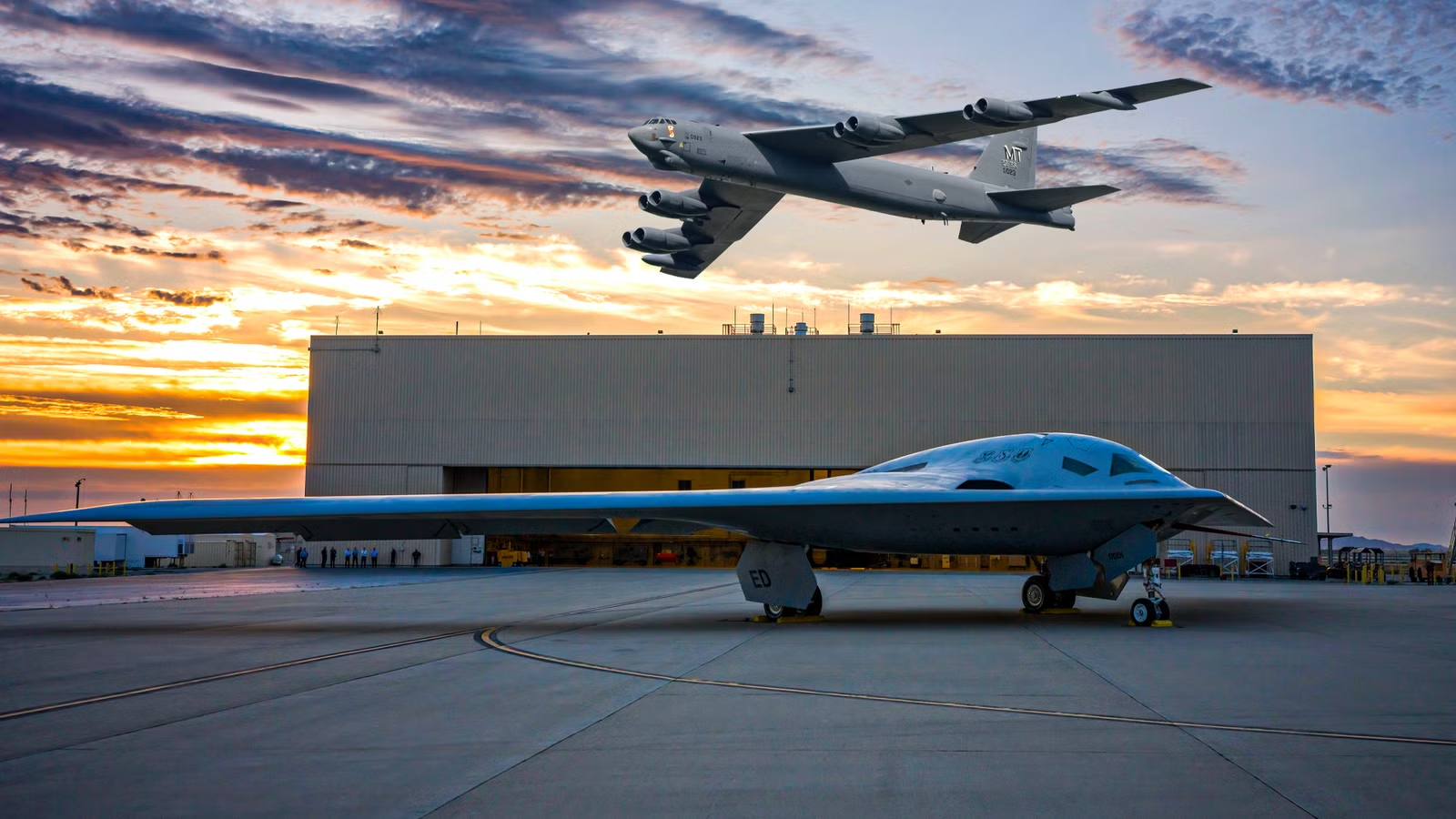
The US Air Force’s Northrop Grumman B-21 Raider is planned to enter service in 2027, while the upgraded B-52J bomber is expected to enter service around 2033, with the older B-52H serving until then. It is working to bring a next-generation stealthy cruise nuclear missile, the AGM-181 Long-Range Standoff Missile (LRSO), into service in 2030 to replace an aging missile: the AGM-86B Air-Launched Cruise Missile.
The AGM-86B has remained in service for decades beyond its original design life, which was originally ten years, although it has received multiple modernizations. While the B-21 and B-52J are very different conventional strategic bomber platforms, the B-21 has been designed to carry the LRSO, while the B-52J is being modernized to carry it.
Armed with the LRSO cruise missile, they will fill a similar nuclear deterrence role. In effect, LRSO provides a common weapons architecture that allows a bomber first flown in the 1950s and one entering service in the late 2020s to perform the same strategic mission using the same munitions.
The Importance Of Missiles

The primary role of fighter jets and bombers is to be platforms that deliver missiles and bombs. At their core, combat aircraft exist to place weapons on target, although modern aircraft increasingly contribute through sensing, networking, and electronic warfare as much as through the weapons they carry.
The B-52 is an interesting case, as it is retained largely as a missile truck for plentiful, cheap, stand-in munitions like JDAMs. However, in the future, its role is seen as increasingly weighted toward expensive, exquisite, stand-off munitions like JASSMs, AGM-181 LRSO, and future hypersonic missiles.
The importance of these munitions can’t be overstated: a fifth-generation fighter jet can be outmatched by a fourth-generation fighter if the latter is armed with state-of-the-art air-to-air missiles and the fifth-generation fighter has to make do with outdated missiles. Many articles and headlines focus on the per-unit cost of a fighter jet: for instance, the flyaway cost of an F-35A is around $87 million).
To some degree, the initial purchase price of a fighter jet is secondary to the costs of maintaining, integrating, training, upgrading, and purchasing munitions. The biggest bottlenecks for many air forces are not the number of fighter jets; it’s the number of trained pilots and magazine depth. With advanced air-to-air missiles typically costing around $500,000 to $1 million each, it doesn’t take long for a fighter jet to fire its initial flyaway cost-worth of missiles in a high-intensity conflict.
The US Air Force’s Aging AGM-86B ALCM

In 2025, The Air & Space Forces Magazine reported that the US Air Force had shared its first-ever concept rendering of the secretive AGM-181 Long-Range Standoff missile. It is set to succeed the AGM-86B ALCM as the B-52’s new primary nuclear weapon starting around 2030. It progressed past its critical design review in 2023 and is expected to carry the W80-4 warhead with a selectable yield of up to 150 kilotons.
The publication wrote that “Air Force budget documents for fiscal 2025 show LRSO’s funding set to balloon from $295.5 million in fiscal 2026 to $1.22 billion in fiscal 2027, indicating a planned start to production of a future total of 1,087 units. The most recent unit cost estimate is $14 million per LRSO missile.” The cruise missile is not expected to be hypersonic or even supersonic. Rather, it is expected to be a subsonic missile.
The LRSO is the second attempt to replace the aging ALCM, which first entered service in the 1980s. The United States Air Force had purchased 460 of a planned purchase of 1,500 AGM-129 missiles to replace it in the 1990s, but it then retired it due to budget cuts and new arms controls in 2012. This left the US Air Force with the older ALCM, but this is soon to change as it moves to procure the new LRSO.
Some Missiles Stick Around For A Long Time

Replacing a mature munition is often far more difficult than simply designing a better one. Sometimes commanders don’t have faith in a new munition and so choose to rely on older munitions. The US Navy learned a lesson soon after Pearl Harbor in the Second World War when a contributing factor to its follow-on humiliating defeat in the Philippines was that its submarines were using the Mark 14 torpedo.
This torpedo repeatedly catastrophically failed, and numerous direct hits US submarines scored on Japanese ships failed to explode. The Royal Navy’s nuclear-powered attack submarine HMS Conqueror famously carried both the modern Tigerfish wire-guided torpedo and the older World War II-era Mark 8. When ordered to attack the Argentine cruiser ARA General Belgrano during the 1982 Falklands War, the crew chose the older weapon because they had greater confidence in its reliability.
Long service lives can also reflect the sheer difficulty and cost of replacing strategic weapons. The LGM-30G Minuteman III entered service in 1970 and remains America’s only operational land-based ICBM. Although repeatedly modernized, it is over half a century old. Its successor, the LGM-35A Sentinel, has suffered major cost overruns and delays, illustrating how even the world’s largest defense budget struggles to replace a mature strategic missile system.
How LRSO Is The Architectural Glue

Arguably, the strongest connection between the ancient B-52 Stratofortress and the incoming B-21 Raider (expected to enter service in 2027) is not their engines or airframes: it’s a missile they have in common. After all, the B-52 is colorfully described as having the radar cross-section of a flying apartment building, while the B-21 is said to have the cross-section of an insect.
The AGM-181 Long-Range Standoff is considered the successor to the old AGM-86B, but it is more. It can also be understood as the architectural glue binding together America’s two nuclear bombers into a single deterrent enterprise. The nuclear cruise missile is being designed as a common cruise missile for both platforms. As the B-21s enter service, the USAF expects to retire its B-1B Lancers by 2037 (pushed back from around 2032) and then retire its B-2 Spirits thereafter.
AGM-181 Long-Range Stand-off Missile timeline | |
|---|---|
2021 | Entered the Engineering and Manufacturing Development phase |
Fiscal 2027 | $1.5 billion in requested funding |
February 2027 | Decision to move to low-rate production |
2030 | Planned entry into service |
The B-52H is being upgraded to the B-52J to serve alongside the B-21 into the 2050s and beyond. The US Air Force is increasingly designing the new B-52J and B-21 around a common nuclear cruise missile, a single mission-planning ecosystem, and a single deterrence doctrine. The unlikely pairing of bombers (separated by around 70 years) is to serve as complementary launch platforms within the same strategic architecture.
The B-21’s Nuclear Role

While the older B-2 and newer B-21 are broadly comparable in mission profiles in some ways, they are also different in others. The B-2 Spirit can be understood as a first-generation stealthy flying wing bomber. It was designed primarily for the USAF’s Cold War nuclear doctrine, able to penetrate enemy airspace and deliver nuclear munitions.
It was also designed for a conventional role, but as an expensive ‘first day’ asset optimized to hit high-profile, time-sensitive targets, and then let other bombers bring in the mass. This was seen in 2025’s Operation Midnight Hammer and 2026’s Operation Epic Fury. In the latter, B-1s and B-52s delivered the bulk of the ordnance.
The B-2’s design makes it great as a high-value first-day asset, but its small fleet size and demanding maintenance requirements have generally limited it to high-value missions rather than sustained, high-tempo conventional bombing campaigns. The B-21 is designed to increase the mission weighting of the conventional force. It will continue to be the primary air-based platform of the US’s nuclear triad.
However, it is also designed with much more sustained conventional roles in mind. Going forward, the US Air Force can no longer assume it will enjoy uncontested air superiority against a peer adversary to permit the B-1 and B-52 to safely operate with stand-in munitions. In this environment, the B-21 is to sustain a higher sortie rate of penetrating missions targeting high-value targets. The B-52 is then to double down on its role as a stand-off missile truck.
Fiscal Year 2027 Budget Documents

In the most recent US budget documents for Fiscal 2027, the LRSO is described as “a nuclear cruise missile capable of penetrating and surviving complex, advanced integrated air defense systems from significant stand-off ranges in Global Positioning System-denied environments.” The missile remains on track to enter Milestone C in 2027 before entering service in 2030.
It is designed to operate from “significant” stand-off ranges, allowing it to be used on the hulking B-52 and provide a credible deterrent. The proposed Fiscal 2027 budget allows the US Air Force to continue with development, integration, testing, and initial procurement, including purchasing ancillary equipment.
The system saw $790 million in funding in Fiscal 2025, split between $580 million in RDT&E funding and $210 million in procurement funding. In 2026, the total remained the same at $790 million, with the split being $447 million in RDT&E and $342 million in procurement. The proposed Fiscal 2027 budget increases this to $1.532 billion, of which $566 million is RDT&E and $997 million is procurement.