dailynewsnblog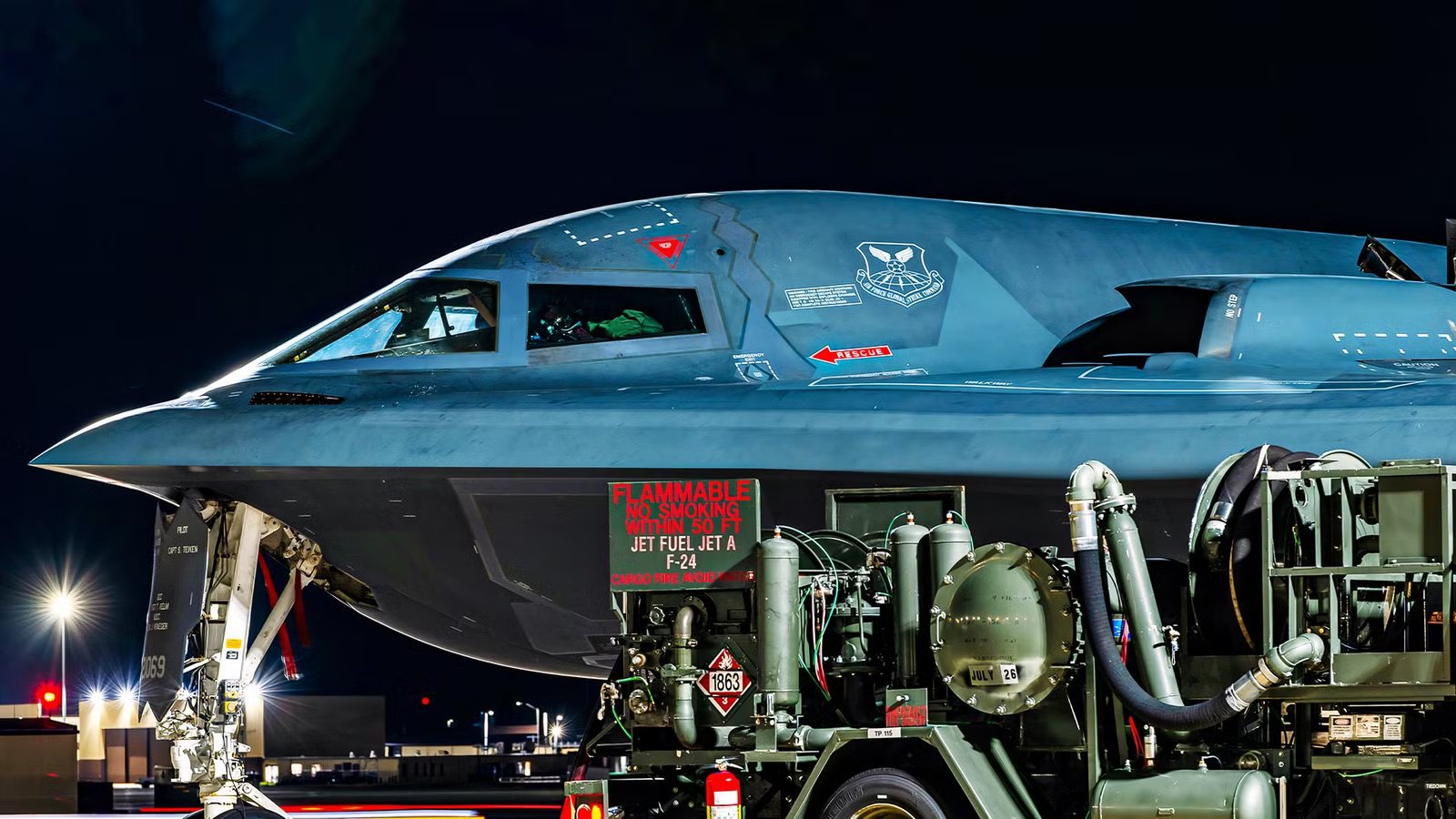
The Northrop Grumman B-2 Spirit is currently the premier strategic and conventional bomber within America’s arsenal. While the aircraft provides a sitting president with incredible options both in terms of deterrence and kinetic strike, it cannot simply operate from any air base unless certain criteria for its storage and maintenance are met in advance.
The stealth coatings that allow the bomber to penetrate an enemy’s potentially sophisticated defenses and threaten or destroy highly valued and heavily defended targets also mean that the aircraft requires specialized maintenance facilities. Such infrastructure is available at the B-2’s home base and at several overseas locations equipped to support expeditionary operations. Where suitable permanent facilities are unavailable, transportable shelters can be deployed, though this takes time and requires specialized personnel to maintain the bomber’s stealth characteristics.
The Rockwell International B-1B Lancer, on the other hand, does not have these limitations. The aircraft is capable of operating out of air bases that can support its weight and other operational requirements. With the Lancer, the United States Air Force (USAF) has a rapidly deployable capability that can be used for deterrence or to strike time-sensitive targets.
The B-2’s Home Base And How It Forward Deploys

The B-2, a global strike bomber, is capable of undertaking missions over any geographic location. However, all the aircraft in this fleet are assigned to one permanent base: Whiteman Air Force Base (AFB) near Kansas City, Missouri, which has an active-duty population of approximately 3,240 airmen. This location is equipped with the fixed infrastructure needed to maintain the Spirit, including climate-controlled hangars, specialized stealth-coating repair facilities, expertly trained maintainers, and secure storage for ordnance that may be required at any moment for a mission.
When the B-2 is required to operate from forward-deployed locations, it can be temporarily stationed at Royal Air Force Base Fairford (FFD) in England. According to the USAF, the $19 million (£14.2 million), 50,000-square-foot (4,645 m²) hangar complex was completed in 2004 and features facilities similar to those at Whiteman AFB, allowing the aircraft to have mission access to Europe, Africa, the Middle East and Central Asia.
However, if military planners require the bomber to be moved closer to a geographic location in preparation for an operation, this is possible if certain prerequisites are met. Namely, temporary climate-controlled hangars must be constructed to protect the aircraft and its sensitive radar-absorbing paint from the elements. These rapidly deployable shelters are called the B-2 Shelter System (B2SS), and they are capable of withstanding extreme high or low temperatures and winds of up to 110 mph (177 km/h). They are manufactured by American Spaceframe Fabricators Inc., and the USAF spent $21.3 million (£15.8 million) to purchase five.
To have this shelter ready, the components must first be transported to the intended operating location, which typically requires the services of an aircraft such as the  Boeing C-17 Globemaster III. Following delivery of the B2SS and the necessary repair materials and equipment for the bomber, an advance team will assemble the structure and certify its operation.
The process of making the shelter operational can take as many as 70 days, with airmen working 12-hour shifts. This was demonstrated by 20 members of the 49th Materiel Maintenance Squadron at forward operating base Diego Garcia, strategically located near the middle of the Indian Ocean. Highlighting the utility of the shelters, B-2s of the 509th Bomb Wing began their 44-hour missions, striking targets in Afghanistan at the onset of Operation Enduring Freedom in 2001, then landed at Diego Garcia, sparing them the need to refuel and fly back to Whiteman AFB.
The B-2’s Highly Sensitive Skin, And The Technicians Who Maintain It

What makes the Spirit lethal is not the fact that it can accommodate 60,000 pounds (27,215 kg) of ordnance. Its lethality is largely due to its low observability, stemming from reduced infrared, acoustic, electromagnetic, visual, and radar signatures, which provide the aircraft with its stealth capabilities. While many aspects of the bomber’s low observability remain highly classified, it is broadly known that the aircraft uses composite materials and radar-absorbing paint.
The latter is highly sensitive and can rapidly degrade under the stress of flight and even certain weather conditions, such as precipitation. Therefore, these crucial stealth coatings require constant maintenance by specialized technicians. Following each mission, these personnel must carefully reapply the radar-absorbing paint, a process that is time-consuming and requires a specific procedure. Any inconsistencies in the thickness or texture of the paint could compromise the bomber’s stealth characteristics. Further, given that the paint reacts to factors such as temperature, humidity, and UV light, any maintenance or storage must take place in highly controlled environments.
Among the maintainers that must deploy with the B-2 to ensure it maintains its stealth characteristics is the 509th Maintenance Squadron’s low-observable section. The majority of these personnel are sheet metal technicians who perform routine post-flight inspections and repair any irregularities on the aircraft’s outer surfaces. This requires a step-by-step process, with maintainers having to start over if any mistakes are made. Even when the process is accomplished without issue, it can take hours.
The B-1B Offers Greater Forward Deployment Flexibility

The B-1B, which began development in the 1970s and was first delivered to the USAF in 1985, does not have the same sensitive basing, operating, or surface maintenance requirements as the B-2. The Lancer can operate from any air base with sufficient hangar space and a runway capable of supporting its weight of 190,000 pounds (86,183 kg).
Presently, the B-1B is based at two primary operating locations in the US: Dyess Air Force Base (DYS) and Ellsworth Air Force Base (RCA). The active fleet consists of 62 aircraft, with two primarily serving as test platforms. While on missions abroad, two of the most common locations for the aircraft to operate from are RAF Fairford and Andersen AFB. The former has a runway measuring 9,993 feet (3,046 meters), while the latter has a runway measuring 11,200 feet (3,414 meters).
B-1B Lancer Specifications | Related Data |
|---|---|
Power Plant | Four General Electric F101-GE-102 turbofan engines with afterburner |
Thrust | 30,000-plus pounds (13,608 kg) with afterburner, per engine |
Wingspan | 137 feet (41.8 meters) extended forward, 79 feet (24.1 meters) swept aft |
Length | 146 feet (44.5 meters) |
Height | 34 feet (10.4 meters) |
Weight | Approximately 190,000 pounds (86,183 kg) |
Fuel Capacity | 265,274 pounds (120,326 kg) |
Payload | 75,000 pounds (34,019 kg) |
Speed | 900-plus miles per hour (Mach 1.2 at sea level) |
Ceiling | More than 30,000 feet (9,144 meters) |
The ability to deploy the Lancer to strategically located forward bases, without the need to construct time-consuming temporary hangars as is the case with the B-2, allows the USAF to rapidly surge bombers to locations near prospective targets on short notice. This allows military planners to conduct deterrence missions when a nation displays aggressive behavior toward a US ally or in regions where American military forces are present. Conversely, should an opportunity arise, such as a high-value target presenting itself or the need to rapidly strike the military forces and infrastructure of an enemy, the Lancer can deploy with little preparation.
While their specific targets have yet to be released, the most recent B-1 missions occurred on July 21, when the bombers took off from RAF Fairford and struck targets within Iran. The most recent round of attacks marked the completion of 11 consecutive nights of strikes.
A formal CENTCOM public release detailing the strikes stated that assets within its command authority “…targeted Iranian military operations centers, maritime capabilities, aircraft hangars, drone storage facilities, and military logistics infrastructure to further degrade Iran’s ability to threaten commercial shipping in the Strait of Hormuz.” The strikes were ordered following months of attacks, including more than 30 launched on commercial vessels transiting the strait.
Both Bombers Make Sacrifices For Their Unique Strike Capabilities

The B-2 and B-1B provide the USAF with two very different approaches to long-range strike. The Spirit offers exceptional stealth and the ability to penetrate heavily defended airspace, but maintaining those capabilities requires specialized facilities, equipment, and personnel. The Lancer sacrifices some of the B-2’s low-observable characteristics but can be more readily deployed to forward locations with fewer infrastructure requirements.
Ultimately, however, both aircraft are approaching the end of their service lives. The Northrop Grumman B-21 Raider is being developed to eventually replace both bombers, combining the penetrating stealth capabilities of the B-2 with greater flexibility and adaptability. The Air Force says the Raider will become the backbone of its future bomber fleet alongside the B-52, with the Air Force seeking to purchase at least 100 of the new stealth bomber, which will provide a new generation of long-range strike capability.
Catch what other trackers miss
Emergency squawks, holds, NOTAMs — live signals, no signup.
Open tracker
Catch what other trackers miss
Emergency squawks, holds, NOTAMs — live signals, no signup.
Open tracker