dailynewsnblog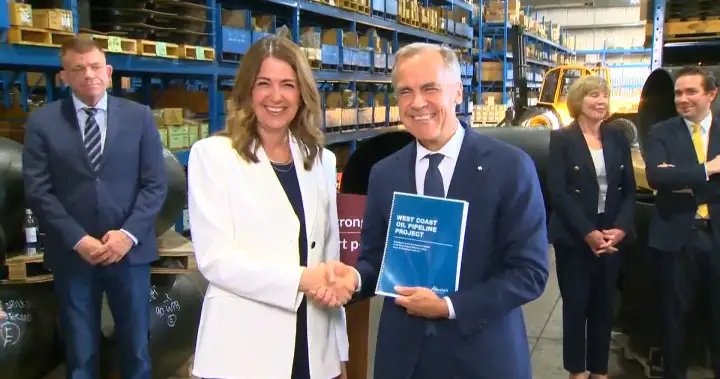
Alberta’s pitch to the major projects office for a new oil pipeline to the West Coast is being billed as a public-private partnership, though its current structure skews almost entirely toward the public end of the spectrum.

Ninety per cent of the proposal would be in the hands of provincial and federal Crown corporations — at least in the beginning.
Energy infrastructure company Pembina Pipeline Corp. would be a minority partner.
Here is a rundown of what each entity does and what they bring to the table:
Prime Minister Mark Carney and Alberta Premier Danielle Smith pose with a copy of the proposal for a new oil pipeline from Alberta to B.C. after it was presented Thursday to the federal government’s “Major Projects” office.
Global News
Trans Mountain Corp.
The new pipeline would have a familiar builder and route.
It would largely follow the path of the existing Trans Mountain pipeline that runs from the Edmonton area to the B.C. Lower Mainland. Trans Mountain Corp., a federal Crown corporation, would be its developer, builder and operator.
The proposal for the new pipeline would see it following the same route to the west coast as the existing Trans Mountain pipeline.
Source: Government of Alberta
The Trans Mountain pipeline has been delivering Alberta crude to southwestern B.C. since the 1950s.
Its former owner, U.S. company Kinder Morgan, proposed an expansion in 2012 to almost triple its capacity to 890,000 barrels per day.
As costs ballooned and the project got snarled in court delays, Kinder Morgan walked away.
The federal government bought the pipeline for $4.5 billion in 2018 to see the expansion through to completion.
The project ended up costing $34 billion, a stark increase from its 2017 estimate of $7.4 billion.
An aerial view of one of the staging areas used for construction of the Trans Mountain Pipeline that was completed in the spring of 2024, at an estimated cost of $34.2 billion.
File Photo
Trans Mountain is a subsidiary of the Canada Development Investment Corp., which answers to Parliament.

Get weekly money news
Get expert insights, Q&A on markets, housing, inflation, and personal finance information delivered to you every Saturday.
The Trans Mountain expansion started up in May 2024, and is now operating at full capacity.
Since that time, the corporation has returned $2.2 billion to its owner, the Canadian government, in the form of interest and dividends.
The price oilsands producers receive for their heavy crude has also risen as their product is now able to now reach Asian markets in meaningful volumes.
Plans are underway to further expand Trans Mountain to almost 1.2 million barrels per day through additional pump stations, chemical additives and some new pipe.
The proposal before the major projects office would “integrate really well with our legacy pipeline,” Trans Mountain chief executive Mark Maki said.
“Same corridor, you can use some of the same people, the same systems,” he said. “All of the stuff that we have already built becomes very, very useful to the new pipeline.”
Alberta Petroleum Marketing Commission
The commission is the “business arm” of Alberta’s energy department, said Richard Masson, a former head of the provincial Crown corporation.
A stake in a new pipeline falls within its mandate to “try to do things that are in the interest of Albertans as the owner of the resource,” he said.
The APMC has a history of committing barrels to early-stage pipeline projects, like the Trans Mountain expansion and Enbridge’s Line 9 revamp in Ontario and Quebec several years ago.
It also committed volumes to the defunct cross-Canada Energy East proposal put forward by TransCanada Corp., now TC Energy.
Up until now, APMC’s biggest and most complicated investment was a deal to supply bitumen to a refinery north of Edmonton.
“This is a big step. There’s no question about it,” Masson said of the West Coast pipeline plan. “APMC has never done anything like this before.”

Pembina Pipeline
Pembina’s core business is natural gas gathering, processing and transport in Western Canada.
It is also constructing the Cedar liquefied natural gas plant and export terminal in northern B.C. alongside the Haisla Nation.
Pembina brings “capital discipline” and “operating expertise” to the pipeline partnership, Prime Minister Mark Carney said Thursday. “And that enriches it.”
In 2021, Pembina formed a 50-50 partnership with a coalition of First Nations and Métis communities to buy Trans Mountain, though the federal government has signaled it has no plans to put the asset up for sale any time soon.
In the meantime, under a “non-binding heads of agreement,” Pembina is to hold a 10 per cent interest in the new West Coast project during construction with the opportunity to double its stake once the pipeline starts up.
It said its role would be “complementing, rather than replacing” Trans Mountain as the project’s lead partner.
Crude oil tankers SFL Sabine, left, and Tarbet Spirit are seen docked at the Trans Mountain Westridge Marine Terminal, where crude oil from the expanded Trans Mountain Pipeline is loaded onto tankers, in Burnaby, B.C., Monday, June 10, 2024.
THE CANADIAN PRESS/Darryl Dyck
“The project represents a once-in-a-generation opportunity to advance nation-building energy infrastructure that strengthens Canada’s economy and expands access to global markets for Canadian energy,” said Scott Burrows, Pembina’s chief executive.
“Our participation will be evaluated through the same disciplined lens we apply to every capital decision.
We have approached our involvement in a way that is measured, that preserves our financial flexibility and that incorporates meaningful protections — so that any participation remains consistent with our financial guardrails and creates durable value for our shareholders.”
There is one area where Pembina’s established core business would intersect with a new bitumen pipeline, Masson noted.
In order for thick, tarry bitumen to flow through pipelines, it needs to be diluted with liquids that come as a byproduct of natural gas production.
Pembina has plants where the liquids — often referred to as condensate or diluent — are separated out of the gas that comes out of the ground.
With all of the oilsands pipeline expansion on the books, the sector is short on those liquids, Masson said.
“If we’re going to do all this, we have to more than double the amount of diluent produced in Canada, which is huge.”
Indigenous partners
The Alberta government says Indigenous equity partnership and consultation will be an “essential part” of the project, with the provincial and federal governments both saying they will “facilitate opportunities” for communities to invest through their respective Indigenous loan agencies.
But Masson doesn’t see Indigenous groups coming on board until the pipeline starts generating steady cash flow.