dailynewsnblog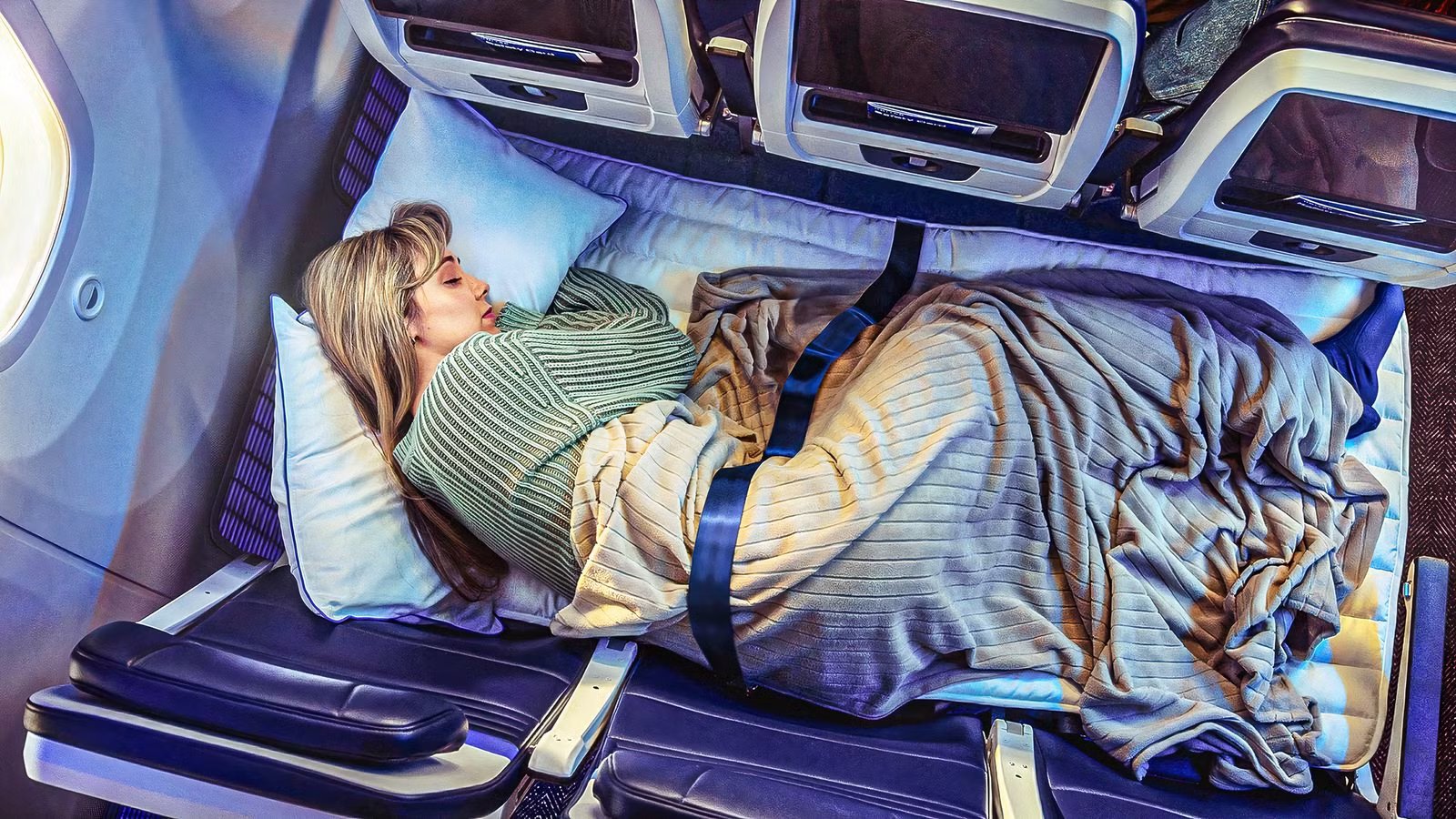
 United Airlines’ Relax Row will emerge as a data-driven compromise between standard economy class and premium cabin in 2027, turning unsold seats into a sleep-focused product on long-haul routes like
  Newark Liberty International Airport (EWR) –
  London Heathrow Airport (LHR) and San Francisco–Singapore. By offering a full row of three economy seats, paired with bedding accessories such as a mattress cushion and eye mask, the airline delivers a measurable increase in usable rest space without redesigning the cabin. Pricing, often positioned in the low hundreds of dollars above base economy fares—far below Premium Plus tickets that can exceed $1,000 on transpacific routes—signals a deliberate push to monetize empty inventory while targeting sleep as the primary passenger need. For US-based travelers and United’s hub network, this directly impacts overnight flight choices and upgrade strategies.
Starting from United’s official product documentation, recent fare tracking data, and comparative analysis with products like Air New Zealand’s Skycouch, this article breaks down the concept across four key factors: onboard comfort, pricing dynamics, competitive positioning, and broader airline revenue strategy. Based on reporting from industry analysts and aviation publications, it examines how Relax Row fits into the growing trend of unbundled cabin experiences and why it matters for transatlantic and transpacific passengers. The sections below outline how the product works, how it compares to Premium Plus and Polaris, and what it signals about the future of economy-class travel.
United Airlines’ Relax Row Is Designed Around Empty Economy Space

United’s Relax Row concept is built on a surprisingly simple idea. Instead of redesigning aircraft cabins with entirely new seats, the airline reserves a full row of economy seats and converts it into a resting area by using bedding accessories and extending the foot space. Passengers essentially gain access to three connected economy seats, allowing them to stretch out during overnight flights. The carrier positions the product as a middle ground between standard economy and more expensive premium cabins.
According to the airline’s official product page, Relax Row includes a mattress cushion, blanket, pillow, and eye mask, along with access to the entire row for one traveler. The concept is currently targeted primarily at overnight long-haul services where sleep quality becomes one of the most important factors in passenger satisfaction. While the arrangement does not provide a true lie-flat business-class bed, it creates significantly more sleeping space than a standard economy seat recline.
What makes the product especially notable is how it leverages unused inventory. Airlines often depart with partially empty economy cabins on certain long-haul routes, particularly during off-peak travel periods. Relax Row allows United to monetize those otherwise unsold seats while simultaneously offering passengers an upgraded onboard experience. In many ways, it reflects the broader airline industry trend toward unbundled comfort products that sit between traditional cabin classes.
How Relax Row Pricing Compares With Premium Economy Tickets

The most fascinating part of the Relax Row rollout is its pricing structure. Unlike Premium Plus fares, which are generally purchased during booking, Relax Row is often offered closer to departure as an ancillary upgrade. As detailed in the previous Simple Flying’s analysis, the cost can vary significantly depending on route demand, seasonality, and remaining seat inventory.
On some long-haul routes, we could see Relax Row upgrades priced in the low hundreds of dollars above a standard economy fare. In contrast, Premium Plus tickets on the same flights sometimes carried fare differences approaching or exceeding four figures. That creates an interesting calculation for travelers who primarily care about sleep rather than enhanced meal service, priority boarding, or additional baggage allowances.
|
Product |
Typical Upgrade Structure |
Key Comfort Benefit |
Major Limitation |
|
United Relax Row |
Add-on upgrade after booking |
Full row to stretch out and sleep |
No dedicated premium seat or extra service |
|
United Premium Plus |
Separate premium economy fare class |
Larger reclining seat with enhanced amenities |
Higher fare difference on some routes |
|
United Polaris |
Business-class fare or upgrade |
True lie-flat suite experience |
Substantially more expensive |
Passengers also need to consider what is included beyond sleeping space. Premium Plus offers wider seats, greater recline, upgraded dining, amenity kits, and enhanced airport privileges on many routes. Relax Row focuses almost entirely on onboard rest. For travelers who already hold elite status or travel light, that trade-off may be perfectly acceptable. Others may still prefer the broader premium economy package despite the higher price.

The Air New Zealand Aircraft That Feature A Cozy Skycouch In Economy
Find the best option for you to fly along Air New Zealand long-haul routes.
Why Relax Row Feels Similar To Air New Zealand’s Skycouch

United’s new product has inevitably drawn comparisons to another well-known economy-sleeping concept: Air New Zealand’s Skycouch . Introduced more than a decade ago, the Skycouch converts a row of economy seats into a couch-like surface using adjustable leg rests. As explored in Simple Flying’s coverage of Skycouch-equipped aircraft, the product has become one of the airline’s signature long-haul innovations.
The similarities between the two concepts are clear. Both products target travelers who cannot justify the cost of business class but still want meaningful rest on ultra-long-haul flights. Both also rely on existing economy seating infrastructure rather than requiring entirely new cabin layouts. However, the implementation differs substantially. Air New Zealand’s Skycouch is integrated into specially designed seat structures, while United’s Relax Row appears more modular, relying on standard seating combined with special bedding accessories.
Frequent flyers discussing the concept on Reddit often note that Relax Row may appeal most strongly to solo travelers, whereas Skycouch has historically attracted couples and families traveling with children. Air New Zealand markets the product as a flexible social and sleeping space, particularly useful for parents traveling long distances with young passengers. United’s version, by contrast, is focused more narrowly on individual rest.
There is also a competitive dimension to the comparison. Airlines worldwide continue searching for ways to differentiate economy cabins without sacrificing too many seats, as, for example, All Nippon Airways with its Couchii feature. Premium economy has also become extremely profitable for carriers, but a sizable gap remains between standard economy and true premium products. Concepts like Relax Row, Skycouch, and Couchii attempt to monetize comfort without permanently shrinking cabin density.
The Real Value Depends On Route Length And Passenger Priorities

Whether Relax Row is worth the money depends heavily on the specific route involved and how passengers personally value comfort. A seven-hour overnight crossing from Newark to London is a very different proposition from a 15-hour Pacific sector between  San Francisco International Airport and Singapore Changi Airport. On ultra-long-haul flights, the ability to stretch out horizontally can significantly reduce fatigue on arrival, especially for travelers heading directly into meetings or connecting itineraries. According to United’s official Relax Row page, the product is specifically designed for long-haul international flights where sleep becomes one of the most valuable onboard commodities.
Pricing is where the comparison with Premium Plus becomes especially interesting. United has not yet published a fixed global price chart for Relax Row, but multiple industry analysts suggest the carrier intends to position it well below United Polaris and generally below Premium Plus pricing on many routes. Points Travel Pro noted that Relax Row may appeal most strongly to couples and families because it isolates the sleep benefit without charging for the broader premium cabin experience. At the same time, examples of United Premium Plus fares on routes such as Chicago–Tokyo and San Francisco–Singapore have shown premium economy pricing regularly climbing above $1,200 to $3,000 roundtrip, depending on seasonality and availability.
Economy fares on the same routes were often hundreds, rather than thousands, of dollars cheaper. For example, fare tracking discussed by Siyatra showed San Francisco–Singapore Premium Plus tickets ranging from roughly $1,060 to $3,000, while standard economy seats on the same flights could range from approximately $474 to $800, depending on travel dates. Industry observers, therefore, expect Relax Row upgrades to land somewhere between those two price bands rather than approaching Polaris-level pricing. Additional reporting from Roaming Cactus suggested United intends Relax Row to feel “far lower than Premium Plus” while still monetizing otherwise unsold economy inventory.
Passengers who prioritize sleep may therefore see Relax Row as a smarter compromise than Premium Plus. Premium Plus certainly delivers wider seats, additional recline, upgraded catering, and airport benefits, but it still leaves travelers seated upright throughout the flight. Relax Row instead focuses almost entirely on one thing: allowing passengers to lie down more naturally. For overnight transatlantic flights , that difference could be marginal. On ultra-long-haul Pacific routes exceeding 12 or 14 hours, however, the ability to sleep horizontally may become more valuable than upgraded meals or lounge access. That distinction is exactly what makes Relax Row such an intriguing addition to United’s long-haul strategy.

Sky-High Luxury: Inside United Airlines’ Premium-Fitted Boeing 767s
The airline currently operates 37 Boeing 767-300ERs, of which 24 have a premium heavy configuration.
United Airlines Is Experimenting With A New Revenue Model

Beyond passenger comfort, Relax Row represents something larger within airline economics. For decades, airlines segmented cabins into relatively rigid categories: economy, premium economy, business, and first class. Increasingly, carriers are moving toward dynamic micro-products that allow travelers to customize the experience through ancillary purchases, as already highlighted by Simple Flying.
Relax Row fits neatly into that strategy. Instead of leaving empty economy seats unsold, United can package them as a premium sleep product. This mirrors broader trends across the industry, where airlines now monetize everything from extra legroom and lounge access to onboard WiFi subscriptions and upgraded dining.
The modern airline cabin is becoming less about fixed class distinctions and more about layered comfort options. There is also evidence that travelers are becoming more selective about where they spend money during flights. Some passengers are willing to sacrifice airport perks or premium meals if they can improve sleep quality. Others may prioritize seat width, lounge access, or priority services instead. Relax Row essentially isolates one of the most valuable aspects of business class, which is the ability to rest more comfortably, and offers a simplified version at a lower price point.
This strategy could become especially important as airlines face pressure to maximize profitability without alienating economy passengers. Adding more permanent premium economy seats reduces the aircraft’s total capacity. Flexible concepts like Relax Row allow airlines to respond dynamically to demand patterns while keeping cabins adaptable.
Could Relax Row Change The Future Of Economy Travel?

One of the most interesting questions surrounding Relax Row is whether it signals a broader transformation in economy-class expectations. Long-haul passengers today are increasingly aware of comfort differences among airlines, especially as social media and aviation review channels expose travelers to more cabin product options than ever before.
Historically, true onboard sleep was treated as an exclusive business-class privilege. Premium economy improved legroom and service, but it rarely solved the core problem of sleeping upright. Products like these challenge that assumption by attempting to democratize horizontal rest at lower price points. Even if the experience falls short of a lie-flat suite, it may still represent a meaningful improvement for travelers who otherwise could never justify Polaris fares.
The long-term success of Relax Row will likely depend on consistency and pricing transparency. If passengers regularly discover that the upgrade costs nearly as much as Premium Plus, the value proposition weakens considerably. On the other hand, if travelers can reliably secure the product for a few hundred dollars above economy fares on overnight routes, it could become one of the most attractive comfort upgrades in long-haul aviation.
There is also the possibility that competitors will respond with similar concepts. Airlines have already shown growing interest in modular cabin solutions, sleep pods, and hybrid seating products. United’s experiment may therefore be less about one specific product and more about testing how passengers value customizable rest options within economy cabins.