dailynewsnblog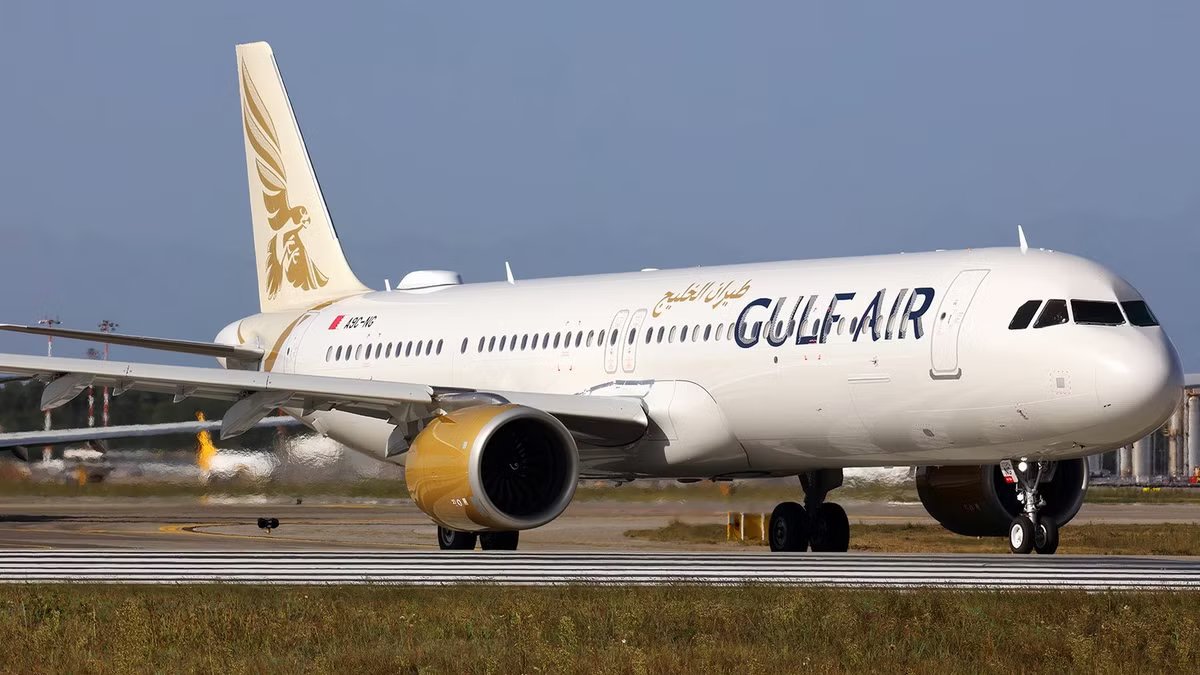
Gulf Air is the flag carrier of the small Gulf state of Bahrain and is based at Bahrain International Airport (BAH), the only commercial airport in the country. However, it is also in a region where it has to compete with much larger and better-known rival airlines. Gulf Air CEO Martin Gauss told Simple Flying at the Farnborough Airshow how the airline is planning to compete with its much larger neighbors that include Qatar’s Qatar Airways, the UAE’s Emirates and Etihad, and Saudi Arabia’s Saudia and Riyadh Air.
Gauss said that Gulf Air’s strategy is to be a signature premium connector. As the CEO explained, “signature premium connector does not necessarily mean boutique because a boutique is, for me, a boutique is a bit too small. I don’t like that word.” I can personally agree with that statement, having flown with Gulf Air from Tbilisi in Georgia to New Delhi in India via Bahrain in 2017.
Gulf Air Believes It Has A Prominent Name

Speaking to Simple Flying at Farnborough, Martin Gauss said of Gulf Air that “it’s a global airline based in Bahrain, connecting places like Shanghai to New York. So it has 76 years of legacy. The name is very prominent. It stands for exclusivity, service, long-haul flying, but it is also the connectivity provider for the Kingdom of Bahrain.”
This makes it considerably older than some of its larger regional counterparts. For example, Qatar Airways was established in 1993 (launched operations in 1994), and Dubai’s Emirates was established in 1985, with Abu Dhabi’s Etihad following in 2003. Saudia is one of the oldest, having been established in 1945 following the historic gift of a DC-3 Dakota by US President Franklin D. Roosevelt. Meanwhile, Saudi Arabia’s Riyadh Air is still working up, having been established in 2023.
As explained below, Gulf Air occupies a sort of middle ground between small airlines and large airlines. Something similar applies to its name and brand. While the airline may not command the international recognition that Emirates and Qatar Airways do, it is not an obscure brand either. The airline is continually improving its offerings. For example, it is currently rolling out high-speed Starlink in-flight WiFi across its fleet. The airline is in the process of more than doubling its widebody long-haul fleet.
From Car To Gate In Ten Minutes

One of the top advantages that Gauss believes the airline has is how easy it is for passengers to go from their hotels to the airplane. The smaller size of the airport also makes it easier and faster for passengers to navigate. Unlike some airports that are located far away from the city, or where passengers need to wrangle with heavy traffic, the airport is located inside the city of Muharraq and adjacent to the capital city of Manama, connected by bridges. Gauss notes:
“We have as a unique asset, something which you can’t copy in the region, that is an airport where you can go in 10 minutes from the car to the gate, if you’re flying in premium, but even in economy, it’s the fastest airport to get from the city into the aircraft. We have a minimum connecting time of 40 minutes, which you cannot replicate at any of the other airports because of the size and because of the way the airport is built and our operation.“
He then explained that the airline’s strategy is to be a signature premium connector for the Gulf with the headquarters in Bahrain. It has also leaned on “Bahraini hospitality, by upgrading our premium product.”
Gulf Air works to provide a leading in-flight service as well as excellent lounges. Speaking of its in-flight meals, Gulf Air says that “our chefs have crafted a selection of dishes using fresh, local ingredients to provide you with a delightful culinary experience. Savour flavours inspired by our home, the Middle East and destinations across our expanding network.“
A Signature Connector Airline

The CEO went on to tell Simple Flying that he doesn’t like to call the airline a boutique airline as it feels it makes the airline seem too small and it isn’t “what we do.” The airline is not so small. Gauss said that the airline is “a signature premium connector for the Gulf.” He explained that an airline can’t be a small boutique airline and still connect  New York JFK Airport with Shanghai, as “that’s not boutique.”
He carried on, saying that it also doesn’t “make sense to say we are a very big boutique [carrier].” Affirming the airline’s marketing strategy, Martin Gauss explained that “therefore, we said we’re gonna be a signature premium connector for the Gulf and important, very important, connecting and ensuring the connectivity for the Kingdom of Bahrain.”
He added that “we’re gonna increase the points to and from Bahrain, because this is our home and this is our home.” Finally, Gauss explained that the airline doesn’t want to be looking at the neighboring states like Dubai or Qatar and just copy them. He said the airline “wants to be [representative of] the Kingdom of Bahrain” and ensure connectivity with hospitality as a signature premium connector.
Gulf Air’s Network

While Gulf Air does fly to New York JFK three times a week with its  Boeing 787-9s, this is its only destination in the United States and, indeed, North America as a whole. Other notable long-haul routes include Shanghai, Guangzhou, Manila, Moscow, Singapore, Bangkok, Nairobi, and Casablanca.
It flies to various destinations in Europe, especially Western Europe. These include Manchester, London Heathrow, and London Gatwick in the United Kingdom, as well as destinations in Germany, France, Switzerland, Italy, and Spain. After these routes, Gulf Air’s network can largely be broken up into regional flights around the Middle East and the mostly migrant labor flights to South Asia.
Flights to South Asia include Dhaka in Bangladesh, Colombo in Sri Lanka, Karachi, Lahore, and Islamabad in Pakistan, and around eight destinations in India, most of which are in southern India (apart from the important New Delhi route). Its leisure flights to the Maldives also technically serve South Asia. These flights appear to be served with Airbus A320 family aircraft and operate as fifth freedom flights to Sri Lanka.
Gulf Air’s Fleet

According to Planespotters.net, Gulf Air has a fleet of 47 mainline airliners, which are an average of 7.6 years old. These are made up of 17 A320s (eight A320ceos and nine A320neos), twenty A321s (four A321ceos and 16 A321neos), and ten Boeing 787-9 Dreamliners. Five of its existing Dreamliners were delivered in 2018, two more followed in 2019, and the other three were delivered in 2023. The airline has another four Airbus A320neos on order along with another two Airbus A321neos.
Its largest outstanding order is for more Boeing 787-9 Dreamliners: Boeing’s records show that it has unfulfilled orders for 17. This gives Gulf Air one of the smaller, but not the smallest, fleets in the region. It is about typical or larger than the typical size for other states in the region (excluding Saudi Arabia, Qatar, and the UAE).
Gulf Air fleet (per Planespotters.net) | Number in service | Number on order |
|---|---|---|
Airbus A320ceo | 8 | |
Airbus A320neo | 9 | 4 |
Airbus A321ceo | 4 | |
Airbus A321neo | 16 | 2 |
Boeing 787-9 Dreamliner | 10 | 17 |
For example, Oman Air has a fleet of 33 aircraft, comprising 24 narrowbody Boeing 737s and nine Boeing 787-9s (with five more on order). Royal Jordanian Airlines has a fleet of 40 mainline aircraft, including eight Boeing 787 Dreamliners (five more on order), with the remaining aircraft being A320-family narrowbodies and Embraer regional jets. Kuwait Airlines has a fleet of 32 aircraft with ten Boeing 777-300ERs, six A330s, one A340, and the remaining being Airbus narrowbodies.
Gulf Air Is Economy-Heavy But Considering Premium

Gulf Air’s fleet of Boeing 787-9s is configured with seating for up to 282 passengers and includes two classes. This is within the advertised 250-325 typical two-class seating capacity of the Boeing 787-9 by Boeing. However, it is also higher density than some other mainline carriers configure these aircraft. For example, British Airways configures its Boeing 787-9s with around 215 seats across a four-class layout (first class, business class, premium economy, and economy).
Gulf Air’s 787-9’s Falcon Gold Cabin (business class) is fitted with 26 seats offering 80–90″ of seat pitch. They also offer in-flight WiFi, have 22″ touch screens, and recline into flatbed seats. The economy cabin has 256 seats with 32″ of seat pitch. The touchscreen is 11.6.” This is a surprisingly economy-heavy configuration for a higher quality airline.
For example, BA configures its Dreamliners with eight first class seats, 38 business class seats, 39 premium economy seats, and 130 economy seats. However, this may soon change. On previous occasions, CEO Martin Gauss has said the airline is actively evaluating the addition of a dedicated premium economy cabin as part of the airline’s broader fleet and product strategy updates. With that being said, no formal rollout date has been set, and no confirmed cabin installation plan has been finalized.