dailynewsnblog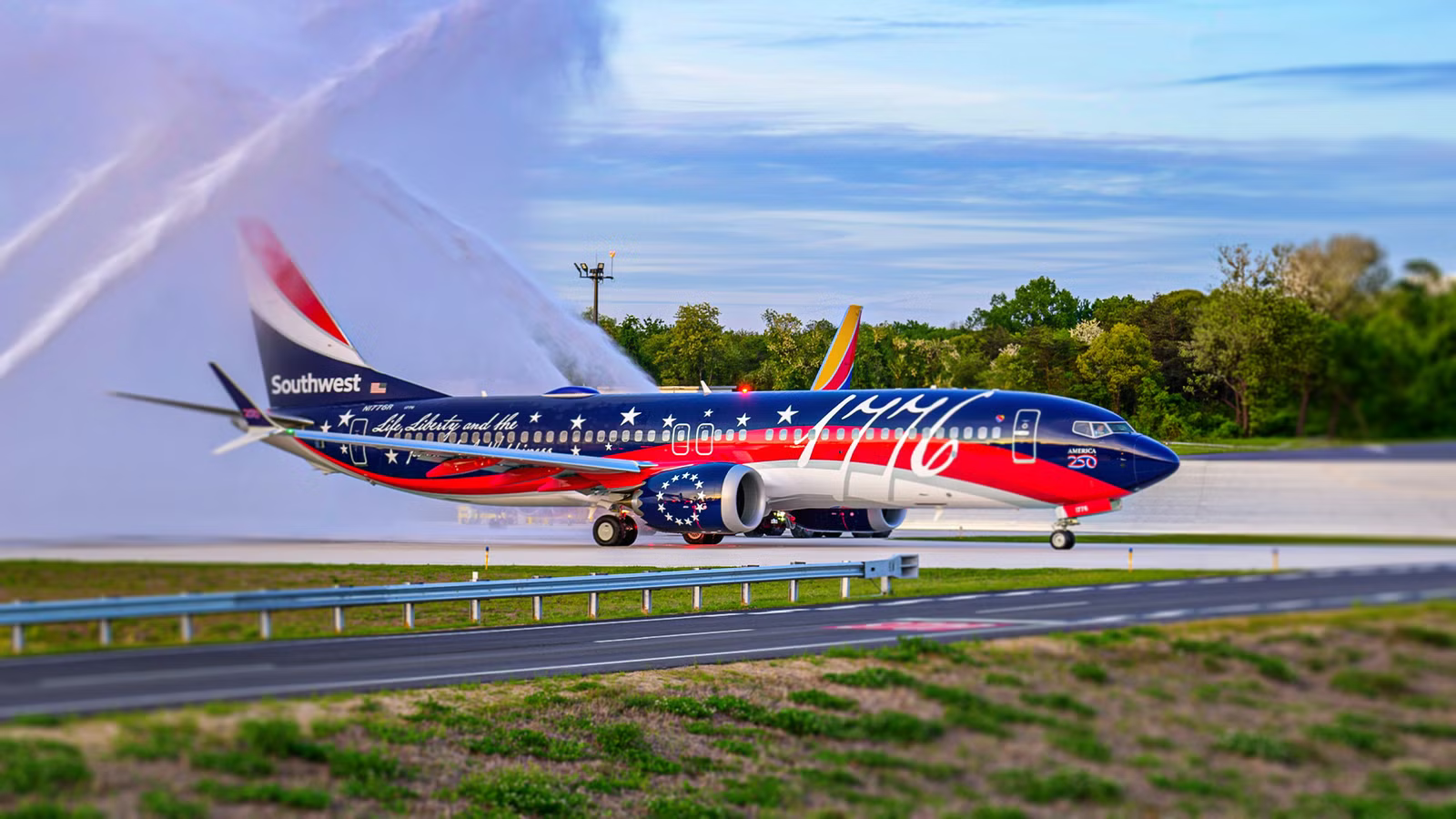
America’s 250th anniversary may have been centered on July 4 with fireworks and parades. However, some of its most visible celebrations are still moving across the country in the sky, and we are not talking about the airshows (but we will mention special aircraft that you can see there).
Rather, we are talking about special liveries: specially marked aircraft from  Southwest Airlines,
  United Airlines,
  American Airlines, and other carriers are being worked into normal schedules that everyone can take. For aviation enthusiasts and planespotters, that creates a different kind of treasure hunt.
The aircraft have individual registrations, but their schedules can change rapidly, meaning knowing where one has been is not necessarily enough to know where it will appear next. So where have the most prominent America 250 aircraft actually flown, which airports offer the best chances of seeing them, and where can you board one?
America 250 Has Become A Flying Flag

The easiest aircraft to identify is Southwest Airlines’ Independence One, a Boeing 737 MAX 8 registered N1776R. The aircraft was unveiled in April as part of Southwest’s partnership with America250 and entered service on April 29 with a particularly symbolic first flight from Dallas Love Field (DAL) to  Philadelphia International Airport(PHL).
Southwest packed the aircraft with references to the nation’s founding, including a giant ‘1776’ in quill-style script, 13 stars representing the original colonies, and wording from the Declaration of Independence. Since then, however, N1776R has behaved much more like a normal Southwest aircraft than a ceremonial showpiece.
FlightAware’s history shows the 737 visiting airports including Chicago Midway (MDW), Sacramento, Palm Springs, Oakland, Denver, Pittsburgh, Baltimore, Austin, Orlando, New Orleans, and Philadelphia. Its July schedule also included a stop at the EAA AirVenture Airshow at Oshkosh, Wisconsin, putting the aircraft in front of one of the world’s largest gatherings of aviation enthusiasts. That broad deployment is important because it means there is no single ‘Independence One route’ to chase.
On August 8, FlightAware’s schedule had N1776R to operate Denver-Seattle, Seattle-Sacramento and Sacramento-Santa Ana, before continuing onward to Denver. The following day’s schedule included Santa Ana-Denver-San Antonio-St. Louis-Las Vegas. In other words, West Coast spotters have a particularly good chance of encountering the aircraft at present, but the next question is whether the same strategy applies to United’s much longer-ranging special livery.
United’s Stars And Stripes Goes Global

United Airlines took a very different approach, putting its Stars and Stripes design on two aircraft: Boeing 787-10 N91007 and Boeing 737-800 N78285. Both aircraft were painted at International Aerospace Coatings’ facility in Amarillo, Texas. Each aircraft also carries a commemorative plaque recognizing United’s active-duty service members and veterans. The difference between the two aircraft is particularly useful for spotters.
N78285 is a narrowbody aircraft designed for United’s domestic and shorter international network, while N91007 is a 787-10 capable of appearing on long-haul routes. In its first days of revenue service, N78285 visited Chicago, West Palm Beach and New York before moving through international destinations in Mexico. It has subsequently been seen at places as varied as Columbus, Reno, Houston, Denver, Portland, San Francisco and Toronto.
N91007 offers an even more interesting chase. FlightAware records show the aircraft operating between Chicago and São Paulo, Honolulu and Chicago, Chicago and Tokyo, Tokyo and Los Angeles. It then had a series of transatlantic services from Chicago and Newark to European destinations including Paris, Rome, Lisbon, Athens and Brussels. More recently, the aircraft has been particularly active flying between Newark and Los Angeles.
The United 787 is probably the best option for enthusiasts hoping to combine an America 250 sighting with international aviation. A passenger flying through Newark, Chicago or Los Angeles has a realistic chance of encountering N91007, while the 737’s wider domestic network gives travelers elsewhere in the United States more opportunities.
American’s America250 Aircraft Are Hiding In Plain Sight

American Airlines‘ America250 celebration is particularly interesting because the airline is simultaneously marking its own centennial year. The carrier announced that two aircraft would receive the official America250 treatment, and the first was an Embraer E175 operated by Envoy Air, registered as N341MB.
It was unveiled at  Dallas/Fort Worth International Airport(DFW) before flying to
  Miami International Airport (MIA) and then operating American’s inaugural Miami-Caracas service on April 30. N341MB subsequently settled into the sort of regional network that makes it both easy and difficult to find.
Flight-tracking records show it working extensively through DFW, visiting cities including Monroe, Missoula, Gainesville, Panama City, Garden City, Oklahoma City, Fort Wayne, Little Rock, Albuquerque, Billings, Brownsville, Lafayette, Springfield and Nashville. In July, its schedule also included Chicago, Toronto, Madison, Rapid City, Fargo and numerous smaller regional airports.
The second aircraft is the Boeing 737-800 N840NN, which gives American’s anniversary campaign a much larger footprint. Its recent schedule has taken it through Dallas/Fort Worth, Chicago, Philadelphia, Miami, Los Angeles, Raleigh-Durham, San Francisco, Phoenix, Austin, New York and several international destinations.
FlightAware’s August schedule showed the aircraft moving between Miami, New York, Charlotte, Chicago, Houston and Calgary, demonstrating how quickly a special-livery sighting can move from one side of the network to another. For American, this matters more than usual. N341MB can disappear into the regional network for a day, while N840NN can move from a transcontinental sector to a Caribbean or Latin American service.
More Stars & Stripes Are In The Air

Southwest and United may have the most recognizable America 250 aircraft, but the celebration extends well beyond the carriers with dedicated full-body liveries.  Delta Air Lines has added an America250 decal to one of its Boeing 757-200s, while
  Alaska Airlines has placed America250 markings on four of its existing ‘Honoring Those Who Serve’ aircraft.
JetBlue has similarly incorporated the celebration into its Vets in Blue aircraft, giving passengers additional opportunities to encounter patriotic markings without the aircraft necessarily being a dedicated America250 special livery. The celebration has also reached NASA‘s research fleet.
Catch what other trackers miss
Emergency squawks, holds, NOTAMs — live signals, no signup.
Open tracker
Catch what other trackers miss
Emergency squawks, holds, NOTAMs — live signals, no signup.
Open tracker
Indeed, NASA Armstrong’s F-15 and F/A-18 were given fresh red, white, and blue paint schemes, adding two highly unusual aircraft to the list of America 250 aircraft worth watching. The aircraft were photographed at International Aerospace Coatings in Spokane, Washington, on July 2 before making their way toward Washington, D.C., where the F/A-18 participated in the July 4 flyover over the National Mall, as NASA documented on their Freedom 250 appearance.
The NASA aircraft are particularly appropriate additions because they are not simply ceremonial jets. Rather, the F-15s and F/A-18s form part of NASA Armstrong’s research fleet at Edwards, California, where aircraft are used to investigate new technologies and support flight-test programs. The F/A-18, for example, has a long history of supporting NASA research and chase operations, while the F-15 has been used for experimental aeronautics research.
This makes the Freedom 250 paint scheme a celebration of America’s aviation and aerospace heritage as much as its history. NASA has taken the connection one step further with the X-59, its experimental quiet-supersonic aircraft. The unique aircraft received a Freedom 250 logo on its engine and tail, providing a distinctly futuristic addition to the anniversary fleet.
The X-59 is the centerpiece of NASA’s Quesst mission, which is investigating whether future supersonic aircraft could fly over land while producing a quieter sonic ‘thump’ instead of the disruptive sonic booms traditionally associated with supersonic flight. NASA’s Quesst program makes the X-59 one of the most technologically significant aircraft carrying an America 250 connection.
|
Operator |
Aircraft |
Registration / Aircraft |
Anniversary Treatment |
Where To Spot It |
|---|---|---|---|---|
|
Southwest Airlines |
Boeing 737 MAX 8 |
N1776R – Independence One |
Full red, white and blue America250 livery |
Southwest’s nationwide network, particularly major hubs such as Dallas, Denver, Chicago and Baltimore |
|
United Airlines |
Boeing 787-10 |
N91007 – Stars and Stripes |
Full Stars and Stripes livery |
Newark, Chicago, Los Angeles and United’s international network |
|
United Airlines |
Boeing 737-800 |
N78285 – Stars and Stripes |
Full Stars and Stripes livery |
Major United hubs and domestic and international routes |
|
American Airlines |
Boeing 737-800 |
N840NN – American 100 Anniversary |
American 100 and America 250 commemorative markings |
Dallas Fort Worth, Miami, Chicago, Philadelphia and other major hubs |
|
Envoy Air / American Eagle |
Embraer E175 |
N341MB – America250 |
America250 commemorative livery |
Dallas Fort Worth and American Eagle’s regional network |
|
Delta Air Lines |
Boeing 757-200 |
N553NW – Ship 5653 |
America250 decal added to existing aircraft |
Delta’s major US hubs and domestic network |
|
Alaska Airlines |
Boeing 737 |
Four Honoring Those Who Serve aircraft |
America250 decals added to existing four patriotic liveries |
Alaska’s US network |
|
JetBlue |
Airbus A320 |
N775JB – Vets in Blue aircraft |
America250 markings incorporated into military-themed livery |
JetBlue’s domestic network |
|
NASA Armstrong |
F-15 |
Research aircraft |
Red, white and blue Freedom 250 paint scheme |
NASA Armstrong, airshows and special appearances |
|
NASA Armstrong |
F/A-18 |
Research aircraft |
Red, white and blue Freedom 250 paint scheme |
NASA Armstrong, airshows and special events |
|
NASA |
X-59 |
Experimental supersonic aircraft |
Freedom 250 logo on engine and tail |
NASA research flights and Quesst test operations |
The variety is what makes the 250th anniversary particularly interesting for aviation enthusiasts. A commercial aircraft can be followed through its normal passenger schedule, while NASA’s research aircraft are much more dependent on testing programs, airshows and special appearances.
Together, however, they demonstrate how broadly the anniversary has been incorporated into America’s aviation landscape. That also means there is no single airport that guarantees a sighting. The best opportunities depend on whether the goal is to find a dedicated airline livery, a subtler anniversary decal, or one of NASA’s much rarer research aircraft.