dailynewsnblog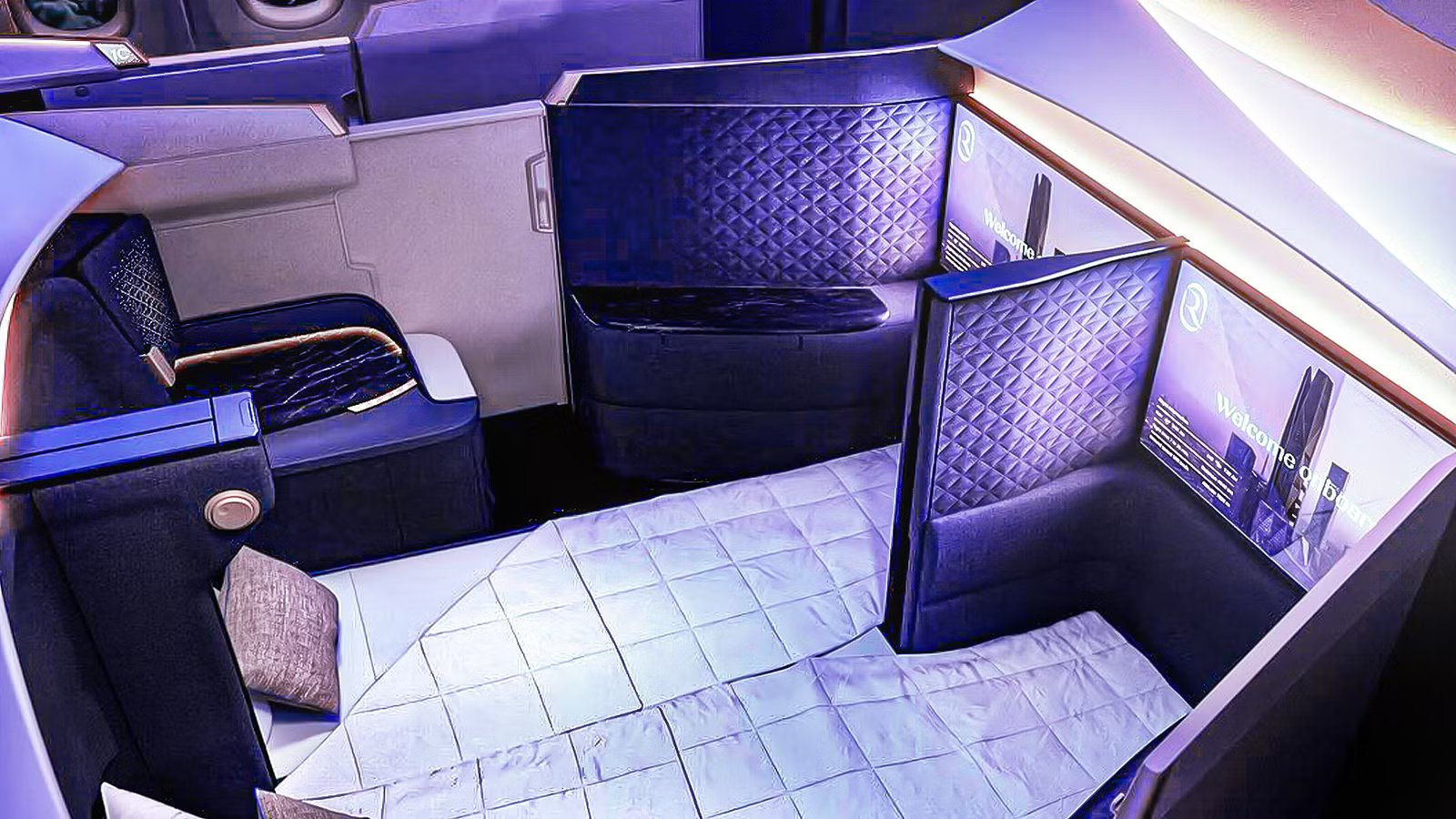
Which airline’s premium economy has best-in-class screens and one notable gap? Of course, it’s  Riyadh Airwith its massive screens and questionable lavatory arrangement. Its premium economy leads with genuinely best-in-class technology while delivering seat dimensions that are merely industry-standard, creating a product that’s revolutionary above the armrest and ordinary below it.
The airline has configured 39 Premium Economy seats in a 2-3-2 layout on its Boeing 787-9 fleet using Recaro PL3530 seats with privacy headrest wings, shared cocktail trays, 19.2-inch seat width, and 38-inch pitch. The cabin features 15.6-inch 4K OLED screens, Bluetooth audio streaming, and four USB-C power outlets per seat, with PriestmanGoode’s design incorporating a “canopy twist” motif and veined marble-effect cocktail tables.
A notable gap in the product is the lack of dedicated premium economy lavatories, with passengers sharing facilities with the economy cabin. This enters a premium economy market where established carriers like Cathay Pacific, Japan Airlines, and Air New Zealand have set increasingly high standards. This article explores Riyadh cabin design in more detail.
Riyadh Air’s Strategy

Riyadh Air is a major component of Saudi Vision 2030, a strategy to diversify Saudi Arabia’s economy away from oil and establish the country as a global transport and tourism hub. Aviation and tourism are therefore quite central to Vision 2030. The country is targeting tourism to contribute over 10% of GDP by the end of the decade. Fully owned by the Public Investment Fund (PIF), the flag carrier aims to connect Riyadh to more than 100 destinations by 2030 while supporting the creation of over 200,000 jobs worldwide. SA also aims to reach 300 million annual air passengers by 2030, including 100 million tourists. These goals are a little ambitious, considering that Saudi Arabia handled an estimated 107 million passengers in 2023, according to AOG, and current geopolitical instability in the Middle East may further complicate growth.
Riyadh Air’s premium-focused strategy reflects Saudi Arabia’s intention to compete directly with established Gulf carriers such as Emirates and Qatar Airways. Although delivery delays have pushed the launch of commercial operations towards late 2025 or 2026, the airline has already begun invite-only demonstration flights to refine onboard service standards and test systems such as the Euphony audio platform (a system integrating high-fidelity speakers and Cabin Noise Compensation). The airline has positioned itself as a luxury carrier since launch, aiming to redefine premium travel through technological integration and culturally relevant design.
A key part of this strategy is Riyadh Air’s premium economy product. CEO Tony Douglas described the cabin as a “business-minus” category, combining upgraded seating, service, and soft product standards to create an experience closer to business class than to traditional premium economy. The Boeing 787-9 premium economy cabin now features 39 seats arranged in a standard 2-3-2 configuration across six rows. The paired window seats are designed particularly for couples, while the spacious layout caters to passengers seeking greater comfort without the cost of business class travel.
Standard Premium Economy Dimensions

Riyadh Air’s premium economy cabin is designed to offer a comfortable long-haul experience, with seats that recline and feature an expandable leg rest for added relaxation. We can all agree that the seat defines the entire flight experience. Therefore, the airline has opted for Recaro PL3530 seats.
In terms of dimensions, Riyadh Air’s premium economy seats offer a 38-inch (96.5 cm) pitch and 19.2-inch (48.7 cm) width, placing them broadly in line with industry standards for Boeing 787 premium economy cabins. Virgin Atlantic, for example, provides a wider 21-inch (53.3 cm) seat while maintaining the same 38-inch (96.5 cm) pitch, typically in a similar 2-3-2 or 2-4-2 configuration depending on the aircraft. Cathay Pacific’s premium economy seats measure 20 inches (50.8 cm) wide, while Qantas offers an even slightly wider 20.5-inch (52.1 cm) seat on its Boeing 787 fleet.
Catch what other flight trackers miss
Emergency squawks, holds, NOTAMs — live signals, no signup.
Open tracker
Catch what other flight trackers miss
Emergency squawks, holds, NOTAMs — live signals, no signup.
Open tracker
Across the industry, the 19-20 inch wide seat has effectively become the benchmark for premium economy. Most airlines create premium economy by removing one seat per row from a standard economy layout, resulting in eight seats per row on aircraft such as the Boeing 787. Going significantly beyond the 21-inch (53.3 cm) mark would usually require airlines to remove an additional seat per row, something that is often difficult to justify financially in a mid-tier cabin product. As a result, Riyadh Air’s seat dimensions may not be industry-leading, but they remain very much in line with what passengers now expect from a modern premium economy experience.
Rather than focusing solely on extra seat width or pitch, Riyadh Air appears to be differentiating its premium economy product through thoughtful comfort features, modern cabin styling, and a strong emphasis on technology and entertainment.

6 Airlines With The World’s Widest Premium Economy Seats In 2026
More space, better meals, and none of the business class price tag — but only if you know which airline to book.
Added Privacy Wings

Riyadh Air is also attempting to distinguish its premium economy product through small but significant design enhancements. The airline’s seats now include privacy headrest wings, a feature designed to improve passenger comfort and create a greater sense of personal space during long-haul flights. This is particularly notable because Emirates chose not to include the same feature despite using the identical seat model.
By incorporating privacy wings, Riyadh Air is signaling a stronger emphasis on passenger comfort and exclusivity within premium economy. The decision reflects the airline’s broader strategy of positioning its premium economy cabin closer to the “business-minus” experience rather than a conventional intermediate product.
Massive 4K OLED Screens

One area where Riyadh Air is clearly trying to stand out is technology. The airline placed a major focus on the digital passenger experience when designing its Boeing 787-9 premium economy cabin, aiming to create a product that feels modern and future-focused rather than simply comfortable.
Every premium economy seat features a massive 15.6-inch 4K OLED entertainment screen, making it one of the largest displays offered in premium economy by any airline. The high-resolution screens are paired with Bluetooth audio streaming, allowing passengers to connect their own wireless headphones instead of relying on traditional wired options.
Riyadh Air also offers fast complimentary WiFi for travelers enrolled in its forthcoming frequent flyer program, adding another premium touch for long-haul passengers who want to stay connected throughout the flight.
Power and charging have also been carefully considered. Each premium economy seat includes four USB-C power outlets, along with additional USB connectivity options designed to support high-speed charging for modern devices. Interestingly, Riyadh Air has chosen not to include wireless charging pads, a feature increasingly seen on newer airline seats. Instead, the airline has prioritized fast and reliable wired charging, recognizing that many travelers still find wireless charging too slow for power-hungry smartphones, tablets, and laptops.
The decision also aligns with Saudi Arabia’s wider push towards universal USB-C charging standards by 2025. By focusing on high-performance wired connectivity, Riyadh Air appears to be prioritizing practicality and future-proofing over trend-driven cabin additions.
Is Starlink About to Replace Seatback Screens Forever?
Not every airline will eliminate seatback screens entirely, but some may see a clear opportunity to reduce reliance on traditional IFE.
PriestmanGoode Cabin Design

Beyond the technology and seating, Riyadh Air is also placing significant emphasis on design. The airline has worked closely with London-based design studio PriestmanGoode to create an interior that feels distinctly Saudi while still delivering a contemporary premium experience.
According to the airline, the cabin design draws deeply from Saudi Arabia’s cultural and historic roots, blending heritage-inspired elements with modern luxury. Rather than adopting the generic neutral tones often seen in airline cabins, Riyadh Air has developed a bold and carefully curated color palette that helps the aircraft stand out from competitors in the region.
Lighting plays a major role in shaping the atmosphere onboard, helping highlight the rich textures and finishes used throughout the cabin. In the premium cabins, mocha gold and veined stone accents contrast elegantly with deep purple surfaces, creating a sophisticated, almost boutique-hotel feel. The broader palette includes dark indigo, mocha, iridescent shades, skyline blue, sunset peach, and lavender tones. These colors are intended to reflect both the identity of Riyadh and the warmth of Saudi hospitality.
One of the most distinctive design elements is the “canopy twist” motif integrated throughout the premium cabin. Developed by PriestmanGoode, the sculptural pattern takes inspiration from the geometric architecture of Riyadh’s King Abdullah Financial District, where futuristic skyscrapers blend with traditional design influences. The motif has been built directly into the seat shells and cabin monuments, creating a cohesive visual identity across the aircraft interior.
Overall, Riyadh Air appears to have struck an impressive balance between cultural identity and modern luxury. The result is a premium economy cabin that feels visually distinctive rather than simply functional.
One Notable Gap

This premium economy cabin seems to have it all. However, there is one notable drawback: the lack of dedicated lavatories. The 39 premium economy passengers have to share facilities with the main economy cabin, likely leading to longer queues for travelers paying a premium fare.
As comfortable and well-equipped as the seats are, waiting in line for the restroom detracts from the overall experience. Unfortunately, this is not unique to Riyadh Air; Qantas’ Boeing 787 premium economy cabin faces a similar issue. Still, despite this inconvenience, Riyadh Air’s Boeing 787-9 premium economy looks like a very strong overall product.