dailynewsnblog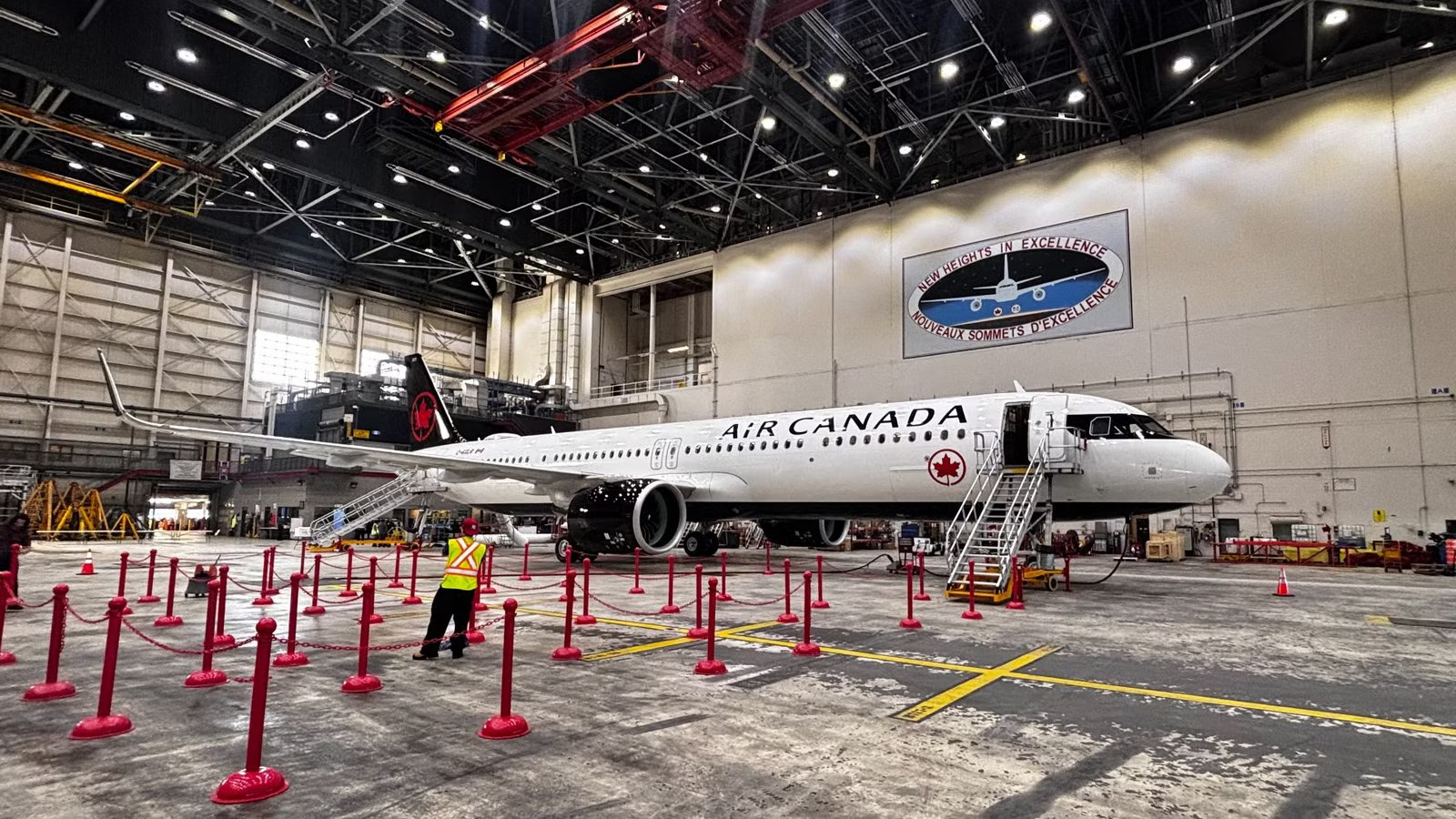
 Air Canada became the first operator in the country of the Airbus A321XLR when it took delivery of its first example on April 24th in Hamburg, Germany. Slated to begin service in June, 29 more are expected to join the fleet, and the airline has an option for ten more as well, according to Flight Global.
The jet is the first narrowbody in the airline to have lie-flat Signature Class seats. The inaugural route for the newest addition to the AC fleet will connect Montreal International to Palma de Mallorca, just in time for the Summer Rush.
An All-New Single-Aisle Airliner Experience At Air Canada

The first jet to be delivered, tail number C-GXLR, is one of 15 to be leased from SMBC Aviation Capital. The other 15 are being purchased directly from Airbus, while Air Canada retains the possibility of increasing that order to 25 total. All of these jets will be powered by Pratt & Whitney PW1100G turbofans, which combined with advanced aerodynamics and composite materials gives the jets 30% lower fuel burn and a range of 4,700 nautical miles (8,700 km).
The exceptional range and efficiency of these planes is complemented by the Airbus airspace interior designed to emulate a premium widebody atmosphere in the cabin. Full LED ambient mood lighting continuously adjusts spectrum tones to match time zones on a ten-hour flight, easing transitions for flyers. The entryways and cabin monuments incorporate warm architectural finishes, complete with a signature maple leaf motif.
Looking beyond the style and interior design, the Airbus A321XLR eliminates the typical fatigue of long-haul flying on smaller airliners. The functional improvements to cabin equipment have made radical improvements to air quality, humidity, sound suppression, and usable space inside the airspace cabin. Mark Galardo, Executive Vice President and Chief Commercial Officer, and President of Cargo at Air Canada, made this remark in the official press release:
“Air Canada is building one of the most modern and capable fleets in the industry…this game-changing aircraft will shortly be deployed across the Atlantic from Montréal and Toronto, while also becoming a staple [in transcontinental] markets.”
AC De-Risks The Cost Of Flying To Offer Customers More Destinations

While Air Canada does fly the Boeing 787 Dreamliner on long and thin international routes, which are very similar to what the mission will be for the A321XLR, it is a full-size widebody jet and comes with more risk, as the operating costs are significantly higher. It is far safer financially for AC to use this small number of A321 XLR jets to service variable, seasonal destinations like those in Europe that are very popular during the surge months like summer.
The A321XLR features just 182 seats with 14 Signature Class and 168 Economy. Air Canada’s baseline Boeing 787-8 configuration holds 255 seats, while the larger 787-9 holds 298. Flying a 787 means Air Canada must sell close to 300 tickets per flight to cover massive operating costs. A 787 runs the risk of potentially capturing too few premium passengers on these routes out of season, but the XLR can reliably make a steady profit on lower-volume traffic.
Finally Delivered: Air Canada’s 1st Airbus A321XLR Leaves Hamburg Bound For Home
Air Canada’s first Airbus A321XLR will open new long-haul narrowbody routes from North America to Europe.
New Tech Makes Every Flight Better AC’s New A321XLR

Engine roar and wind resistance fatigue the brain over long distances, but the P&W GTF engines use newly designed fan cowlings to cut that down on the outside. Inside the jet, Airbus packed extra acoustic insulation blankets behind the sidewall panels, specifically near the new Rear Center Tank and the galley areas, dropping cabin ambient noise levels well below those of legacy airplanes.
The A321XLR’s overhead architecture is flatter and higher, creating a vertical clearance that mimics the open, airy feeling of a widebody twin-aisle jet. The interior walls are also contoured to taper outward at shoulder height, granting passengers an extra inch of personal space alongside wider window frames. Overhead luggage space is increased by 60%, and every seat gets a 13-inch 4K OLED entertainment screen paired with a dual-folding tray table featuring an integrated tablet holder.
Airbus uses specialized zone-drying and active moisture-injection systems to maintain higher relative humidity levels. The cabin air recycling system completely renews the entire cabin air volume every 2 to 3 minutes, trapping 99.97% of airborne particles. This prevents dry eyes, throat irritation, and dehydration on a transatlantic flight.
Catch what other trackers miss
Emergency squawks, holds, NOTAMs — live signals, no signup.
Open tracker
Catch what other trackers miss
Emergency squawks, holds, NOTAMs — live signals, no signup.
Open tracker