dailynewsnblog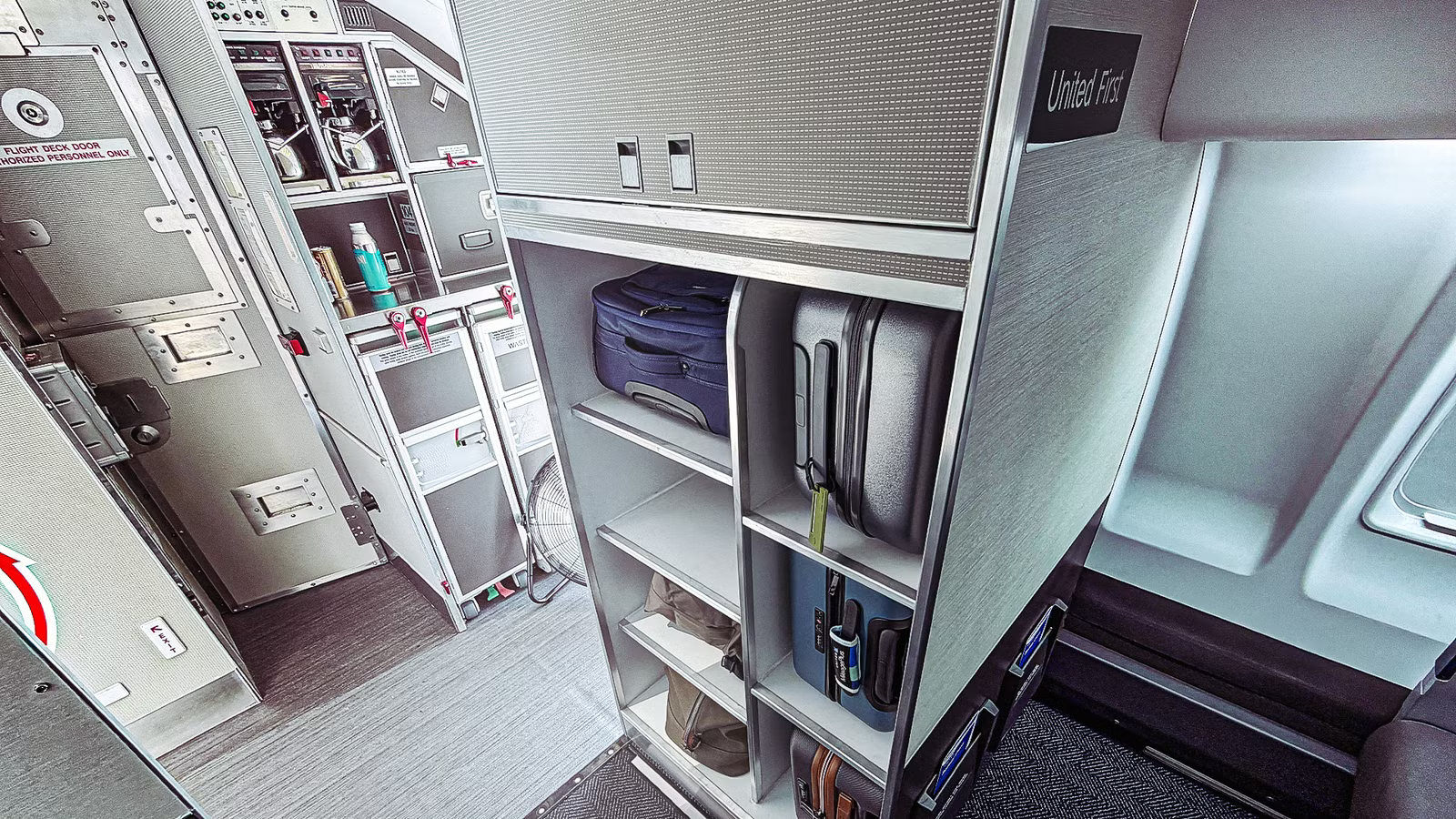
 United Airlines is taking some of its regional aircraft and giving them an unusually premium makeover. The airline is converting 50-seat Bombardier CRJ200 aircraft operated by SkyWest Airlines into 41-seat CRJ450s, with seven United First seats, 16 Economy Plus seats, 18 standard Economy seats, and Starlink Wi-Fi. The most noticeable change, however, is not the seats or connectivity, but what some passengers will find above them – nothing.
Instead of traditional overhead lockers in First Class, the Bombardier CRJ450 has a full-height luggage closet near the boarding door, with seven dedicated spaces for larger carry-on bags. The  Star Alliance carrier has presented the change as part of a more open, private jet-like First Class experience, but the luggage closet also reveals something more practical about the economics of the aircraft. The real goal is not simply to make First Class look better; it is to protect premium passengers from one of the biggest problems on small regional aircraft while accepting that Economy passengers will still face a shortage of overhead space. Let’s take a closer look…
The CRJ200 Needed A New Purpose

The Bombardier CRJ200 has had a long and difficult life in US regional aviation, and its small cabin was never especially friendly to modern carry-on luggage. Although the aircraft was designed around a 50-seat configuration, its overhead lockers are notoriously restrictive, meaning standard trolley bags generally cannot be accommodated in the same way they can on larger aircraft like the Boeing 737 or Airbus A320. That has made gate-checking a routine part of flying on the type, particularly when passengers arrive with larger carry-ons.
United Airlines is now trying to make those aircraft useful for a different market rather than simply retiring them. The CRJ450 removes nine seats from the original 50-seat layout and replaces the all-Economy configuration with seven First Class seats and 34 Economy seats, including Economy Plus. The result is an aircraft that is smaller in capacity but considerably more valuable from a premium-revenue perspective, following the strategy United Airlines previously used with the CRJ550.
That distinction matters because the aircraft does not need to solve every problem for every passenger to be commercially useful. United Airlines is effectively taking scarce cabin volume and deciding where it can produce the greatest improvement in the customer experience. Seven First Class passengers represent a small group, but those passengers are also the travelers United Airlines most wants to keep happy, particularly on routes connecting smaller communities with major hubs such as  Denver International Airport (DEN) and
  Chicago O’Hare International Airport (ORD).
Why Remove First Class Overhead Lockers?

At first glance, removing overhead lockers from First Class appears to make little sense, because passengers still need somewhere to put their luggage. The CRJ450’s answer is to move that luggage out of the ceiling and into a dedicated closet positioned near the front boarding area. The closet has seven spaces capable of holding larger carry-on bags, effectively creating enough space for one trolley case for every First Class passenger.
The seven-bag calculation is the key to understanding the design. United Airlines is not trying to create a giant luggage room that solves the entire aircraft’s storage problem; it is creating a controlled storage area precisely matched to the seven premium seats. By removing the overhead lockers, United Airlines gains visual openness in the cabin, eliminates the bulky structures hanging over passengers, and gives First Class a noticeably different appearance from the cramped CRJ200 interior. The latest data from ch-aviation shows that SkyWest Airlines currently operates a total of 498 aircraft, as outlined in the table below:
Aircraft | Number In Fleet | Number On Order |
|---|---|---|
Bombardier CRJ200 | 69 | – |
Bombardier CRJ450 | – | 50 |
Bombardier CRJ550 | 40 | 29 |
Bombardier CRJ700 | 83 | – |
Bombardier CRJ900 | 36 | – |
Embraer 175 | 270 | 69 |
There is also a subtle operational advantage. Because the closet is located close to the aircraft door, passengers can put their larger carry-ons away before moving deeper into the cabin, rather than competing for limited overhead space above their seats. The design therefore turns luggage storage into part of the premium cabin product, while also allowing United Airlines to claim that its smallest regional aircraft offers an experience more reminiscent of a larger premium cabin. The airline itself describes the configuration as being designed to evoke a private-jet feeling.
What About The Other Passengers?

The problem with calling the closet a complete solution to gate-checking is that the numbers do not support that idea. There are seven First Class seats and seven dedicated trolley case positions, so the closet can theoretically protect every First Class passenger from having a standard larger carry-on sent to the aircraft hold. That is a very neat solution, but it solves the luggage problem for exactly the seven passengers who have the strongest reason to expect preferential treatment.
Behind those seven seats, however, the Bombardier CRJ450 has 34 Economy passengers. United Airlines is giving that cabin larger overhead lockers, and the redesign allows standard trolley cases to be loaded sideways, something the original CRJ200 overhead lockers generally could not accommodate. That is a substantial improvement because it turns previously unusable carry-on capacity into practical storage, but the overhead lockers still do not contain enough space for every Economy passenger to bring a trolley case onboard.
In other words, the aircraft’s luggage equation remains uneven. First Class gets exactly enough dedicated storage for its entire passenger population, while Economy gets more useful storage but still has to rely on gate-checking when demand exceeds capacity. That may be entirely intentional. United Airlines can improve the Economy experience substantially without spending the space required to provide a guaranteed overhead position for all 34 passengers, while simultaneously creating a very visible distinction between the premium and non-premium cabins.
A Premium Cabin Built Around Scarcity

The unusual luggage arrangement also makes more sense when the Bombardier CRJ450’s seat count is considered. United Airlines is giving up nine seats compared to the standard CRJ200, and those missing seats represent physical space that can be redistributed around the cabin. Seven of those spaces effectively become First Class seats, while the remaining cabin is divided into 16 Economy Plus and 18 standard Economy seats. The aircraft therefore sacrifices capacity in exchange for a more valuable passenger mix.
The luggage closet is one part of that larger strategy. Rather than treating every inch of the CRJ200 as something that must be filled with seats or storage, United Airlines is using the space to make the front cabin feel less crowded. On a jet as small as the CRJ200, even a relatively modest change can be obvious because passengers are sitting immediately beside the aircraft’s walls and low ceiling, making conventional overhead lockers feel particularly intrusive.
This is also why the private-jet comparison should be understood as a marketing concept rather than a literal description of the aircraft. The Bombardier CRJ450 remains a narrow regional jet with seven First Class recliner seats, but removing the overhead lockers changes the visual proportions of the cabin.
Economy Still Has A Gate-Check Problem

For Economy passengers, the Bombardier CRJ450 is nevertheless a meaningful improvement over the aircraft it replaces. The enlarged overhead lockers can accommodate full-size trolley cases when they are positioned sideways, giving passengers a realistic place to store bags that previously would have been sent to the gate-check process almost automatically. That change should reduce the number of bags that have to be tagged at the gate, even if it cannot eliminate the problem altogether.
The important limitation is that sideways loading uses more horizontal overhead locker space than simply placing bags lengthwise in a larger locker. United Airlines can therefore fit substantially more useful luggage than before without creating enough capacity for every passenger. Some Economy passengers will still need to gate-check bags, particularly when a large percentage of travelers arrive with full-size carry-ons.
That creates an interesting contrast within the same aircraft. A First Class passenger has a dedicated seven-bag closet that effectively guarantees space for a trolley case, while an Economy passenger can board with a perfectly acceptable carry-on and still discover that there is no room left overhead. From a passenger’s perspective, that may seem backwards if the advertised benefit of the closet is described simply as solving gate-checking, but from an airline perspective, it is a rational allocation of limited space toward the highest-value cabin.
The CRJ450 Has Not Reached The Finish Line

There is another reason the luggage closet should not yet be treated as the final word on the Bombardier CRJ450: the aircraft remains part of an ongoing certification and modification program. SkyWest Airlines has advised that the conversion from CRJ200 to CRJ450 would take a couple of weeks, with multiple aircraft being handled at a time, and the company expects the aircraft to begin operating for United Airlines in fall 2026. More than 50 CRJ450s are expected to be in service by 2028, while SkyWest Airlines has also discussed a larger potential CRJ450 fleet across its operations.
Catch what other flight trackers miss
Emergency squawks, holds, NOTAMs — live signals, no signup.
Open tracker
Catch what other flight trackers miss
Emergency squawks, holds, NOTAMs — live signals, no signup.
Open tracker
As of September 2026, however, the Supplemental Type Certificate required for the new interior had not yet been granted by the Federal Aviation Administration. That certification is an important step because the CRJ450 involves modifications to the existing CRJ200 configuration, including the new seating arrangement and luggage-storage installation. The first modified aircraft can therefore serve as a demonstration and certification platform without necessarily representing the configuration passengers will immediately encounter in scheduled service.
That distinction became particularly noticeable after reports indicated that the aircraft used for the media presentation had subsequently returned to the original CRJ200 interior. Such a reversal can look dramatic from the outside, but returning a prototype aircraft to its previous configuration while certification work continues is not inherently unusual. The more important question is when the approved CRJ450 interior will enter regular service, because that is when the seven-bag closet, larger Economy overhead lockers, premium seating, and Starlink connectivity will finally be tested against the realities of everyday regional flying.