dailynewsnblog
A frenetic tale of two realities, both alike in dysfunction, which immerses the player in servitude and struggle.
After first hearing about Roman Sands Re:Build, and following along with bits of its development over the last few years, it’s been a real ride getting to sit down with it; the demo from a couple years ago gave us a glimpse at both of the game’s very different acts, a contrast that I initially misunderstood as a moving continuously back-and-forth between two realities situation (it’s not). Fast forward to last night: almost fourteen hours in, Re:Build is already cementing itself in my head as one of those unclassifiable experiences that defies neat or sensible analysis and certainly isn’t the sort of game that, in an ideal world, should be scored. (The “Re:Build” appendage is to distinguish this game from 2019’s Roman Sands, its first iteration that was reportedly not quite cooked yet.)
Re:Build is a tonal whiplash in game form: the first act is a fiendish immersive sim drenched in a vaporwave glitchcore palette, and the second is a slow, plodding journey through what I can only describe as Evangelion survival purgatory (I am not well-versed in Eva, but know enough about it to recognise its hallmarks and signature aesthetics). Both acts prod at the abject madness it takes to stay alive, and both are set in fractured realities beset by time loops. By “staying alive,” I don’t mean the basics of breathing and eating, or the general duty of parenting or caregiving, but the great chaotic ballet of service, sacrifice, and maintenance that goes into keeping life as a whole going (in Singapore, we call a lot of this stuff “sai kang” – Hokkien for “shit work”). Everything is stylish as hell and the intro video goes so hard I fear that the game may not live up to the vibes, which are currently orbiting us somewhere in space.
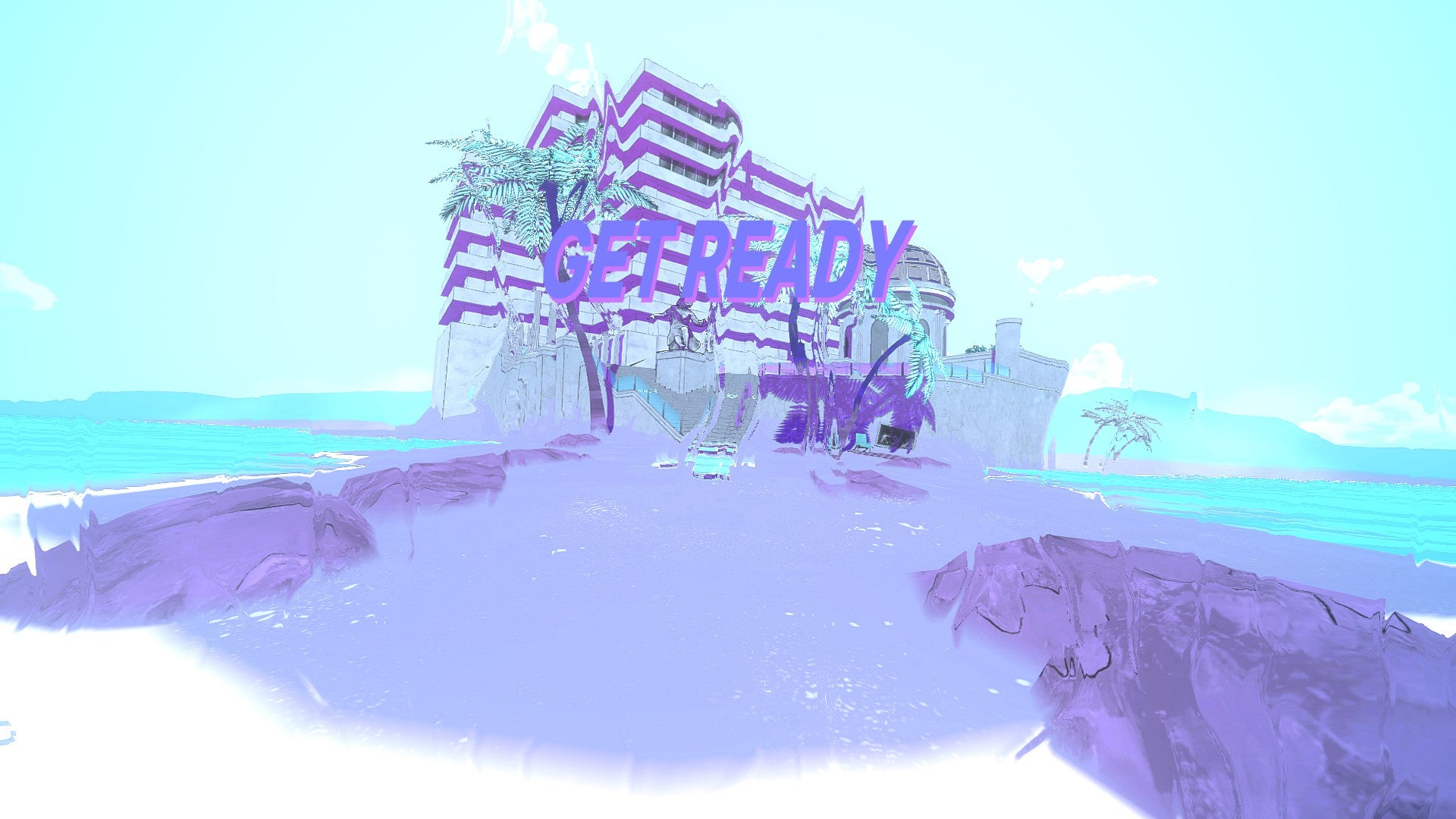
In Act One, the player washes up on the beach of a cursed resort, where each day their sole purpose is to please its four miserable residents in increasingly optimised ways. A lot of it is indentured-servant bullshit devoid of dignity: cleaning up vomit, fetching trinkets, giving massages to joyless hags, and so on. Every day is part of a hellish sunbleached cycle, and depending on the changes and discoveries made around the resort each day, offers a slightly more optimised route to keep these awful people happy. Each morning I emerge from the waves, and each day my body becomes a machine devoted to the fine art of meeting and anticipating the master’s needs; in the evening, I return to the ocean, where my performance is evaluated. Did I mention the frighteningly engorged sun hanging in the sky, poised to deliver our annihilation?
I will always admire an imsim that commits not just to pushing the player over the edge, but getting a willing player to run screaming toward the precipice all on their own. Re:Build’s first act is a masterclass in doing exactly that, if you have the constitution and mental resilience for the (brilliantly designed) busywork. I’ve had my share of service jobs, and owned-and-operated a couple of brick-and-mortar businesses that occasionally involved picking up human faeces (not part of the job description). Re:Build expertly reproduces a very specific sort of service work – the endless layers of exploitation and mental gymnastics, the gradual feeling of lulling yourself into a speedy productive rhythm, the poisoned high of performing the most banal, demeaning tasks for people who couldn’t care if you were alive or dead.
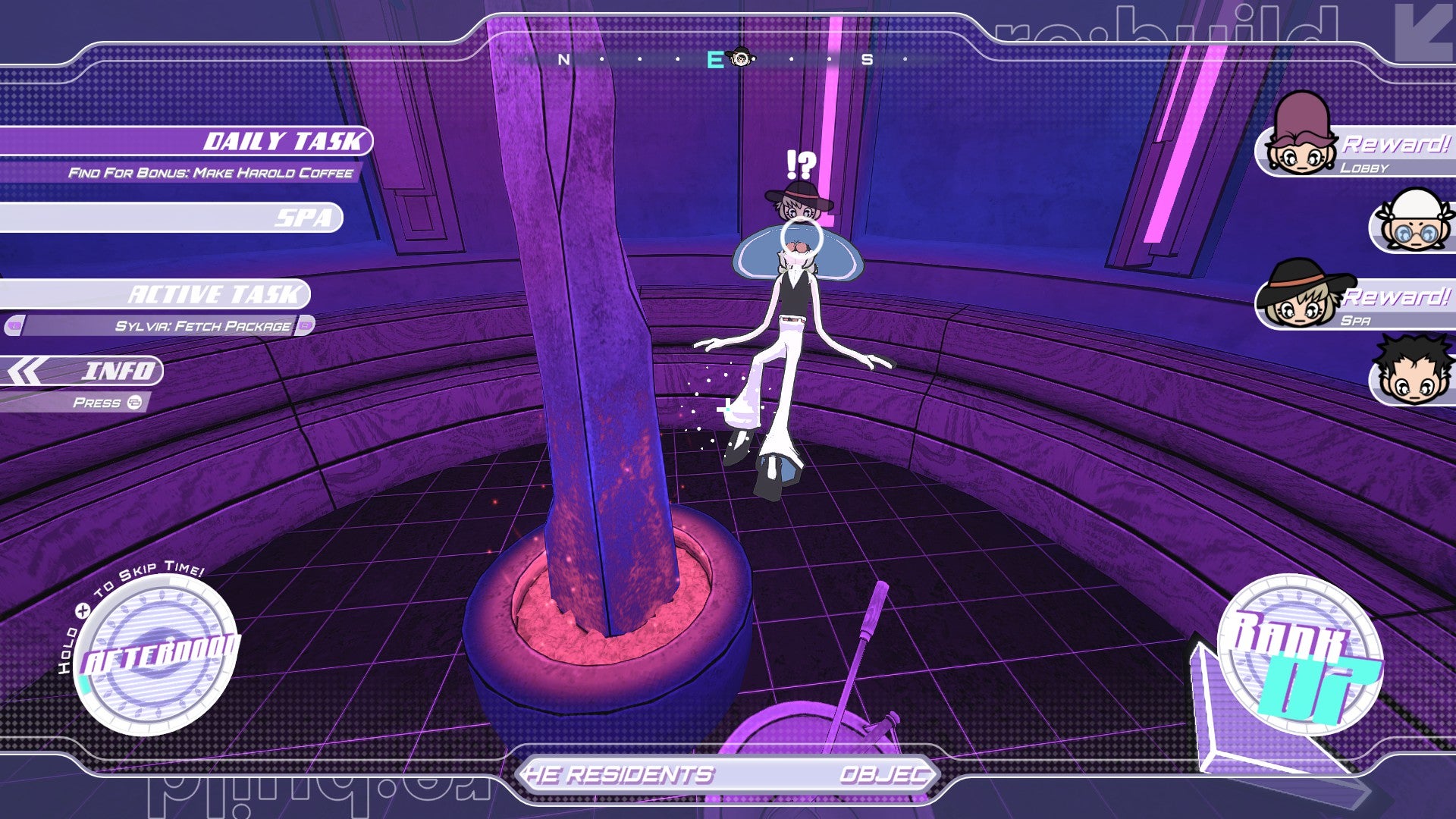
Video games and capitalism prepared me well for this moment; there is nothing like chasing the stupid high of checking off silly little tasks for little to no reward (it’s all mostly cosmetics and gacha, and occasionally a key item to move the story along). Every time I move between areas eats up a block of precious time, and the residents move around to different locations as the day goes on. I develop pathetic, affectionate pity for Bunk, the pervy writer who spends all day getting tanked, throwing up, and hitting on Sylvia; the latter is an evasive manipulative sort who would almost certainly find a way to make the trolley problem worse. Betty and Harold are the old couple from hell, a two-headed moral justification for euthanasia.
And then I meet Kara, my mysterious chain-smoking coworker who actually knows what the island is – we’re trapped, apparently, in the decaying dream of an angel – and how to set ourselves free. I spend almost six hours ranking up to level 31+ in Act One, chugging along even when I become braindead and frustrated, promising myself that the next day will be better, that I’ll finally complete the puzzles I’m working on between making negronis and fetching towels. The thing is, I have all the tools I need at this point, but committing myself to a real solution is to leave behind my toxic but familiar little miseries.
Oh right, the puzzles. You almost forget you’re there to get off the damn island before the sun goes sideways. There are three big ones to solve around the resort, sort of in the tradition of Myst, and a couple of them are trickier than they look; there’s no overt signposting for the solutions besides common sense (for instance, it’s pretty easy to see a link between the orrery in the courtyard, and another similar planetary display inside the resort) or trial-and-error shenanigans. Depending how distracted you get by the residents’ parasitical need for your attention, the puzzles can be solved pretty easily once you have all the requisite items. At times, the UI design wasn’t as clear as it could be, and doing the orrery puzzle on a controller was nightmarish (it was fine once I switched to the keyboard and mouse).
My biggest pain point is Act Two, when we get to the real sad-sack heart of Re:Build: my cow has died, and I have to move around her dead body and stare at her lifeless face while I get my bearings. I’ve just woken up in some kind of sealed, failing zoological research station, and there’s a parasite on board interfering with critical systems. Kara is here too (or at least, someone who looks just like her and knows me), talking to me over some kind of communication network, but she isn’t wildly helpful, and I have to move around the station managing oxygen flow so that I can handle the aforementioned parasite before I share the same fate as my poor cow. After Act One, the atmosphere here is a bit like ducking underwater into thick, oppressive isolation – just the sound of my footsteps and the station’s creaky sounds of protest as I cluelessly try to poke at various valves and gears.
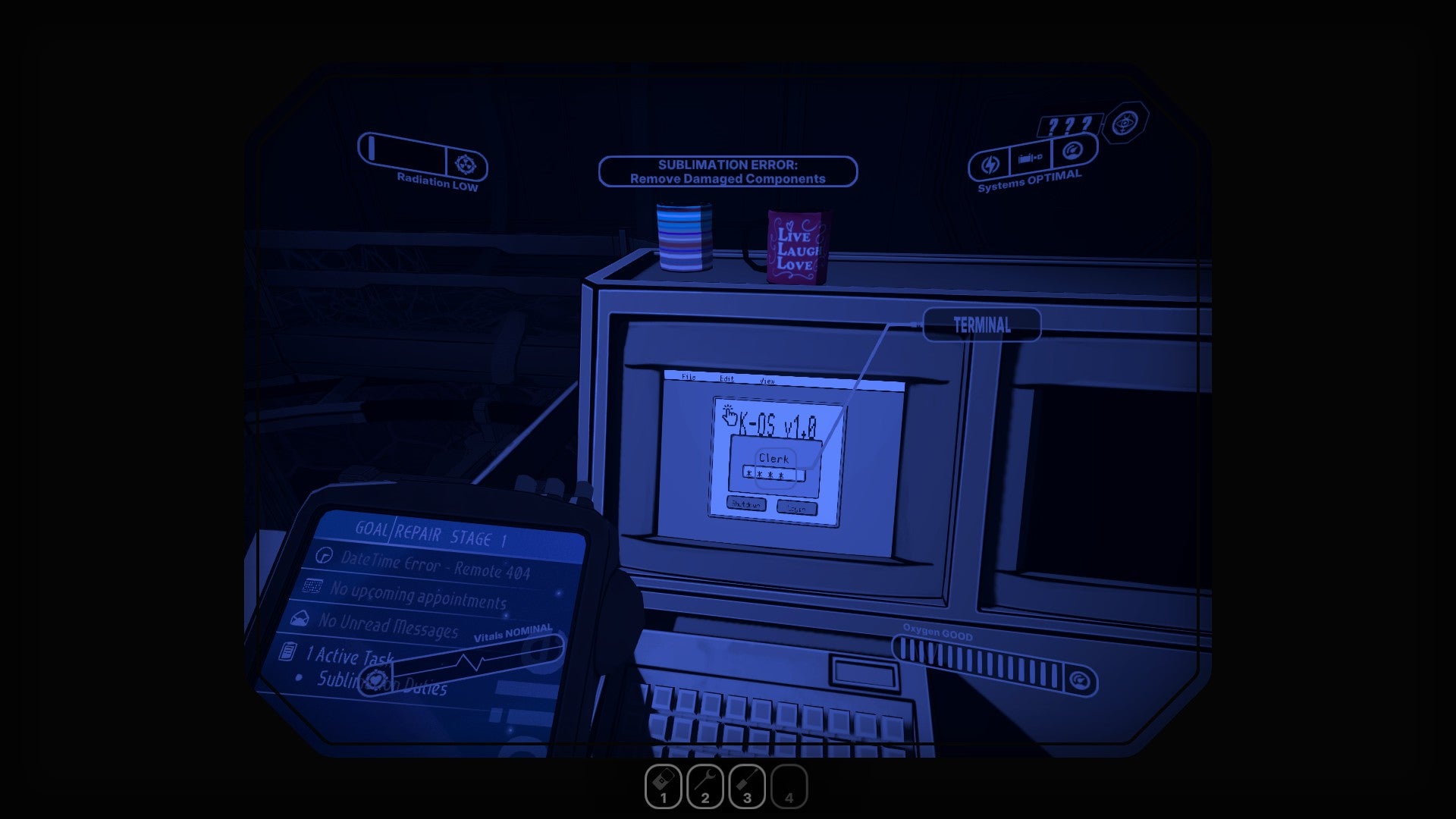
There’s a lot to unpack here on several levels for Evangelion fans, especially because the in-game interfaces around the station are clear little homages to the very distinct NERV supercomputers, through their iconic bicolor graphical displays that almost singlehandedly keep Tumblr going. There’s also a lot to unpack with how, after exploring enough in the station to thread together the connections to the resort, both acts are strange cousins from the same nightmarish tree. Act Two is appropriately punishing for a lot of reasons, but there is nothing “fun” about pushing through Act One either. It is a marathon of masochism that I’ve willingly signed up for, hungry for the little microdoses of serotonin along the way, snug in the false intimacy I’ve developed with the residents. The drum-n-bass soundtrack is diabolically good, too – frenetic breakbeats are the perfect, peristaltic sonic accompaniment to keep me going. Act Two, though, has the same vibes as the imploded billionaire submersible: bleak as hell, undeniably stressful, and heading towards an increasingly palpable but unknowable doom.
I am not good at figuring out doohickeys and cranks and mechanical bits, which is why I will be the first to die in a crisis. I’m okay with that. In Act Two, you have a lot of these things around you – valves and buttons and little levers? I think they’re levers? Things you can manipulate with tools – a screwdriver, wrench, and even a PDA that gives you abstract Ikea-like information about all the broken equipment that defies logical touch. I fiddle with all of the doodads, without a thought in my head, because I left my brain and body juice behind in Act One. I pick up clumps of garbage for no other reason other than it feels right to have a tidy environment to die in. I am not sure if I’m doing the right thing, directing air the right way, or pressurizing the right rooms, but it’s a cyclical world, so I have nothing to lose except my waning scraps of morale. All I know is that I must enact a process called sublimation, and if I fail or pass out, I will simply wake up in the dorm section, surrounded by all the little gacha toys from Act One. It’s a lovely closed loop of quiet, iterative horror, but the pace takes its toll on me quickly.
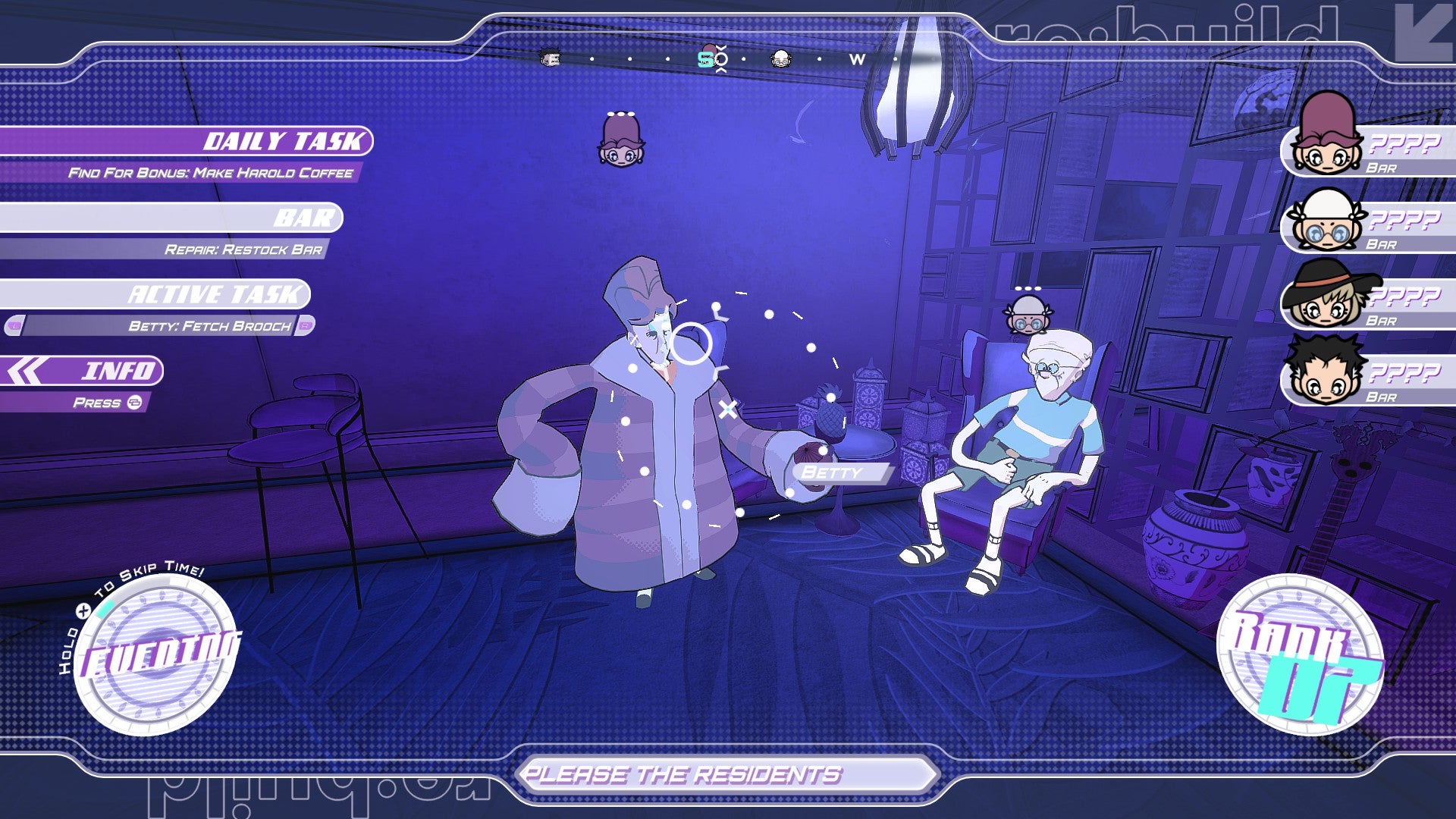
I would be lying if I said I didn’t hit a wall several times in the game, in both acts. Existential despair is a hell of a drug. But so are gacha games, and the unlikely combination of gacha-imsim-puzzle genres feels inexplicable until you see it in action and know that sweet frisson of psychological radiance whenever you get a little reward. The general tone is not far removed from the most diminished husk of a person you know, who communicates through droll quips and dark humour, like some kind of existential terrorist. Act Two, set in the sunless depths of a submerged research facility, is a deliberate sensory deprivation of all the pleasant little chimes and juicy clicks and animations that propelled me forward in the resort. Here, I am surrounded by gloom and stagnation, and my only chance at life is to court death. I smoked for almost 15 years and quit in my early 30s, and at times that felt less grim than my worst hours spent stuck in Act Two.
Re:Build will ask a lot from you as a player, and it is extremely not-for-everybody, but Act Two was exceptionally not for me. I do not wish to come back here, which is, considering its setting is a psychological horror deathtrap, a heartfelt compliment to the devs. It is, however, a critical narrative companion to Act One, and for all its misery, should not be waved away as the “less engaging” or “more draggy” section for the sake of ease. Each act riffs on the other to explore the nature of keeping ourselves and others alive, and maintaining life (or failing) at the expense of our own. Both are two sides of a profoundly dense coin, and can only be fully understood as a pair.
The price may be your sanity, intense overthinking about the flesh that houses your consciousness, and maybe some time spent looking up how to troubleshoot a few bugs. But in return, Roman Sands Re:Build will do the important and underappreciated work of clamping your eyelids open to face the uncomfortable intricacies of living, keeping life going, and the rituals we develop to maintain our realities. I’d just prefer one in which my cow makes it out alive.
A copy of Roman Sands Re:Build was provided for this review by Serenity Forge.