dailynewsnblog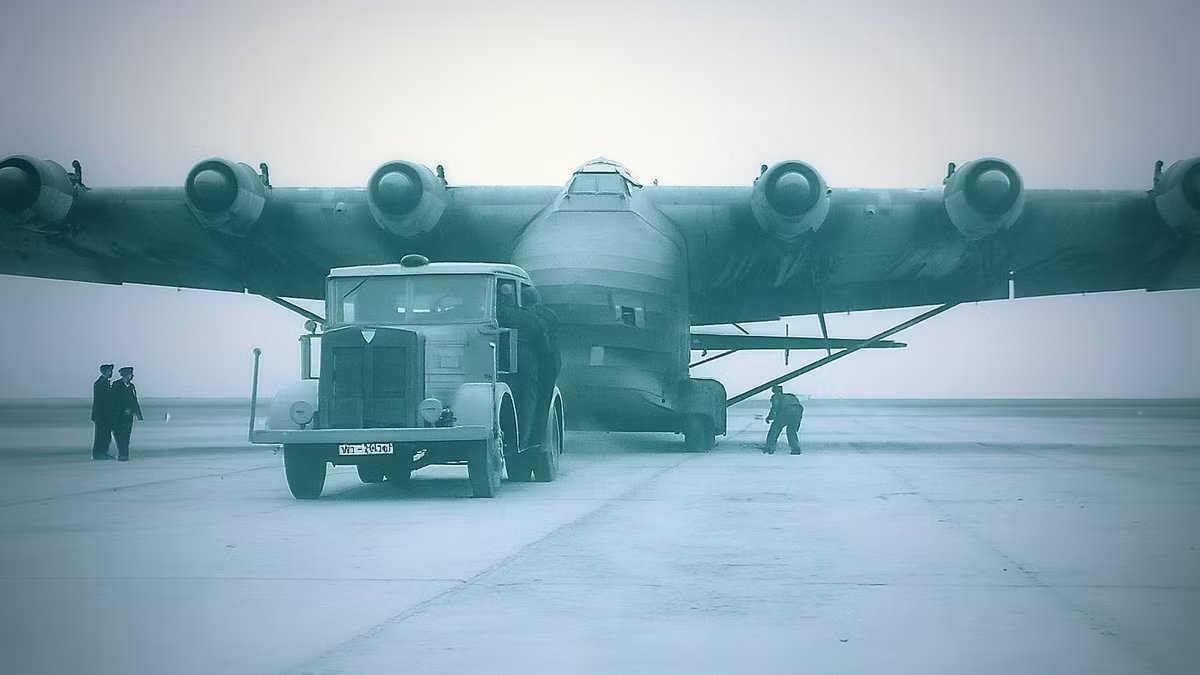
During the Second World War, the Allies (particularly the US and UK) massively outproduced the Axis powers (particularly Germany) with bombers and transport aircraft. The conflict changed aviation forever and turbocharged the development of aircraft as countries sought to knock each other out and to sustain their operations in far-flung corners of the world. Let’s examine five of the largest military aircraft produced during the Second World War.
1
Messerschmitt Me 323 Gigant
The Me 323 had a wingspan of 181 feet and a max take-off weight of 94,799 lbs.

The German Me 323 Gigant is regarded as the largest land-based transport aircraft flown during the Second World War. It was a powered variant of the Me 321 military glider and resulted from the German requirement to have a large assault glider for Operation Sea Lion (the planned invasion of Great Britain after the fall of France).
|
Role |
Heavy transport |
|---|---|
|
Number produced |
213 (with 15 conversions) |
|
Engines |
Six Gnome-Rhône air-cooled radial piston engines |
The Germans built a total of 213 Me 323 Giants (including 15 converted from the Me 321 glider). Germany lost the Battle of Britain, so the invasion of Great Britain never went ahead. However, the Me 323 was used in the Invasion of Crete, the Invasion of the Soviet Union, and in the North African campaign. It was able to transport around 100 fully-equipped troops and carry military vehicles.
2
Boeing B-29 Superfortress
The B-29 had a wingspan of 141 feet and a max take-off weight of 133,500 lbs.

The B-29 Superfortress is regarded as the most successful of the largest aircraft built in the Second World War. It succeeded the B-17 Flying Fortress, and only arrived late in the war, so it was mostly used against Japan. Infamously, it was responsible for much of the fire-bombing of the country and for dropping the two nuclear bombs that ended the war. It went on to serve in the Korean War, and the last were retired in 1960 (American allies also flew them). Two B-29s (including ‘Doc’) are flying today.
|
Role |
Strategic bomber |
|---|---|
|
Number produced |
3,970 |
|
Engines |
Four Wright R-3350-23 Duplex-Cyclone radial piston engines |
The B-29 was the most expensive military project of the war, costing $3 billion (much more than the Manhattan Project, which cost $1.9 billion). It featured many cutting-edge innovations for its time, including an analog-computer-controlled fire-control system, a pressurized cabin, and a dual-wheeled tricycle landing gear.
3
Douglas XB-19
The XB-19 had a wingspan of 212 feet and a max take-off weight of 162,000 lbs.

The Douglas XB-19 was the Douglas strategic bomber counterpart to the Boeing B-29. It was a four-engined heavy bomber that was slightly bigger than the B-29 (‘XB’ denotes ‘Experimental Bomber’) and was the largest bomber built for the US Army Air Force until the Convair B-36.
|
Role |
Heavy bomber |
|---|---|
|
Number produced |
One prototype |
|
Engines |
Four Wright R-3350-5 Duplex Cyclone radial piston engines |
The 1940s were a period of dramatic change in warfare and warplanes, and the XB-19 was obsolete before it was completed. However, the experimental bomber was thought to be still useful for other roles and was earmarked for conversion into a cargo aircraft. However, these modifications were never completed, and the aircraft flew for the last time on August 17, 1946, before being scrapped in 1949.
4
Hughes H-4 Hercules ‘Spruce Goose’
The H-4 Hercules had a wingspan of 319 feet and an empty weight of 250,000 lbs.

The H-4 Hercules, better known as the Spruce Goose, remains one of the largest aircraft ever flown (albeit briefly). It was only produced as a prototype and was to be a strategic airlift flying boat for transatlantic flights. As the aircraft was made almost entirely of birch (there were wartime restrictions on the use of aluminum), the aircraft gained the nickname Spruce Goose. It only flew once on a very brief flight on November 2, 1947, and was later canceled. It is now on display at the Evergreen Museum.
|
Role |
Strategic Airlift |
|---|---|
|
Number produced |
One prototype |
|
Engines |
Eight Pratt & Whitney R-4360 Wasp Major radial piston engines |
The project’s origins stemmed from the need for the US to transport masses of men and equipment to support the war in Europe at a time when German U-boats were running amok in the Atlantic. The idea was to fly over them, but by the time it was developed, that problem was long gone. The H-4 Hercules remains the largest flying boat ever built. Although the plane didn’t take flight until 1947, the initial contract for such a transport was commissioned by the United States Department of War in 1942.

No Spruce Goose: US Takes Second Shot At ‘Ekranoplan’ With Liberty Lifter
If built, the Liberty Lifter could supply the military with an ekranoplan that combines the benefits of ship and aircraft transportation.
5
Blohm & Voss BV 238
The XB-19 had a wingspan of 197 feet and a max take-off weight of 220,462 lbs.

The BV 238 is famous for being the heaviest aircraft ever built when it first flew in 1944, and was the largest aircraft produced by the Axis powers of the Second World War. It was to be a slow but very well-armored and armed bomber and would have been able to land on water.
|
Role |
Flying Boat Bomber |
|---|---|
|
Number produced |
One prototype |
|
Engines |
Six Daimler-Benz DB 603G piston engines |
A massive aircraft, the BV 238 was equal in weight to two B-29 Superfortresses and had a range of over 6,000 miles. It was a flying boat intended to demonstrate German technological superiority, but it was never successful. Indeed, only one prototype was produced, with two more incomplete. The prototype was destroyed by the Allies by strafing, causing it to partially sink near the city of Lübeck.