dailynewsnblog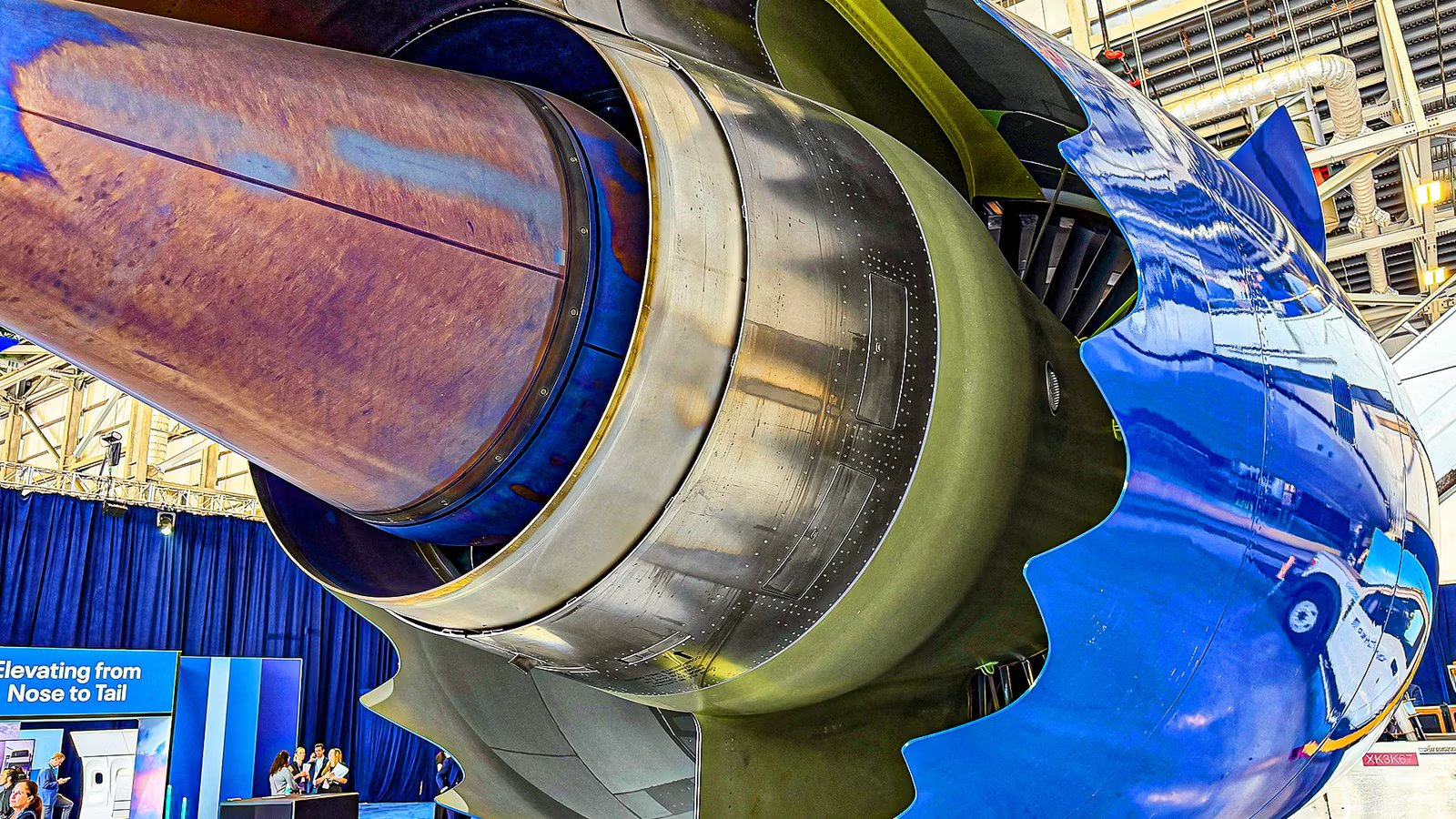
Boeing’s engine chevrons have long become one of the easiest visual clues separating aircraft like the  Boeing 787, 747-8, and 737 MAX from many rivals. Those serrated nacelle edges look dramatic, but they were never added for just style alone. They were introduced to solve a very specific problem. Modern high-bypass turbofans may be far quieter than older jets, yet the violent mixing of hot core flow, cooler bypass air, and the surrounding atmosphere still creates a major share of engine noise.
Chevrons help tame that noise by reshaping the exhaust flow and promoting smoother mixing. That makes them valuable for community noise reduction and airport compliance, which is why Boeing and its partners invested heavily in the technology. However, the same mechanism that makes chevrons quieter also explains why they can hinder overall operational performance. By energizing, mixing, and generating vortices, chevrons inevitably spend some of the flow’s energy on noise control rather than purely on propulsion.
In other words, they are not a win-win but rather a carefully calculated and tactically made engineering compromise. As newer acoustic liners, advanced insulation materials, and cleaner nozzle designs improve, the tradeoff becomes much harder to ignore. This is the real story behind Boeing’s famous serrated engine edges.
Which Boeing Jets Feature Engine Chevrons?

It is also important to note that such chevrons are not present on all new Boeing jets. Boeing’s commercial lineup today is primarily built around a relatively tight family of both widebody and narrowbody aircraft. These include the Boeing 737 MAX in the single-aisle market, the 787 Dreamliner in the mid-size long-haul segment, the 777F and in-development 777X at the top end of the twin-engine widebody market, and the 767-300 Freighter as a cargo mainstay.
If we widen the lens slightly to Boeing’s most recent commercial programs, the 747-8 also remains important in any discussion of engine design because it was one of the company’s last flagship four-engine aircraft. Among these jets, engine chevrons are not a fleet-wide Boeing trademark, but a feature found on only certain models. The 787 is the best-known example, and Boeing explicitly highlights the serrated nacelle edges as part of the plane’s noise-reduction package.
The Boeing 747-8 also used chevrons, including on its GEnx-powered nacelles and core nozzles, while the 737 MAX carries visible chevrons on its LEAP-1B nacelles as well. By contrast, Boeing’s 767 and 777 families are not generally associated with the same serrated treatment, and the newer 777X has notably chosen to move away from the look altogether. That makes chevrons a selective Boeing solution, not a universal one.
Chevrons On The LEAP-1B

On the Boeing 737 MAX, the chevrons fitted to the CFM LEAP-1B are one of the engine’s most distinctive visual features, but they are there for acoustic engineering, not branding. The LEAP-1B is the exclusive engine for the 737 MAX, with a massive fan, impressive thrust capabilities, and an overall package designed to give the MAX lower fuel burn and lower community noise than earlier 737 variants. This made the engine extremely popular with operators, especially those who were in search of operational efficiency.
The engine offered impressive performance, all while not being too taxing for more urban airfields that faced significantly higher noise restrictions, according to PC Magazine. The serrated trailing edges on the nacelle of an aircraft help mix the fast-moving core exhaust, bypass flow, and surrounding air more smoothly. That matters because abrupt mixing is a major source of jet noise, especially during takeoff and climb. Boeing has indicated that the 737 MAX 8 has a 50% smaller noise footprint than the 737-800.
This is helped in part by the engine’s impressively low bypass ratio and the nacelle’s chevron design, which it describes as an advance inspired by the 787 Dreamliner itself. However, the LEAP-1B’s chevrons also illustrate the core compromise behind the technology itself. By forcing extra mixing and creating vortical structures in the overall exhaust stream, chevrons reduce noise at the cost of a small performance penalty. NASA’s testing found a representative chevron nozzle produced only a negligible thrust reduction, but one that was still measurable.

The Striking Differences Between The Airbus A321XLR & Boeing 737 MAX 10
The Airbus A321XLR and Boeing 737 MAX 10 represent the pinnacle of evolution in the aviation industry, pushing narrowbodies to their absolute limits.
The GEnx Also Has Chevrons

On the General Electric GEnx, chevrons became one of the clearest outward signs that Boeing and its engine partners were prioritizing noise reduction alongside fuel burn and reliability. The GEnx powers the Boeing 787 family and the 747-8, and in both applications, the engine was designed as a major step forward from earlier widebody powerplants, with composite fan blades and fan case, reduced parts count, and strong efficiency metrics. The GEnx is the fastest-selling widebody engine in its history, and it can power the 787-8, -9, -10, and 747-8.
What makes the GEnx especially interesting in a chevron discussion is the fact that Boeing did not apply the feature in the same way on every aircraft. NASA notes that the 787 uses chevrons on the nacelles, all while the 747-8 goes further, with chevrons on both the nacelles and the inner core engine nozzles. That reflects how seriously Boeing treated the aircraft’s acoustic signature, particularly on two large long-haul jets expected to operate at noise-sensitive airports.
However, the GEnx can also capture the core drawback of chevrons. They work by smoothing the mixing between exhaust streams and outside air, cutting down on turbulence and noise, but that mixing is not free. NASA testing found only a negligible thrust penalty, but a still measurable one, highlighting that the chevrons are a deliberate engineering trade-off rather than a no-cost gain.
Why Don’t Airbus Jets Have These Chevrons?

Strictly speaking, Airbus does actually use chevrons in some cases, but it has generally not made them a defining visual feature in the way Boeing did on the 787, 747-8, or 737 MAX. Airbus’s technical material on the A320 family discussed a chevron nozzle and explained the underlying problem clearly. Namely, chevrons can reduce jet noise by improving the mixing between core flow and bypass flow, but they also have a small impact on engine performance.
That is ultimately the key reason Airbus has chosen to be more selective. If the noise benefit can be achieved through other measures, an airframe manufacturer may prefer to avoid adding a device that slightly hurts thrust, fuel efficiency, or engine behavior margins. On newer Airbus programs, the company has leaned more heavily on a broader acoustic package instead of making chevrons the centerpiece. Airbus says its latest aircraft reduces noise through engine-airframe integration, airframe refinement, and nacelle acoustic technologies.
On the A320neo, for example, Airbus highlights high-bypass engines and nacelles with ‘zero splice’ inlet acoustic liners derived from the A380 and A350 XWB, while the company also points to major gains from airframe and operational noise management. As such, the best way to frame it is not that Airbus does not have chevrons, but rather that it has usually preferred less visually obvious noise-reduction solutions when they offer a better overall trade between acoustics and efficiency.

How Many Engine Types Power The Boeing 787 Dreamliner?
The Boeing 787 Dreamliner soars through the skies, but what powers this marvel of aviation?
Other Ways To Reduce Engine Noise

Engine chevrons are just one way to make an aircraft notably quieter. A more fundamental approach is to design the engine to produce less noise from the start. Higher-bypass turbofans lower exhaust velocity, while slower fan speeds, optimized blade shapes, and acoustic liners inside the nacelle can help absorb or reduce noise before it leaves the engine.
Airbus, for example, makes an effort to emphasize engine integration and nacelle acoustics as major parts of its noise-reduction strategy. Just as importantly, not all aircraft noise comes from the exhaust nozzle. Landing gear is a major noise source during approach, which is why manufacturers and researchers also focus on gear fairings, cleaner airframe design, and other aerodynamic refinements.
Airlines can reduce noise operationally as well, especially through continuous-descent approaches that keep aircraft higher for longer and reduce time spent at higher overall thrust settings. As such, the main alternatives to chevrons are quieter engine architectures, better nacelle liners, cleaner landing-gear aerodynamics, and smarter arrival procedures.
The Bottom Line

At the end of the day, jet engines are critical components of any commercial aircraft. Without high-performance jet engines, the commercial aviation industry as it stands today simply would not exist. However, far more goes into the design of these impressive machines than passengers can imagine.
The choice of adding engine chevrons to certain Boeing aircraft variants is certainly eye-catching. For many, they are aesthetically pleasing, but they do bring a unique opportunity to the table. These chevrons can lower engine noise significantly, which may mean quieter journeys for passengers.
More importantly, they will lower the aircraft’s noise footprint, something that airports and nearby residents will certainly relish. However, this often comes at the cost of overall power output, something that can have legitimate operational consequences for operators with restrictions.