dailynewsnblog
OTTAWA — Mark Carney is spending political and state capital left, right and centre.
Moving aggressively to reduce reliance on the unpredictable United States of America, to bolster national unity and, Carney says, to put Canada on a more prosperous path, the prime minister is on a tear.
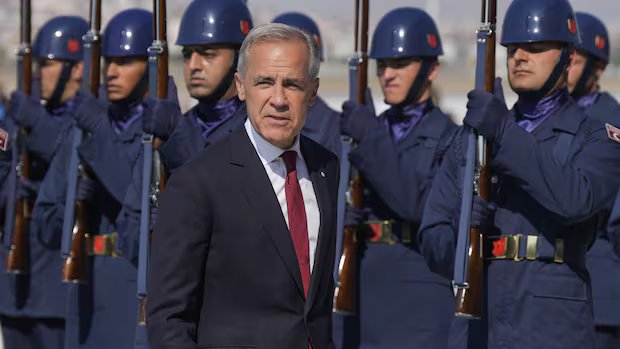
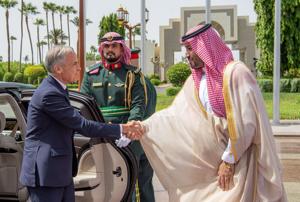
“We have a pretty clear strategy of where we want to go,” he said Thursday in Saudi Arabia, where he touted commercial agreements in health technology, mining, infrastructure and defence he said are worth more than $1 billion.
“We’re trying to make the country, I think we will do this, more resilient, more independent, more strategically autonomous,” Carney said.
To make deals with countries that have dubious human rights records, like Saudi Arabia, China or Turkey, Canada cannot “lecture countries from afar,” he said, but must engage and make concerns known in private, not in public. “It’s not for me to judge” how women’s rights are faring in the Saudi kingdom, Carney said, as he suggested more women have entered the Saudi workforce than in India or Japan. (In fact, according to the World Bank, the rate of Saudi women in the workforce is just barely above India’s, while Japanese women make up a much greater percentage of the work force, 56.4 per cent.)
That’s a prime minister prepared to spend political capital to do business.
Or, as he put it in Davos, he’s dealing with the world as it is, not as he wishes it to be.
In more than a year since taking office, Carney has set Canada on a different path: one where government is willing to spend big, absorb risk and use public capital to get projects built when the private sector won’t go first — betting the rewards will outweigh the costs.
That philosophy is now shaping everything from energy infrastructure and ports to defence, AI, and foreign investment.
The banker-turned-politician said his is a “pragmatic” plan to make Canada more resilient and there are lessons to learn from Saudi Arabia’s “transformation” over the past decade: “Track what you’re trying to accomplish … Make course corrections when necessary. Cut your losses if something isn’t working … Borrow from others where you can. Partner where you can,” he said.
Of note, the prime minister who is spending tens of billions of dollars of public money on his “build, baby, build” agenda added to that list that Canada already has “a lot of capital” at home but still needs foreign capital. With foreign money comes expertise, perspective, and broader linkages for Canadian companies, he said, adding decision-makers from the Saudi sovereign wealth fund and others have confirmed they’ll attend his global investment summit in Toronto in September.
Carney’s pitch to the world is that Canada has a long-term agenda and is making itself “more attractive for investment.”
But in practice, Carney has made clear he is not willing to wait for the private sector to goose the nation-building projects he has in mind. If anything, the past two weeks prove Carney’s plan very much relies on using public funds where a reluctant private sector is still wary of spending big bucks.
Carney committed tens of billions of dollars to a pair of mega-deals last week with B.C. and Alberta.
With an eye on Asian markets as a route away from dependence on the U.S., and a way to rebuff Alberta separatists’ argument that Canada doesn’t work, Ottawa and Alberta have agreed to split up to 90 per cent of the potential $44-billion cost to “de-risk” construction of a new oil pipeline to the Pacific coast, which could work out to about $19.6 billion apiece – a number PMO has not confirmed.
On the same day, Carney committed to spend what British Columbia pegged at $20 billion (which the prime minister’s office confirmed Friday) to expand a key port from which to load the Alberta oil onto deep-sea tankers, to expand other ports, highway tunnels and rail lines, to develop critical mine projects, to protect a southern killer whale population, said to fund child care. All but the child-care money is new, and not all B.C. projects have been announced, PMO said.
It’s not a quid pro quo, said Carney. It’s “compensation” for the “risks” B.C. is taking, said B.C. Premier David Eby.
The prime minister has calculated that these big projects may be high political risk, but they’re high reward.
So, framing his mission as nation-building, he walked back regulations to address climate change; passed laws to enable his majority government to override environmental and other laws; studied privatizing airports, ports and other public assets to seed a new sovereign wealth fund; planned to weaken clean electricity regulations to accommodate gas-powered plants; and referred energy, critical minerals, mining and nuclear projects, along with other public works and a high-speed-rail line, to the newly empowered Major Projects Office for fast-track approvals.
Plus, Carney has made a very public pivot away from the U.S. on defence spending, artificial intelligence and digital sovereignty, all while asserting a stronger national security posture in the Arctic.
Having surrounded himself with others, mainly men, of his own ilk — people with corporate and investment banking ties or economic expertise — Carney is a modern-day C.D. Howe, recruiting from the private sector and orchestrating the many moving parts of his big puzzle from the top office, not from a cabinet seat where Howe led Canada’s industrialization efforts during and after the Second World War.
“It’s very different from what we’ve seen before,” said Charles St-Arnaud, chief economist with Servus Credit Union in Alberta. “I call it kind of more state capitalism in some ways. It’s that the government is realizing that to kick-start investment, they will need to in some way provide the incentive for the industry, de-risk in some ways financially the project.”
St-Arnaud said it’s “not nationalizing for (the sake of) nationalizing. It’s nationalizing to ensure that there’s an upside in terms of revenues for the future … He’s understanding that sometimes you need public capital to leverage private capital.”
To economists like St-Arnaud, it is not surprising Carney has championed the proposed new pipeline.
It would run along an existing right-of-way held by the Crown-owned Trans Mountain Corporation, which already operates two pipelines (from which Ottawa is reaping a windfall, thanks to its purchase by the Trudeau government). Ottawa and Alberta will be “equal partners” in the venture, and a private company, Pembina Pipeline, will hold a 10 per cent interest with an option to raise that to 20 per cent.
So far, however, no word on which oil companies — which Carney says will still have to adhere to tough industrial carbon pricing and pay for a mega-carbon-capture and storage project — have signed on to ship the desired one million barrels of oil a day through the pipeline.
As St-Arnaud describes it, the oil industry in Canada has changed just as it has globally. “Regulation was not the only hurdle,” he said.
Oilsands companies are reluctant to spend the massive amounts of capital required at the front-end to build a new pipeline, to expand production capacity and, in Canada’s case, to build the Pathways carbon-capture project Carney demands. Instead, they are investing in maintaining or tweaking existing production to grow profits, and focused on returning dividends to shareholders, not on investing in projects to grow or expand capacity.
Carney gets that, said St-Arnaud.
Hence the prime minister and Alberta’s premier have stepped up to take on the first burden — building the pipeline — while seeking commitments to expanded production and to the Pathways project.
On the other end of it all, said Rick Anderson, an energy sector consultant and senior fellow at the C.D. Howe Institute, holding the majority share of the pipeline not only makes it more likely to get built, but will also reap the same big benefits for Ottawa that the Trans Mountain purchase has in tolls, royalties and higher corporate taxes.
“I think Carney’s all-in for state enterprise. I don’t mean socialism, I mean the mixed Canadian tradition of state enterprise,” Anderson said. “We started Petro-Canada, we started Air Canada, and we started CN Rail. We run them for a bunch of years, figure out eventually they’ll do better in the private sector, lose them, and they flourish, and meanwhile they serve their need while nobody else wanted to build that, the private market wasn’t doing it.
“Mark Carney, (Energy Minister) Tim Hodgson, (Finance Minister) François-Philippe Champagne, (Clerk of the Privy Council) Michael Sabia and (Carney’s chief of staff) Marc-André Blanchard — those are five people with really solid, deep investment community credentials and experience,” said Anderson. “When they say, ‘Invest in it,’ they mean invest in things that’s going to get paid back … it’s not just spending money.”
Who ultimately “pays for it,” he said, will be the “users of the energy. That’s who pays for the oil pipelines. That’s what pays for electricity and electricity grids and nuclear plants and everything else.
“The investors are just intermediaries who put money on the table to get the thing built and then make a profit on the return. But they don’t spend money that disappears off the government balance sheet as an expense. This is an investment.”
And while Anderson said the government might eventually privatize the pipeline, St-Arnaud expects Ottawa to retain ownership because it will become a source of long-term revenue.
St-Arnaud said there’s been a “big realization” over the past 10 years: “what I call the Reagan-Thatcher consensus — that the government should, if they want to help an industry, just give tax breaks or subsidies and move out of the way; I think most people are realizing that that doesn’t work.”
But Conservative Leader Pierre Poilievre still believes Liberal government regulation and red tape are the main stumbling blocks to unlocking free markets.
Poilievre’s newly named foreign affairs critic Eric Duncan said in an interview that when he looks at Carney’s global deal-making — such as the prime minister highlighted in Saudi Arabia — he sees announcements and photo opportunities but little concrete to show for them. He noted a Financial Times report that said the Major Projects Office advised the United Arab Emirates it doesn’t have shovel-ready projects ready to receive a $70-billion investment pledge that Carney secured in November.
“I think they’re woefully unprepared,” said Duncan, adding the agreements “lack a lot of detail and frankly they’re non-binding and they’re aspirational in many cases.” He noted the Major Projects Office manager Dawn Farrell told a committee there were 500 projects under review.
From where St-Arnaud sits, it’s all going to take a while.
After three decades of declines in manufacturing, exports and productivity, he does not believe Canada has ready access to the kind of capital — which he pegs at up to $6 trillion, and not $1.8 trillion over 10 years RBC has suggested, nor the $1 trillion over five years Carney has identified — needed to reverse that.