dailynewsnblog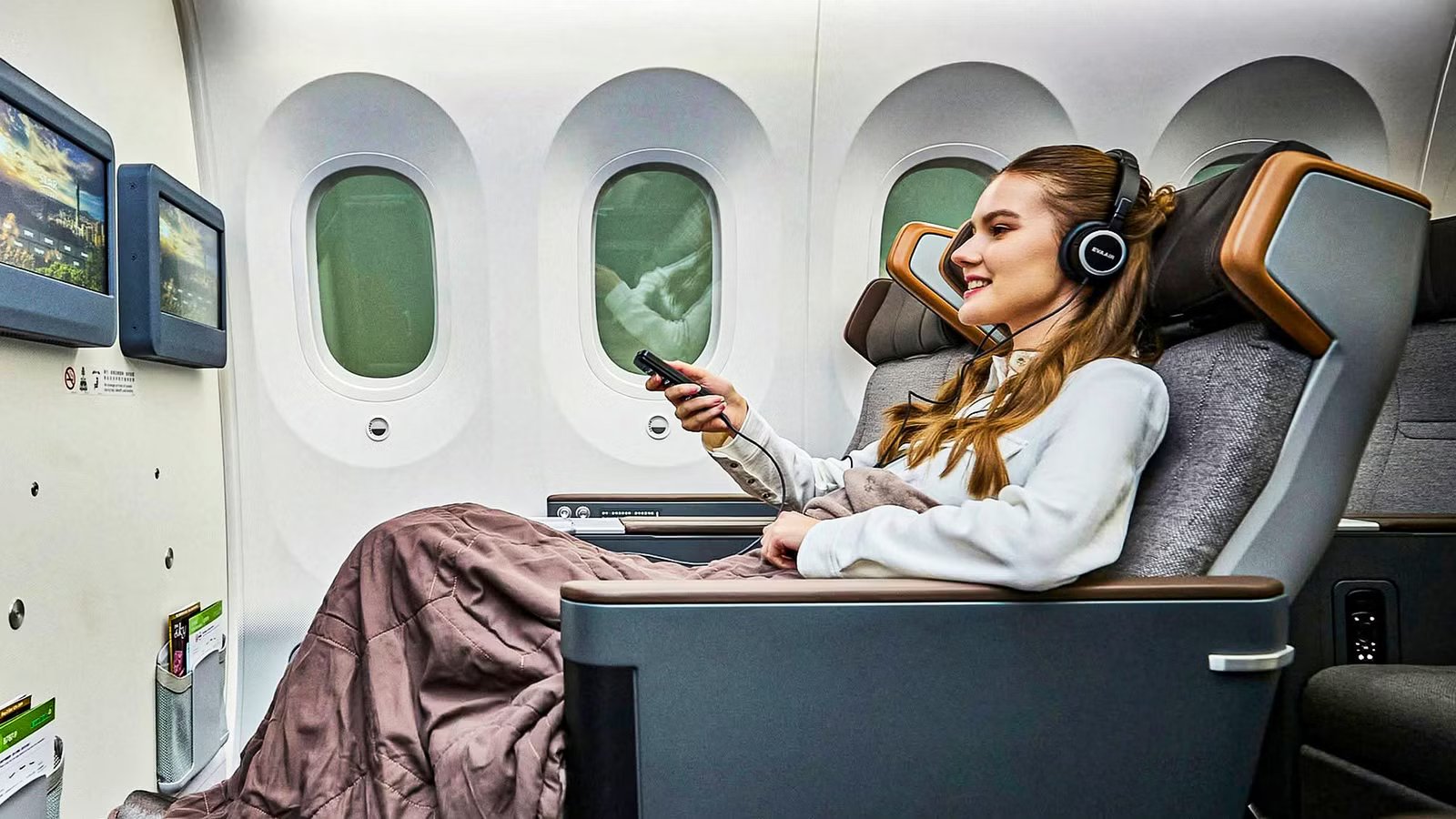
Getting passengers in seats is the number one priority of all airlines. How an airline achieves this is usually down to routes as well as the product itself, and how it differs from others in the market. Today, the most contested part of the cabin has arguably become the premium economy section. Global carriers are racing to capture affluent long-haul commuters, and the strategic challenge is no longer just about building a spacious seat, but deploying it where it can inflict the maximum competitive damage. EVA Air is one of the airlines that is leading the way, a pioneer of the premium economy concept, and still retaining its dominance.
The airline’s recent progress signals a deeper structural shift in how boutique international airlines challenge massive legacy alliances on ultra-long-haul flight tracks. Instead of funneling travelers through crowded West Coast transit points, the focus has shifted toward capturing high-yield corporate and premium leisure demand directly from prime East Coast markets. Following on from the previous article covering this new product, this guide focuses on how this premium economy product is allowing the airline to make major inroads into the transpacific market.
The Perfect Route?

First, the new staple route between Taipei Taoyuan International Airport (TPE) and Washington Dulles International Airport (IAD) begins a tale of aggressive expansion of intercontinental capacity. Operating four times per week, this new corridor marks the tenth North American gateway for the carrier, pushing its total regional footprint to an unprecedented 98 weekly flights. By entering the US National Capital region, the airline is intentionally establishing a direct pipeline into a market that generates immense corporate, diplomatic, and premium diaspora traffic.
Skipping over traditional multi-stop routings changes the financial landscape for travelers who have spent years navigating arduous connections. In the past, more than 40,000 passengers traveling annually between the Washington metropolitan area and greater Asia had to connect through highly congested West Coast hubs. The new direct 7,860-mile (12,649 km) sector completely removes that friction, offering an efficient 14-hour eastbound sprint and a 15.5-hour westbound block time, to the delight of these regular travelers.
The economic ramifications of this single route injection are massive, highlighting the high yield value of mature transpacific corridors. According to EVA Air, the new service will generate more than $61 million in annual economic impact for the capital region while significantly altering market share balances. For an independent carrier operating outside the major transatlantic mega-alliances, getting a firm foothold at Dulles is an excellent way to capture elite corporate accounts that traditionally rely on domestic legacy carriers.
Catch what other flight trackers miss
Emergency squawks, holds, NOTAMs — live signals, no signup.
Open tracker
Catch what other flight trackers miss
Emergency squawks, holds, NOTAMs — live signals, no signup.
Open tracker
The Aircraft Of Choice

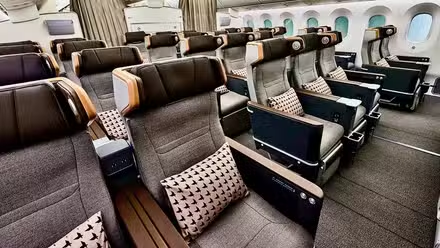
A route is never complete without an accompanying aircraft, and fortunately for EVA Air, the best choice is already in the fleet. The carrier chose to configure its newest batch of Boeing 787-9 Dreamliner airframes in a tightly optimized three-class layout, balancing premium margin and structural density. Total capacity is capped at 278 seats, meticulously divided into 26 Royal Laurel business class suites, 28 Premium Economy spaces, and 224 standard economy seats.
Dedicating just four rows to the premium economy environment in a spacious seven-abreast, 2-3-2 configuration is the airline’s way of breaking away firmly from the industry status quo. This specific cabin density allows the airline to implement a stunning 42-inch (106.7 cm) seat pitch, giving passengers far more individual living space than competitive alternatives. Each seat incorporates an advanced cradle-motion system that slides the lower cushion forward and upward simultaneously, providing an eight-inch (20.3 cm) recline without encroaching on the passenger behind.
The cabin composition maximizes revenue potential on a per-square-foot basis by catering to an affluent middle market that values workspace over basic transit. Each space is loaded with utility, featuring a 15.6-inch (39.6 cm) high-definition touchscreen monitor, built-in personal electronic device holders, and dual power configurations. Choosing a lower seat count over a dense layout, the airline creates a scarce, high-demand asset that allows it to maintain robust pricing integrity during both peak and shoulder travel seasons.
Why Washington, DC Is The Next Big Transpacific Gateway
One particular carrier is planning to expand its services significantly.
Getting Hooked On The Premium Economy Experience

The immediate arrival of a 42-inch (106.7 cm) product standard at Dulles heavily disrupts the traditional long-haul landscape connecting the eastern United States to East Asia. Elite regional competitors have historically maintained a highly uniform product standard on their ultra-long-haul fleets, typically capping their mid-cabin offerings at a conventional 38-inch (96.5 cm) pitch. This four-inch (10.2 cm) discrepancy creates a severe competitive deficit for legacy operators that have long relied on cabin density to maximize raw ticket volume.
When contrasted against the tight layout choices of alternative alliance carriers, the spatial divergence becomes clear to corporate travelers who pay close attention to each and every product offering. Competitors operating out of neighboring East Coast hubs often deploy an eight-abreast 2-4-2 alignment on their flagship aircraft, narrowing the cushion width available to individual passengers. The choice to scale down to a seven-abreast configuration on a widebody frame brings back substantial shoulder room, turning a long 15-hour flight track into a highly manageable workspace.
Put simply, this is precisely how an independent player dictates market expectations from a single international gateway. Travelers experiencing the enhanced spatial layout quickly develop a lower tolerance for restrictive industry-standard cabins on subsequent transpacific journeys. As this route matures into the late summer season, the presence of an elite intermediate tier will force surrounding operators to re-evaluate whether their high-density configurations can truly protect their premium market shares.
From West To East

Launching a direct transpacific service to the East Coast serves a clear structural purpose by shifting traffic away from traditional West Coast connecting gateways. Travelers originating in the mid-Atlantic region had to funnel through immense hubs like Los Angeles or San Francisco to reach East Asia. This extra domestic leg adds hours of travel time, heightens the risk of misplaced baggage, and introduces the fatigue of terminal transfers. Now offering a direct alternative, the carrier skips over these consolidated bottlenecks entirely and establishes a more streamlined transit corridor.
Capturing the high-value traffic flowing from the corporate and diplomatic sectors needs direct geographic access to the political heart of the United States. Connecting points like Seattle or Los Angeles add operational friction that premium business travelers actively seek to avoid. The three-class aircraft setup provides a dedicated mid-cabin space that perfectly aligns with corporate travel rules, which frequently restrict business class booking but permit premium travel on long flights. What this means is that EVA Air now directly competes with legacy alliances by pulling lucrative corporate contracts away from domestic multi-stop routings.
Route Type | Primary Connection Point | Total Transit Time (Average) | Disruption Risk Points |
Traditional Multi-Stop | Los Angeles or San Francisco | 19 to 21 hours | Two |
Direct Mid-Atlantic | Non-stop to Taipei | 15.5 hours | Zero |
The geographic advantage is particularly striking when analyzing the specific corporate demand from the defense and technology corridors flanking Virginia and Maryland. These fields rely heavily on constant communication with East Asian manufacturing bases, making efficient transpacific transport a vital business requirement. Avoiding a West Coast transfer saves corporate clients at least three hours per direction while ensuring that high-yield revenue flows directly into a single carrier instead of being divided among domestic codeshare partners.
How The Airline That Invented Premium Economy Continues To Innovate In Luxury Service
EVA Air offers an industry-leading onboard service in all travel classes.
A Well-Informed Strategy

Operating flights that exceed 15 hours always tag along with the steep weight penalties of ultra-long-haul aviation. To sustain a route of this length, an aircraft must carry thousands of gallons of fuel simply to burn it off during the initial hours of flight, which severely restricts the remaining payload capacity available for heavy cargo. Relying heavily on discounted economy passenger fares cannot offset these intense operating costs, especially as the maximum size of the business class cabin is limited by the dimensions of the cabin. The commercial viability of the route relies heavily on maximizing the revenue density of the mid-cabin environment.
The mid-cabin space acts as a financial buffer because it generates premium-tier margins while consuming far less floor space than luxury lie-flat berths. Corporate travelers moving through this cabin category typically pay fares that are twice the cost of a standard economy ticket, yet the footprint per passenger expands by only a fraction. Operating with a highly optimized revenue density like this keeps the route consistently profitable during off-peak travel seasons when leisure demand declines.
Destination via Taipei Hub | Average Connecting Window | Regional Market Type |
Manila | Under two hours | High-Volume Corporate / Labor |
Ho Chi Minh City | Under two hours | Technology Supply Chain |
Tokyo Haneda | Two hours | Premium Corporate |
The true power of this mid-cabin asset is fully realized when it is integrated into a rapid-transit hub network. Arriving at a hub in the early morning allows travelers to clear transit security and board connecting flights to major East Asian manufacturing and financial centers within a tight window. EVA Air’s coordination turns a single ultra-long-haul route into a comprehensive gateway, capturing complex multi-city business itineraries that traditional domestic carriers cannot easily replicate with multi-carrier alliances.
Pulling Away In The Lead

The launch of the Mid-Atlantic corridor is only the initial phase of a broader systematic strategy to standardize this premium configuration across the global network. Introducing a dedicated three-class layout on the twin-engine widebody fleet is, of course, a distinct shift away from treating premium economy as an optional regional product. Ultimately, it positions the mid-cabin experience as a foundational tier that will define all future intercontinental operations moving forward.
As more factory-fresh airframes arrive from the assembly line, this high-comfort standard will gradually scale into highly competitive West Coast markets and key European trunk routes. Markets like San Francisco, Munich, Milan, and Vienna are scheduled to receive these reconfigured three-class widebodies to ensure product consistency across diverse transpacific and transatlantic flight paths.
EVA Air’s fleet harmonization creates an intense competitive challenge for global alliance partners who continue to operate older configurations with inferior legroom standards. Starting to standardize an industry-leading pitch across a growing widebody fleet establishes a new quality benchmark that leaves rivals with little choice but to either invest in costly cabin retrofits or cede lucrative market share. The race is now well and truly on, and it seems that EVA Air is the one to chase.