dailynewsnblog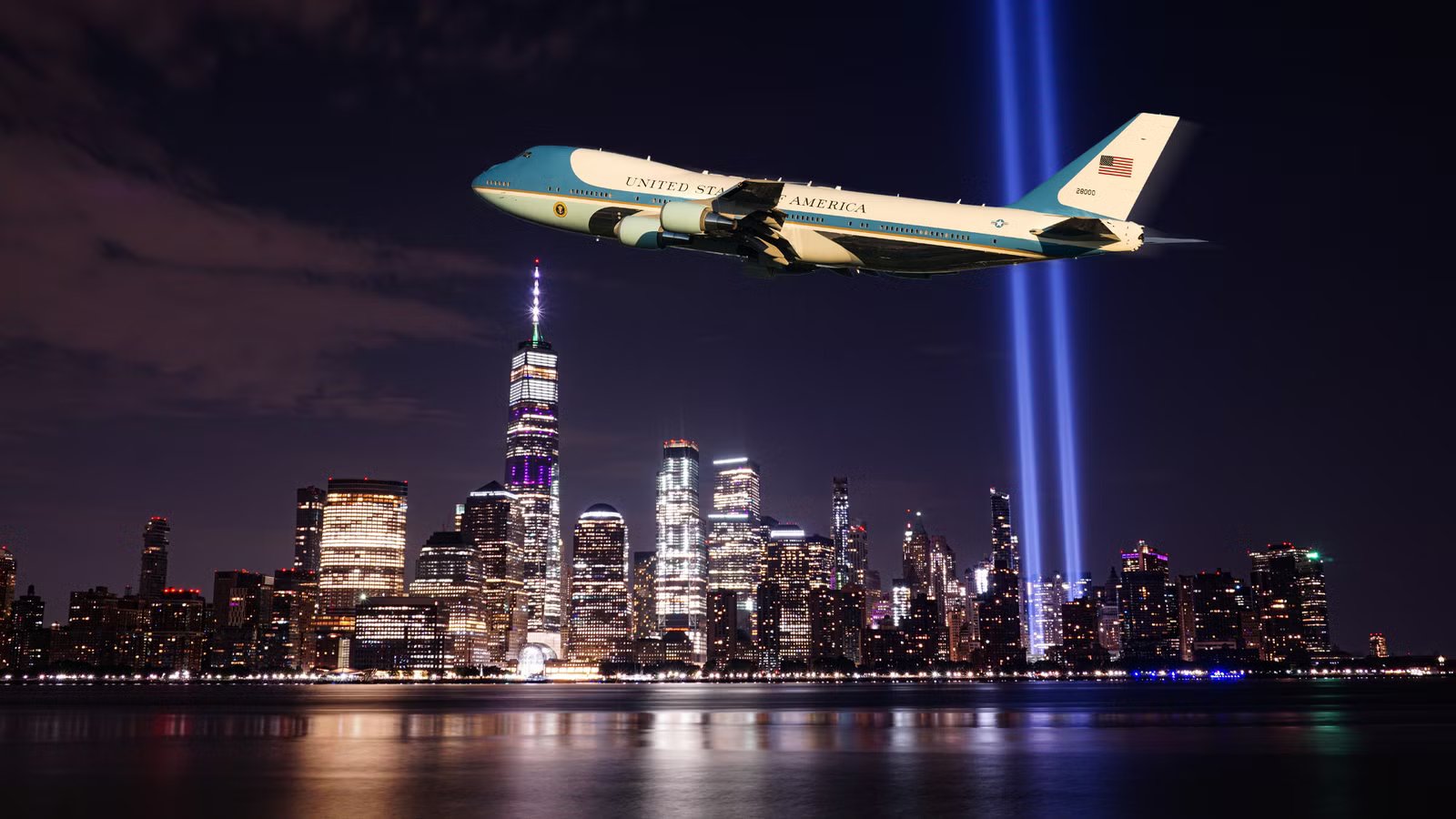
Air Force One is perhaps the most iconic military aircraft in history. Serving as the primary mode of long-distance transport for the United States president, it’s designed not only to be a plane but also as an airborne White House, where the president can command forces and lead the nation while in the skies. As such, it hardly resembles a private jet or a VIP converted airliner on the inside, instead filled with offices, a medical treatment facility, and a host of classified equipment. Because of this, Air Force One has valiantly served the president and the nation during some of America’s darkest times.
While Air Force One is today associated with a pair of 747-based Boeing VC-25As, it’s actually a callsign for any United States Air Force aircraft carrying the president. Similarly, Marine One, Army One, Navy One, and Coast Guard One are the callsigns for any aircraft within these military divisions carrying the US president. In addition, Executive One is the callsign for a civilian aircraft carrying the president. Mostly, however, the president travels on aircraft operated by the USAF and the US Marine Corps.
History Of Presidential Flight

Theodore Roosevelt became the first president to ever take flight, flying aboard an early Wright Flyer in 1910, the year after he officially left office. His fifth cousin, Franklin Delano Roosevelt, would become the first sitting president to fly aboard an aircraft in 1943, aboard ‘Dixie Clipper’ (a Boeing 314 Clipper owned by Pan Am) to the Casablanca Conference. While the US Navy had procured a Douglas Dolphin in the 1930s for presidential use, FDR never traveled aboard it, instead using trains and boats for long-distance travel like his predecessors.
The use of submarines by Nazi Germany in World War II meant that traveling by air was far safer than by sea, and flying increasingly became the preferred means of travel by the president after 1943. After the war ended, a new wave of advanced long-range propliners came onto the commercial market, with the military derivatives of some of these planes used to transport the president. This included the Douglas VC-54C (based on the DC-4), Douglas VC-118 (based on the DC-6), and Lockheed VC-121A (based on the Constellation).
Air Force One became a jet in the late 1950s, with the arrival of the Boeing VC-137 (based on the 707). The VC-137 platform was relied upon for decades, and was designed with a greater focus on communication compared to propliners, which were more luxurious than the initial VC-137A variants. As they were designed during the height of the Cold War, they were meant to function as mobile command centers given the risk of nuclear war. In 1990, the VC-25A arrived, adding even more communications capabilities while also adding more defensive technologies.
The Only US Presidential Inauguration On An Aircraft

What was meant to be a routine visit to Dallas, Texas, turned into tragedy when President John F. Kennedy was shot and killed in his motorcade on November 22, 1963. Riding in the car behind Kennedy was his vice president, Lyndon B Johnson, who was not injured in the assassination. The two cars traveled to the nearby Parkland Memorial Hospital, where Kennedy was pronounced dead half an hour after the shooting. Johnson was encouraged to leave immediately for Washington in case he was also a target for assassination, but first wished to know of President Kennedy’s condition.
Twenty minutes after being informed that Kennedy was dead, Johnson was driven to Dallas Love Field (DAL), where SAM 26000 (a Boeing VC-137C) was waiting. Having entered service just one year before the assassination, it was the newest and most advanced presidential transport in the USAF’s fleet. Its communications equipment would allow Johnson to immediately get to work after takeoff, but before that could be done, he had to be officially sworn in as the United States President.
|
Aircraft |
Base |
Number |
Registrations |
|---|---|---|---|
|
Boeing VC-137A |
Boeing 707-153 |
Three |
58-6970, 58-6971, 58-6972 |
|
Boeing VC-137B |
Boeing 707-153B (with JT3D turbofans) |
Three (all converted from VC-137A) |
58-6970, 58-6971, 58-6972 |
|
Boeing VC-137C |
Boeing 707-353B |
Two |
62-6000, 72-7000 |
Johnson waited for Jacqueline Kennedy, who insisted on only leaving Dallas with her deceased husband’s body. Onboard, 27 people were crammed into the stateroom of the VC-137C, and the oath of office was administered by federal judge Sarah Hughes as the plane’s engines were starting up. At 2:38 pm local time, Lyndon B Johnson was officially sworn in as the 36th president of the United States, and Air Force One departed DAL for Washington, D.C., nine minutes later.

5 Historic Air Force One Aircraft That Have Carried US Presidents
Air Force One has been the designation for aircraft carrying the US President for decades.
When The Ground Became Unsafe For The President

On the morning of September 11, 2001, four US airliners were hijacked by Al Qaeda terrorists. Two (American Airlines 11, United Airlines 175) were flown into the ‘Twin Towers’, part of the World Trade Center in downtown Manhattan, while a third (American 77) was flown into the Pentagon. The fourth, United 93, was downed in Pennsylvania after the passengers revolted against the hijackers. During this time, President George W. Bush was visiting a second-grade classroom at Emma T Booker Elementary School in Sarasota, Florida, when he was advised that the US was under attack.
Bush initially addressed the US from the school, and was then rushed to SAM 29000, a VC-25A that would serve as Air Force One for the day. At the time, information was both abundant and scarce, with little clarity as to the extent of the attacks. Bush was considered a prime target, and with reports indicating that planes could be headed to Washington, much debate ensued onboard over where to transport the president. Initially, the VC-25A traveled to Barksdale Air Force Base in Louisiana, then to Offutt Air Force Base in Nebraska, before finally returning to Washington over eight hours after leaving Florida.
American and Canadian airspace were ordered closed after the attacks, with only a handful of exceptions. This included Air Force One, which climbed to 45,000 feet (the 747’s service ceiling) along with fighter escorts, which were deployed due to fears of Air Force One being a target. For a time, Air Force One was the only aircraft in the skies on September 11, with President Bush and his staff responding to the attacks onboard until landing at Andrews Air Force Base and returning to the White House in the evening.
Secret Trips On Air Force One

Presidents have used Air Force One for low-profile missions conducted in secret, including to Iraq by Presidents Bush and Donald Trump. Sometimes, these aircraft do not even use the Air Force One callsign. The most striking case of a secret presidential trip by air, however, came in 2023, when President Joe Biden traveled to Kyiv, Ukraine. Opposed by the Pentagon and Secret Service, this was the first time in modern American history that a sitting president had traveled to an active combat zone not controlled by the US.
Biden left the White House at 4 am local time in secret, and rather than take the VC-25A, he instead traveled aboard a  Boeing C-32A (based on the 757-200) to keep a low profile. To further increase secrecy, the plane did not use the Air Force One callsign, but rather ‘SAM060’. The C-32A flew to Rzeszów, Poland, with a refueling stop at Ramstein Air Force Base. From Poland, two identical overnight trains departed, with one carrying Biden to Kyiv along with a second ghost train, and Biden would be in Kyiv for roughly five hours before departing for the US.
|
Aircraft |
Base |
|---|---|
|
Boeing VC-25A |
Boeing 747-200B (General Electric CF6) |
|
Boeing C-32A |
Boeing 757-200 (Pratt & Whitney PW2000) |
Democrats almost universally supported Biden’s visit, while many Republicans criticized the trip. However, it is considered one of the most impactful presidential trips to Europe in modern times, both in terms of its geopolitical message as well as the lengths that Biden and his team went through to make it possible. Biden’s plans were not made public before his arrival, and he traveled with a very small team, including only two journalists.

Air Force One Performs Daytona 500 Flyover As Trump Heads To NASCAR Race
The iconic jet visited Florida to drop the President off for the big race.
The Modern Air Force One Aircraft

With the arrival of the Boeing VC-137A in the late 1950s came a shift in focus from providing the president with a luxurious method of long-range transport to using a mobile command center. The three VC-137As (later converted to VC-137B specification) were ordered during the height of the Cold War, when concerns about nuclear war with the Soviet Union were at an all-time high. As such, these planes came with advanced communications to allow the president to command the nation from the air. The same was true for the two VC-137Cs ordered later.
When the two VC-25As were ordered in the late 1980s, the US faced a weakened Soviet Union, and the planes would arrive shortly before the Soviet Union collapsed in 1991 (one was delivered in 1990, while the other came in 1991). The VC-25A adds to the VC-137’s communications capabilities, but also adds significantly more defensive technologies, as the focus shifted more towards survivability. This is because when the VC-25As were ordered, surface-to-air missiles and electronic warfare became legitimate threats.
Boeing is currently working on modifying two 747-8is into the VC-25B, which will largely carry on the same philosophy as the VC-25A but more advanced than its 35-year-old predecessor. One feature that was intentionally left out, however, is air-to-air refueling, which was present on the VC-25A and some VC-137s. This is because it was never actually used.