dailynewsnblog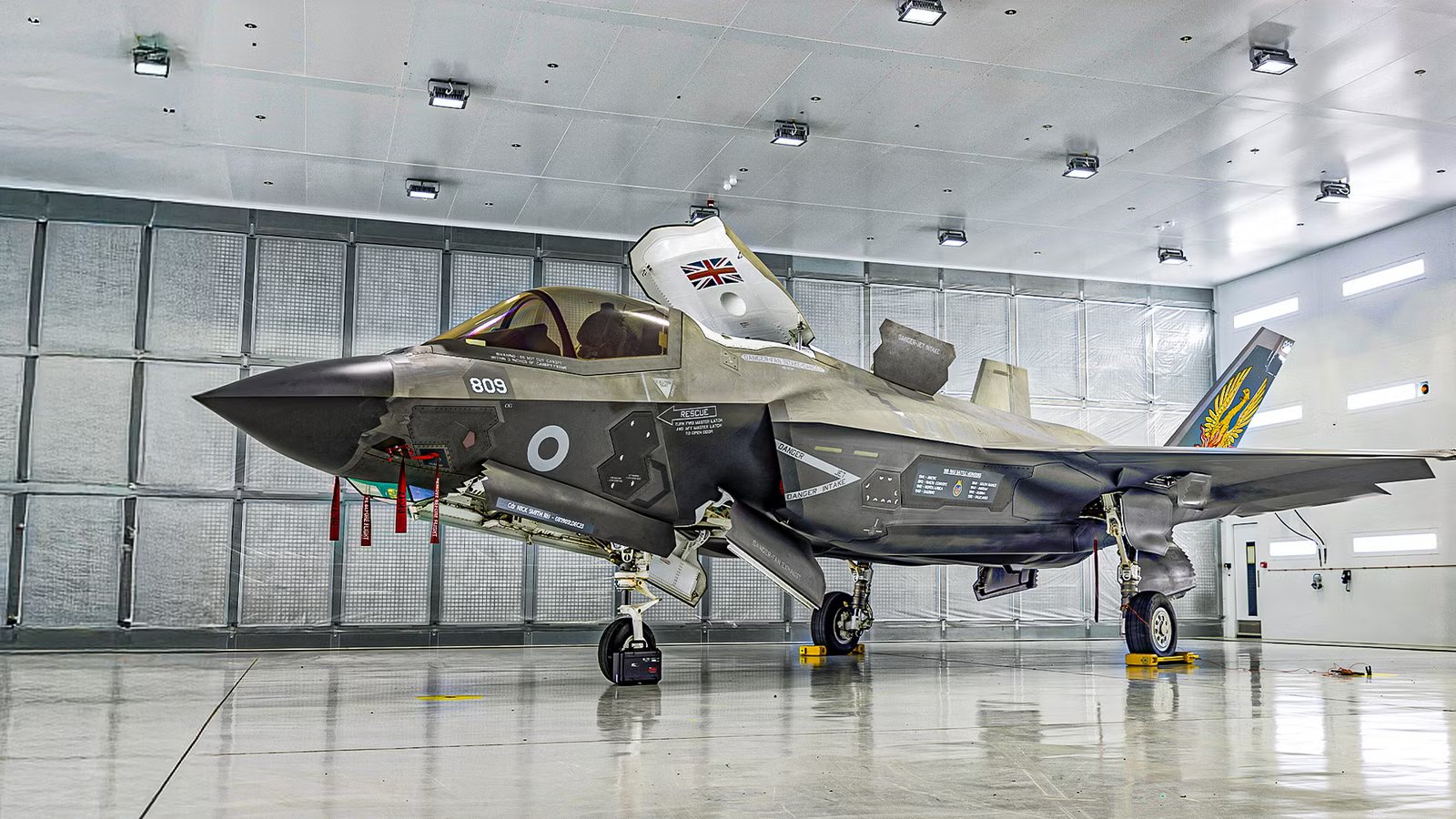
Of around 500 fighter jets delivered globally in 2025, 191 of them were Lockheed Martin’s F-35 Lightning II fighter jets. After years of delays and cost overruns (like most fighter jet programs), it is now taking its place as a mainstay fighter jet of the United States and its allies. The record 2025 deliveries were driven by Lockheed finally clearing a major backlog caused by issues with its TR-3 upgrade, meaning that deliveries will likely dip in 2025.
Even so, the average production rate of the F-35 over the last five years likely makes it the most produced fighter jet in the world, while noting uncertainties over China’s J-10 and J-20 production rates. The F-35 is currently the only 5th-generation fighter jet on the international market, except for a limited number of Su-57s apparently delivered to Algeria. There are now more F-35s in the world than all other 5th-generation fighters combined.
Lockheed Martin’s Record F-35 Deliveries

In January 2026, Lockheed Martin reported it had delivered a record 191 F-35 Lightning II fighter jets. Its previous delivery record was 142 years per year. This included all three variants: the conventional F-35A, the STOVL F-35B, and the carrier-based F-35C. It also included the limited number of F-35s assembled in its Italian and Japanese final assembly and check-out facilities. By the end of 2025, Lockheed described the global fleet as “almost 1,300.”
Most of these fighter jets were delivered to the United States military, although many were exported to allies around the world. The F-35 is not only taking its place as the primary high-end US Air Force fighter jet, but European air forces are also progressing through their transition to the jet. Norway and the Netherlands have fully transitioned, while Denmark has now fully deactivated its F-16s as it works up the F-35.
By the end of 2024, over 1,100 F-35s had been delivered. These included 797 F-35As, 204 F-35Bs, and 102 F-35Cs. Add in the approximately 200 that have been delivered since then, and around 1,300 F-35s have been delivered. The US Air Force has now likely received over 500 F-35As, and European air forces have collectively received over 200 of their roughly 650 planned F-35s. F-35Bs are delivered to the US Marines, Japan, Italy, and the UK. All F-35Cs are delivered to the US Marines or the US Navy.
Clearing Backlog From TR-3

The main reason why Lockheed Martin was able to ship so many F-35s was being able to complete the Technology Refresh 3 (TR-3) upgrade program. Issues with the integration of the upgrade had caused the US to refuse delivery of the jets. This resulted in a buildup of up to 120 F-35s around Lockheed’s facilities in 2024 that it couldn’t deliver. Bloomberg reported in 2025 that the undelivered jets numbered 72, although it’s unclear if they were just US jets or also export jets.
The issue was resolved in 2024, with Lockheed managing to deliver 110 F-35s that year, including some jets that had been stored. Most of the F-35s sitting around were shipped off to their customers in 2025, resulting in a delivery, but not a production surge. Lockheed Martin has the capacity for a stable F-35 production rate of 156+ jets per year, not 191. In all, about 93 jets were delayed backlog jets, and the remaining 98 jets were ones contractually scheduled for delivery in 2025.
In July 2025, Bloomberg reported, “Lockheed Martin Corp. has delivered F-35 jets parked at its Fort Worth, Texas plant to the US government as of May 1 after several months of delay due to late software improvements.” Going forward, Lockheed says it will have a stable production rate of 156+ F-35s a year, although it’s unclear what the target for 2026 is.

Why The Lockheed C-130 Hercules Won’t Be Retired Anytime Soon
The C-130 family has demonstrated the ability to remain flying for 70 years, while production is not expected to wrap up until the 2030s or 2040s.
Impressive Record 2025 F-35 Deliveries

Lockheed Martin wrote, “Annual F-35 production is now running at a pace five times faster than any other allied fighter currently in production, underscoring the program’s scale and maturity.” This is almost an understatement. In 2025, it was very likely the most delivered fighter jet in the world. Only the very uncertain production numbers of Chinese fighter jets could come close.
In 2025, more F-35s were delivered than all other frontline American, European, Russian, Pakistani, and Indian fighter jets combined. Put another way, the F-35 contributed more than half of all non-Chinese fighter jet deliveries in 2025. Thinktank Rusi’s Justin Bonk estimated China delivered 220-280 fighter jets, including up to 100 J-10s and up to 120 J-20s.
However, China-watching OSINT accounts like Hurin put the J-10 number closer to 40 and the J-20 number at around 100. Lockheed Martin delivered around 20 F-16s, Boeing delivered nine F-15EXs and 14 F/A-18 Super Hornets. The Europeans delivered around 41 fighter jets, including 25 Dassault Rafale, around 12 Eurofighter Typhoons, and four Saab Gripen Es. Russian industry delivered 33–39 frontline fighters.
F-35 Milestones In 2025

2025 also marked a number of milestones for the F-35 program. Besides resolving the TR-3 upgrade program, the first F-35A for Finland was rolled out (Finland is purchasing 64 F-35As), Belgium received its first F-35A in-country while also increasing its order, and Norway became the first country to complete its program of record. Denmark and Italy also increased their programs by 16 and 25 fighter jets, respectively.
Dutch F-35s became the first F-35s to kinetically protect NATO airspace when they downed Russian drones over Poland, while Israeli and US F-35s played a central role in suppressing and destroying Iranian air defenses. It’s also believed that F-35Cs (operated by the Marine Corps) saw their first combat use in late 2024. In September 2025, Lockheed Martin reached the final agreement for Lots 18-19 for the production of up to 296 F-35s for $24 billion.
Lockheed says it marked “the finalization of the largest production contracts in program history.” However, not everything was sunshine and roses for the program. The US, disappointed by years of cost overruns and delays, reduced its buy for 2026 (although not the program of record), while geopolitics raised questions in Canada and put its 88 buy in doubt. Canada has purchased the first 16 F-35s, but it is considering reducing the F-35 order in favor of the Saab Gripen.

Boeing Vs. Lockheed Martin: Which Manufacturer Produces More Fighter Jets?
Which aerospace giant will claim the throne for supremacy in fighter jet production?
F-35 May Now Be 2nd Most Common Fighter

Looking at historic delivery rates, Lockheed delivered nine F-35s in 2011. This increased to 29 in 2012 and ramped up further to 35 in 2013, stayed stable at 36 in 2014 before increasing to 45 in 2015 and 46 in 2016. The first F-35s became operational in 2015, with the first US, Israeli, and British combat deployments coming in 2015 and 2016. In 2017, production rose to 66, and then to 91 in 2018.
Annual deliveries finally crossed the 100 mark, surging to 134 in 2009, before falling back slightly to 123 during the pandemic. A peak was reached in 2021, with 142 deliveries, and then 141 in 2022. TR-3 issues then started sharply reducing deliveries in 2023, with only 98 delivered and another 110 delivered in 2024. The backlog was cleared in 2025, with the new record of 191 F-35s delivered. It is unclear how many F-35s will be delivered in 2026, as Lockheed has not given an estimate, but it will likely be a dip from 2025.
Lockheed Martin F-35 Lightning II deliveries by year (per F-35.com) | |||
|---|---|---|---|
2011 | 9 | 2019 | 134 |
2012 | 29 | 2020 | 123 |
2013 | 35 | 2021 | 142 |
2014 | 35 | 2022 | 141 |
2015 | 45 | 2023 | 98 |
2016 | 46 | 2024 | 110 |
2017 | 66 | 2025 | 191 |
2018 | 91 | Future | 156+ |
With around 1,300 F-35s operational around the world, it is now likely the third most common family of fighter jets, trailing only the F-16 Fighting Falcon family (2,000+ active units) and the Su-27 Flanker family, which is estimated to have around 1,284 units in service (including Su-30/34/35 variants). Given the low Flanker production rate, losses, and Su-27 retirements, the F-35 may be leapfrogging the Flanker family to now be the second most common fighter jet in the world.
TR-3 Paves The Way For Block 4 Upgrade

The TR-3 upgrade was needed to support the upcoming enhancements for the F-35 that are collectively known as Block 4. The TR-3 refresh can be thought of as the F-35’s new ‘computer backbone’ that provides 25 times more computing power than the previous TR-2 computing systems. The War Zone says, “Block 4 will give the F-35 advanced new capabilities, including much-expanded processing power, new displays, enhanced cooling, new EOTS and DAS electro-optical sensors, and a range of additional weapons that will greatly help the aircraft meet its potential.”
The TR-3 debacle is a reminder that modern fighter jets are better understood as super-sensing supercomputers than fighter jets in a classic sense. The F-35 is much more than a fighter jet that flies hidden thanks to its stealth; it is a command platform able to command a ‘god’s eye view’ of the battlespace and pass that situational awareness to other platforms, including 4th-generation fighter jets, significantly increasing their capabilities.
The F-35 is able to carry out electronic warfare and other roles. When competing for Canada’s and Finland’s next-generation fighter jet programs, the F-35 flew alone. The F/A-18 was paired with the EA-18G Growler (with Finland), and the Saab Gripen E was paired with the GlobalEye AWACS (with Finland and Canada). A leak reported by Radio Canada shows the F-35 got a near-perfect score of 93%, a “mile” ahead of the Gripen E’s score of 33%.