dailynewsnblog
An endless parade of references and gags that’s difficult to resist.
There’s something that really stood out for me as someone in the UK who collected American comics at the end of the 1980s. It’s that each new comic you got was a doorway to a world of absolute chaos and gimmickry. I’m not talking about the comic stories themselves, but about the American ads that were suddenly blaring out of the alternate spreads. Topps bubble gum cards. Garbage Pail whatevers. Endless enticements to buy Bayou Billy on the Nintendo Entertainment System. You’d be reading about Batman, knocking gloomily around some Gotham spire, and then you’d turn the page and, WHAMMO, something completely bizarre was being pitched at you.
I need to clarify this quickly: all of this was wonderful. I would read the Batman stories, but I would linger over those ads and their promise of mall-based hyper-consumerist excess. The sheer rush of ideas and novelties was intoxicating. The wild things you could apply for by sending off cereal box tops! And it’s this aspect that the new Lego Batman game captures surprisingly well.
This is not to say that it has adverts in it, although as a Lego game and a Batman game it’s kind of an advert cocktail from the off, albeit a loving and creative one. It’s more that every few seconds it feels like the game forgets it’s a Batman game and throws in a gag about the wider culture. There’s a Back to the Future reference in here. Fine. But there’s also a reference to that famously kid-friendly novel American Psycho. After a while, I stopped noting these things down, just as I stopped noting a reference to Anton Furst, the production designer who created the 1989 Batman’s Gotham City, or Frank Miller and Alan Moore, who get to share the side of a skyscraper.
Again: this is wonderful. And it means that Lego Batman: Legacy of the Dark Knight is as jittery and colourful and pleasing and surprising as anything you might find by thrusting your hand into a big pile of Lego bricks. Everything’s a gag or a joke or an aside or an unlockable that might have someone running to Wikipedia. Anything goes. Everything is up for grabs.
The fact that this doesn’t become overwhelming comes down to the one big reference being made. This is a Lego take on Rocksteady’s Arkham games more than anything. It captures both the bumper-based ‘rush-up-and-glide around an urban open world’ approach, and the glorious Freeflow combat system, which is delivered here with a wonderfully brisk blend of countering, dodging, and charging up ultimates. God, Legacy of the Dark Knight loves to drop you into a fight where it’s you against a whole school bus of baddies: they surround you and circle, the icons appear above their heads, the camera pulls back just so. It really does a great job of invoking the feel and potential of the Arkham games.

This combat, and the open-world traversal, help stitch together a wild campaign that blends and reworks scenes from all of the Batman movies of the last few decades. The tutorial level is an extended riff on the League of Shadows’ Himalayan sequence from Batman Begins, while everything from the Penguin army from Batman Returns to the Flugelheim Museum from the 1989 Batman get an airing – although in my memory the Flugelheim used to look like a train from the outside, and it doesn’t quite so much anymore.
A lot of work has gone into stitching this together in a pleasing way – somehow, via a perfectly pitched good/bad Arnold impression, the developers even manage to crowbar a bit of the wretched Clooney Batman into things – and it feels, at its best, like one of those Jeph Loeb comics where Batman just works his way through a stacked deck of famous villains. Sometimes, it all really, really sings: The Dark Knight’s standout moment forms the basis for The Legacy of the Dark Knight’s standout moment, and I absolutely adored the whole sequence. But even when the game’s just ticking along it’s still fun. It’s still Lego and it’s still Batman.
Moment to moment, you explore the open world Gotham where there are endless spawning brawls to break up and bad drivers to chase down, alongside Riddler challenges and Waynetech treasure caches to find and fast travel routes to unlock by solving simple puzzles. There’s variety to the different districts of the city, but there’s also that perfect blend of Gothic excess and urban menace throughout. There’s plenty to do in Gotham, in other words, but it’s also just a lovely moody place to explore in a fast bat-car, or by gliding about at rooftop height.
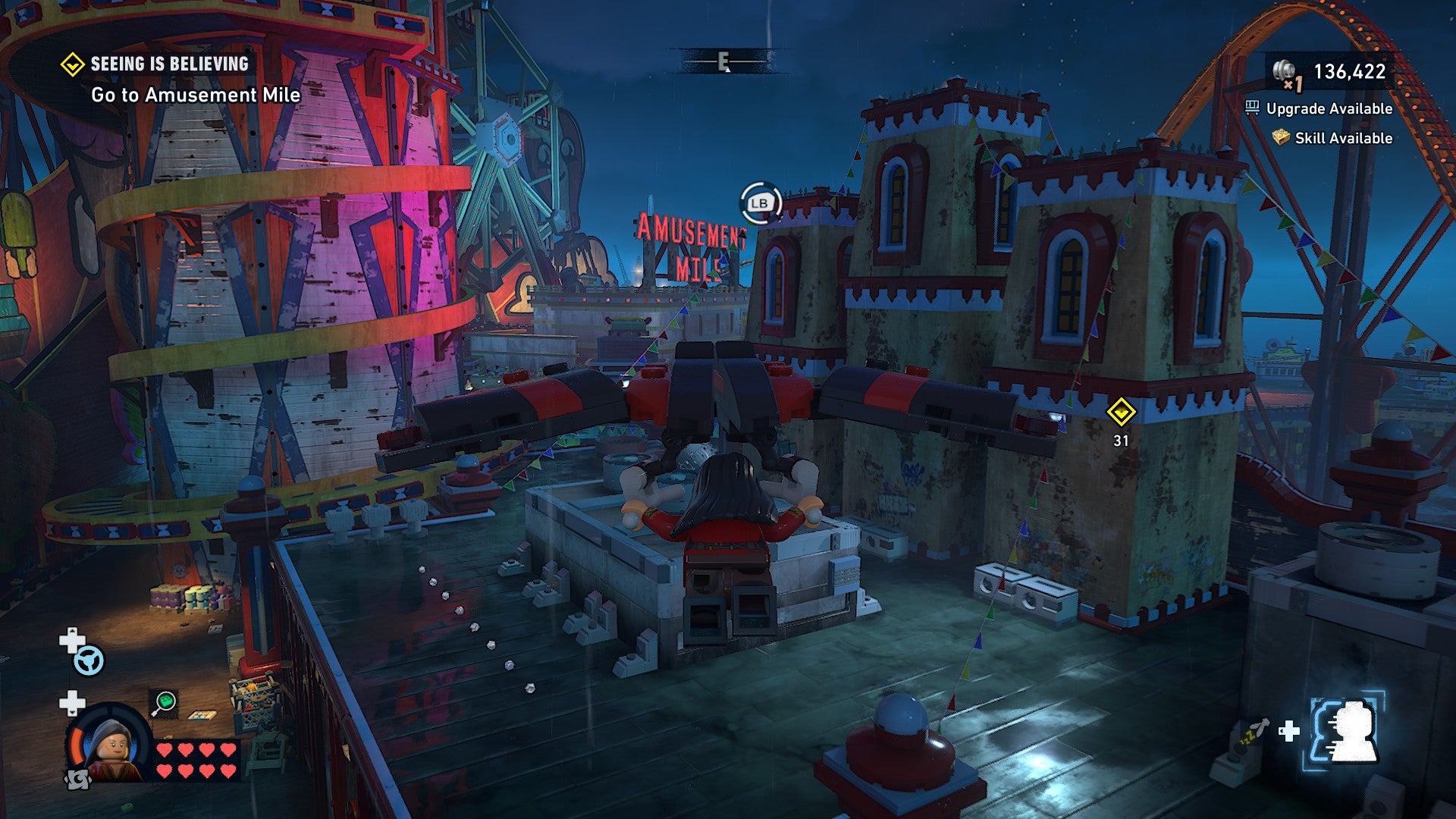
And then there are the missions, which lead you through specific locations, stringing together fights and bosses, but also puzzles and set-pieces and gags. Batman always has a side-kick, because the game is designed around couch co-op and the side-kick always has a bunch of special abilities. Catwoman can cut through glass and can climb walls, and can also summon a cat that can crawl through vents. Robin can tether objects together and pry open doors, amongst other things.
Even Commissioner Gordon gets to have a bit of fun with a gun that can clog up machinery. Alongside Nightwing and Talia Al Ghul, who has a really ingenious power I won’t spoil, only Batgirl slightly disappoints. She can conjure a drone that can become a tether point and she also has a tech-hacking mini-game gadget. Compared to the others, particularly Catwoman and Talia, her sections feel a little slow.
Some missions require that you switch back and forth between a handful of side-kicks and their abilities, and they also shower you with collectibles and nice-to-have trinkets that you can see but can’t immediately reach. There’s also the endless parade of villain cameos and the film references and the fighting, all of which is enough to distract from the fact that, as with a lot of Lego games, you can see the handful of game design pieces that the developers have to deploy fairly openly.

Combat. Puzzle. Combat. Smash everything to make an unlikely Lego device to open a door or cross a gap. This works because it’s all handled with flair and good humour, I think, and because it’s perfect fodder for a knock-about co-op game you play with kids. So much silliness can erupt on the way to a simple objective.
A few things stand out as pleasant surprises here, incidentally. The first is that a kind of streamlined Detective Mode is very good for the moments when the Lego games’ somewhat scatterbrained approach to puzzle design becomes a little too inscrutable. As a result, there aren’t a lot of moments to get stuck here, regardless of how weird a solution turns out to be.
The second thing is that the combat system allows for surprisingly enjoyable stealth too. Part of what I love about the Arkham games isn’t the Freeflow combat so much as the predator moments where you’re hiding in the shadows and working out how to pick people off. Legacy of the Dark Knight doesn’t go as deep as that, but it still has a surprising number of moments where you can work your way through a space, taking out security cameras, inserting yourself into patrol routes, bonking people on the head before they’ve seen you and zipping back into the shadows again.
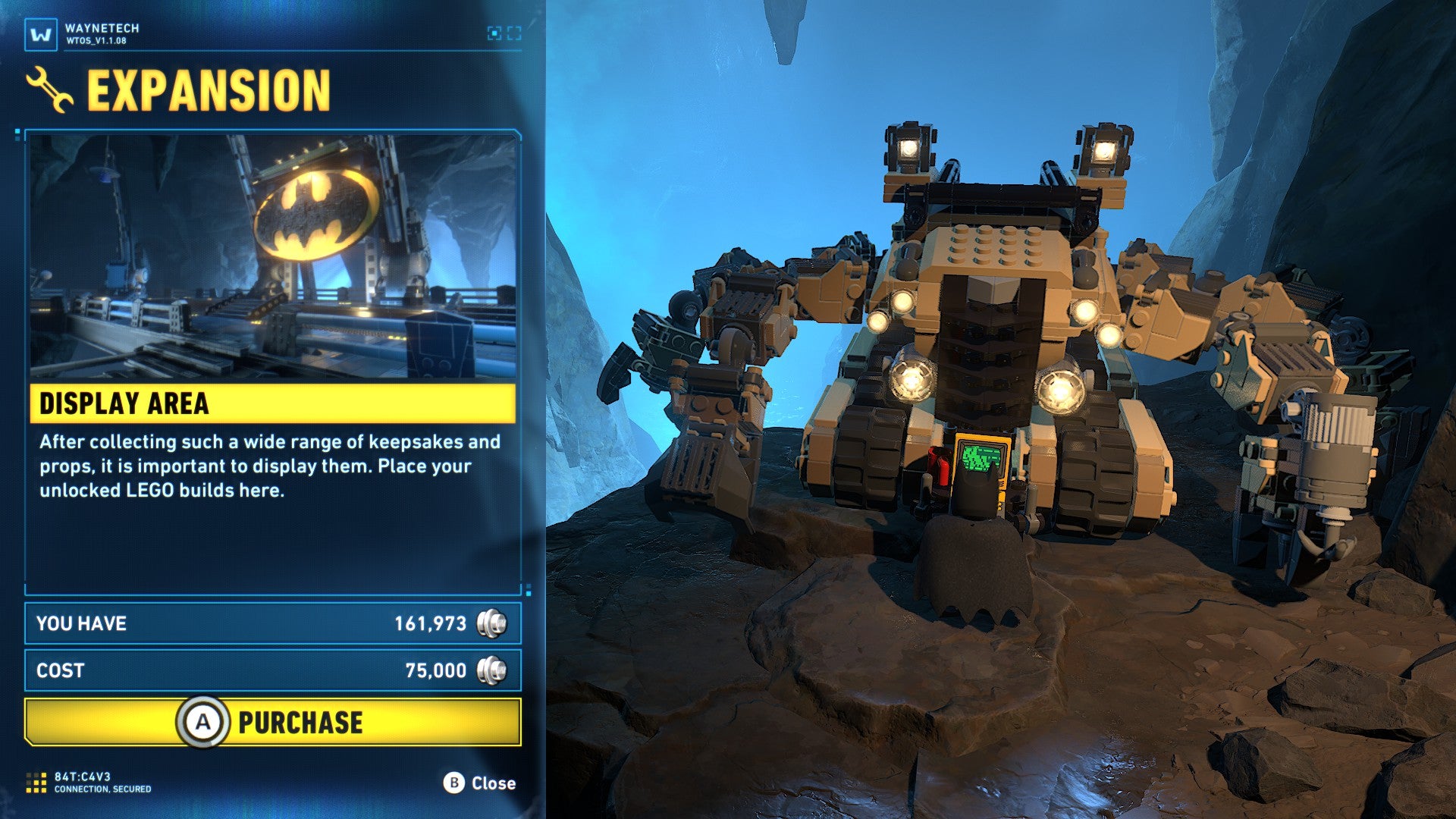
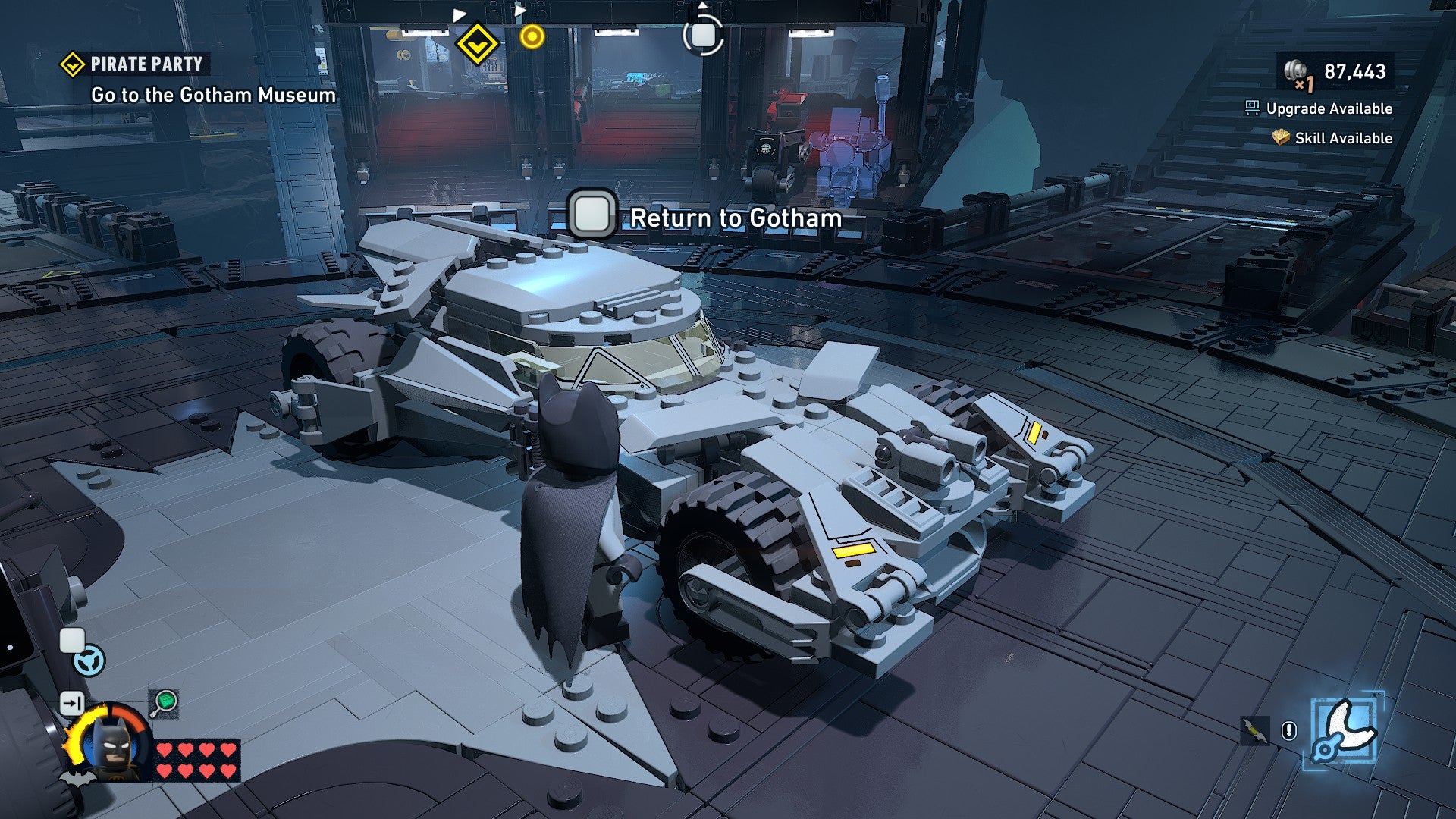
It makes for a campaign that’s generous and charming and absolutely filled with love for Batman and his extended universe. Sure, there’s Poison Ivy and Two-Face, but Legacy of the Dark Knight also drops references to Bat Mite and the Grey Ghost. There’s a whole Bat Cave waiting for you to trick out with collectibles and expand and fill with unlockable suits. You can take to the streets of Gotham in satisfying versions of the Batmobile from the recent movie or the Tumbler from the Dark Knight, or something far stranger. (Driving stuff is fun, incidentally, because it often is largely incidental. There’s little of Arkham Knight’s endless desire to make the car part of the mission. It’s just an optional way to get around when you’re tired of soaring about on your cape.)
There are a few moments when things falter. You can get stuck on the edges of the Lego world now and then, and while it’s fun to track down Waynetech Caches around the city, I can’t really say I used the currency I contained to upgrade a gadget in an interesting way, just as I didn’t find anything too thrilling in any of the characters’ skill trees. There are also moments when aping something like the Arkham games so closely just reminds you of all the ways those games feel so much better. The boost grapple in Arkham City, for example: it makes you feel like you’re tethered to a 747. Its equivalent here is merely fine.

But these are small things to get annoyed about in a game that’s filled with so many other small things that have been included just to make you laugh, or to surprise you, or to make you think back to a comic book story you haven’t thought about in 30 years.
If you’re following the comics today, incidentally, you’ll know that Batman’s currently divided between the horror-adjacent Absolute line written by Scott Snyder and a deeply charming run written by Matt Fraction in which Bruce Wayne is just a sweet, kind fellow, of the kind that Fraction is so good at conjuring. In the comics, in other words, you have your choice of Batman. And you probably always have. And that’s the truth that the Lego games orbit so effortlessly. Every kind of Batman is in here. Everything has a part to play.
A copy of Lego Batman: Legacy of the Dark Knight was provided for this review by Warner Bros. Games.