dailynewsnblog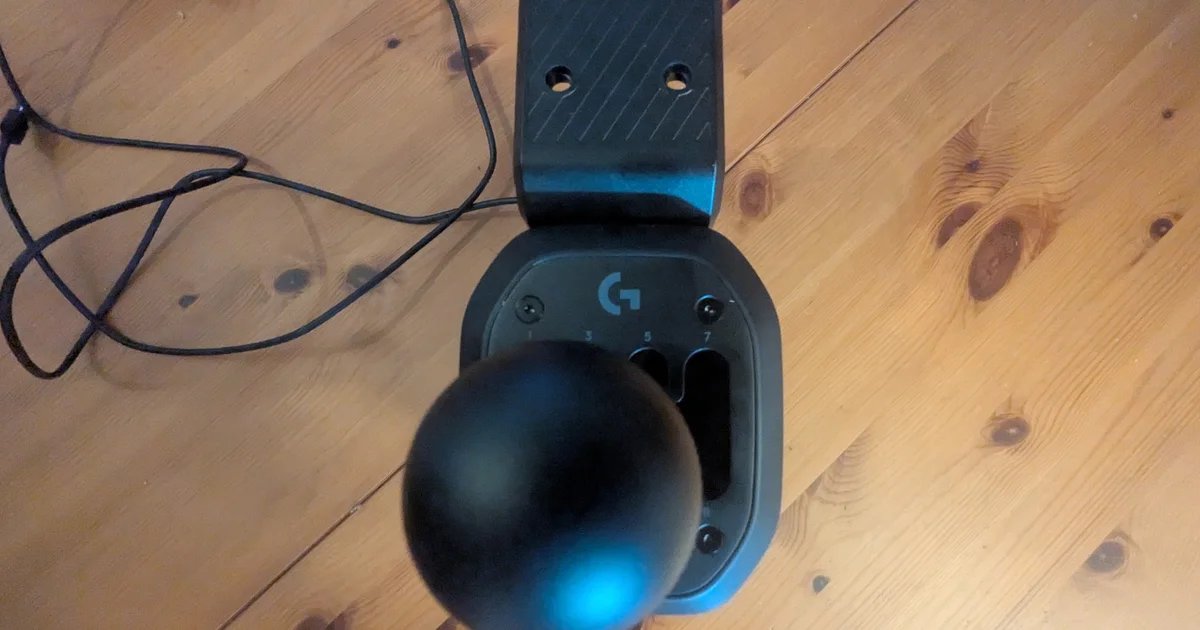
I’m sitting in the pit lane at Donington Park circuit.
My car’s a 1992 Mercedes 190E Evo 2, a blocky German touring car ideal for close-quarters racing. I’m hoping I’ll be able to get it into first gear. You see, while the new Logitech RS H-pattern gear shifter I’ve been testing out has proven easy to set up with 99% of my racing library, introducing it to Raceroom Racing Experience has proven a bit more eventful.
That’s not the shifter’s fault. Raceroom, the quirky rain-free and slightly aged bloke that it is, is being a bit eccentric. Most PC racing games are designed to let you drive any of their cars with whatever mishmash of compatible hardware you’ve got – controllers, wheels, keyboards, full rigs that take up half a room. You can bind anything to any button, and be merrily shifting away with flappy paddles in Euro Truck Simulator as you watch your avatar do the same with the proper gear stick that actual trucks have. Raceroom, by default, has no such patience for your whims.
Its cars permit three types of gear shifting. One, paddle shifting, which requires flicking the plastic or metal triggers found on most racing wheels; one paddle goes up through the gears one by one in order and the other goes back down. Two, sequential shifting, which goes up and down through the gears in order as paddle shifting does, but can use a gear stick that just moves directly forward and back to do it rather than wheel triggers. And three, there’s the most old school, and the one your road car likely uses if it’s a manual: H-pattern shifting. Moving the stick up and left gets you into first gear, back from there goes into second, up and slightly to the right grabs third, directly back from third is fourth, and so on. You move your stick horizontally to slot it into each gear, rather than the more racing car-oriented methods that just entail pushing or pulling forward or back to immediately bump up or down a single gear.
In Raceroom, each car specially matches its shifting style to that of its real life counterpart. So, if you try to change gear in a sequential shifting car with an H-pattern shifter you’ve just plugged in, nothing happens. I can’t recall the opposite ever having been a problem for me, which is curious, but also I assume part of a test specifically aimed at H-shifter users. Because as far as I can tell, Raceroom doesn’t clearly tell you, when you’re picking a car, which type of shifting it uses. Cue me and a bunch of forum users having to find out via trial and error, like we’re playing some sort of car nerd carnival game.
Up until giving this RS H-Shifter a go, I’d managed to log about 400 hours in Raceroom without ever running into its H-pattern mystery box. As much as racing games have always been my bread and butter, starting off with arcade romps like Burnout Paradise as a kid and branching out into sims as I’ve gotten older, I wasn’t a manual gear shifter until a couple of years ago. Even after learning to drive an H-pattern car in real life, I tended to stick with automatic in games out of muscle memory and a struggle to multitask at the speed required for it when going flat out down twisty trails or while wheel-to-wheel with foes. I’ve since made a concerted effort to get into the manual shifting grove, initially via my Logitech G29 wheel’s built-in paddles. Trying out this RS H-Shifter has been my first proper crack at using a physical gear stick for it, and it’s gone more swimmingly than I thought.
To be fair, the RS H-Shifter’s clearly built to be as accessible and user-friendly as the G29 is. Both I’d class as being just above entry level sim racing hardware, costing a fair chunk less than the more complex or customisable rigs and wheels you might splash out for if you spend every weekend on iRacing or are a professional driver looking to have a bit of job-adjacent fun. All I want from racing hardware is something that can be set up in a few minutes by simply strapping it to my desk and then provides a solidly realistic feel as I pound around some virtual laps, slam into people in Wreckfest 2, or do some truck simming for a few hours at a time.
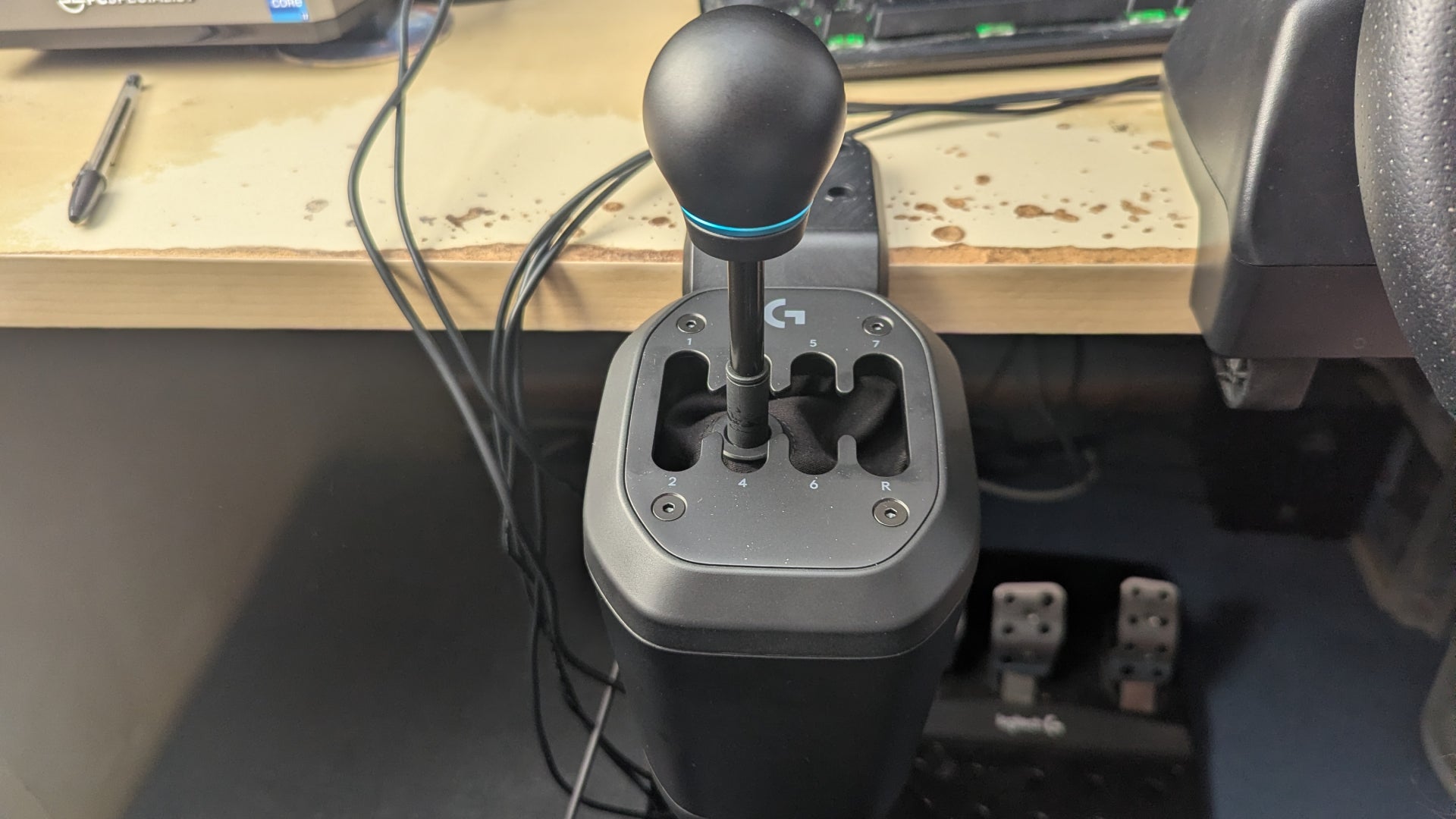
On that front, the RS H-Shifter’s brill. There are only three bits to stick together out of the box, with a gear knob slotting onto the stick protruding from the gearbox itself, then a desk clamp attaching to the gearbox with four nicely chunky screws. From there, you wind the clamp up until it’s tight on your desk or table, plug the cable directly into the back of your PC (console users need an extra adapter that’s sold separately), and you’re good to go.

Outside of the uniquely funky Raceroom, once you’re in-game, getting the RS H-Shifter set up to work alongside your wheel and pedals typically only takes a quick trip to the settings and a few minutes checking that each gear is properly bound to the right gear on the shifter. Then, it’s into the cockpit. Because I’m a masochist, I figured I’d try some stages in the ruthlessly unforgiving Dirt Rally 2.0 first. The classic 60s Mini Cooper’s small enough to fit between gaps into the trees, and its four-speed box served as an ideal intro to the H-pattern life. While I’ve tried Dirt Rally’s range of classic cars with paddle shift before, having to clunk up through the Mini’s four gears in the fashion you would do in the real car certainly adds something extra tactile to the sensation of being behind the wheel. Learning to listen to the engine revs rising in order to pinpoint when you should change up becomes even more important when you’ve got to flick a stick up, down, left, or right, rather than just pushing to click instantly into the next gear.
With the RS H-Shifter, this is especially true when the time comes to shift into the top gears, as I discovered as I progressed up the historic rally ladder into the likes of Ford Escorts and Lancia 037s. The first four gears, being closest to when the stick naturally settles on the box’s left hand side, are easy to slot into. Fifth and sixth come with a bit more resistance as you pull the stick further to the right. Getting in seventh or reverse on the far right often requires a full on fight. The latter means that if you spin out or crash, as is wont to happen in racing games, you’d better be a bodybuilder if you’ve hopes of quickly backing out of whichever scenery you’re lodged in. The brand-newness of the RS H-Shifter I was using might account for some of this stiffness, but it was bad enough for me to be worried that if I had to go for those gears too often or dived for them too forcefully, I might damage the shifter.
Another hangup I discovered as I raced on into the likes of Automobilista 2, Wreckfest 2, and Forza Horizon 5 is that, if you instinctively go to tighten up the shifter’s clamp after a fight to get it into reverse pivots the whole box slightly to right, you can end up in a bit of a pickle. This was likely down to my wooden desk being a bit old and past it, but I did end up drilling a small hole into the underside of it as a result of some overzealous cranking (yep, there are two of us now). The good news is that since that moment of ‘Oh, that’s not ideal’, I’ve not had any repeat incidents.

That isn’t to say that when I delved into American Truck Simulator with the shifter, I avoided having other kinds of incidents. Since trucks have a boatload more gears than cars, the truck sims are unsurprisingly a bit more complex to set up with the 7-speed h-shifter. Since I’d be driving a vehicle with nearly double the number of gears than the shifter has slots for – 16, not counting reverse or crawl gears in the case of my Kenworth W900 – ATS had me pick how I wanted it to split up those gears across multiple layouts of the shifter’s inputs, which I could then switch between on the fly by pressing buttons on my wheel. Since it’s the simplest, I went for a range transmission. This meant I’d shift up through the first six or seven gears, then push the button so I could shift up from eighth up to about thirteenth, pushing the button again to access the topmost gears. Shifting back down required the opposite, with each separate collection of gears having a different speed of reverse gear attached to it.
This takes some getting used to, but it also emphasises one area in which H-pattern shifting proves superior to sequential or paddle shifting: block changes. Rather than having to go through each of the truck’s relatively short gears in numerical order every time, making it a faff to get up to speed after stopping at traffic lights, you can easily slide up from first to fourth if you’ve got enough revs on. From there, I tended to slide up to sixth, then about ninth to take me up to about 30mph, then on to twelfth and sixteenth once I hit the highway. It went really well, right up until I nearly missed a turn off because I was vibing too hard and rolled it after failing to shift down from sixteenth in time as I jammed the anchors on.
All in all, I’m not sure I’ll end up a full-time H-pattern convert going forwards thanks to Logitech’s RS H-Shifter, but I can certainly see myself whipping it out if I want an extra challenge or dose of realism when hopping behind the wheel of a truck or retro racer. Now, if you’ll excuse me, this Merc 190E in Raceroom has let me H-shift into first, so I’m off to fly down the Craner Curves.