dailynewsnblog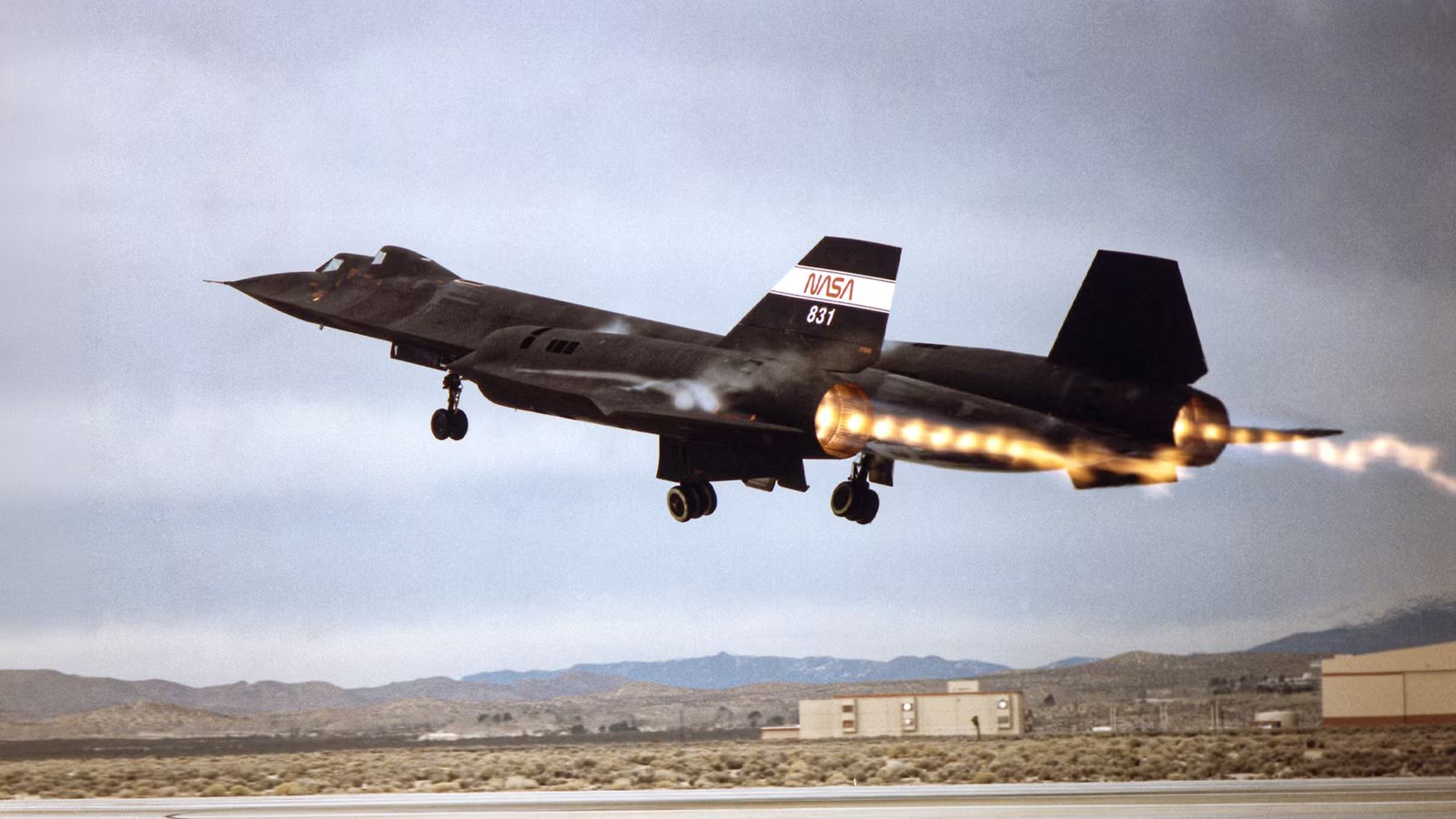
The Lockheed SR-71 Blackbird remains the unchallenged champion of speed in the flying world. It is true that some unmanned Hypersonic vehicles have surpassed the Blackbird in speed, but no manned aircraft has ever come close to touching its record. In a final act to cement the legacy of the legendary Skunk Works spy plane, its final journey was one of its most epic and went down in the record books as one of the fastest flights of any plane in history.
Piloted by US Air Force Lieutenant Colonel Yielding with reconnaissance systems officer Lieutenant Colonel Joseph Vida in the backseat, Blackbird serial number 61-7972 would set four official world records on March 6, 1990. The transit from coast to coast only took 64 minutes and 20 seconds from the moment the Blackbird took off from Los Angeles and touched down in Washington DC.
Flying at an average speed of Mach 3.3 and hitting 2,242.48 mph, the skin of the SR-71 could exceed 600 degrees Fahrenheit (315 degrees Celsius). The Blackbird was turned over to the Smithsonian Institution after it was set down in the nation’s capital, where it would be prepared for the display hangar that has been its home since 2003. And to this day, the legendary jet can rest easy knowing that its place in the annals of aviation history is secure.
The Coast To Coast Record

The primary record for the definitive journey in the history of the SR-71 program was the overall speed between Los Angeles and Washington DC. This performance represented the aircraft’s incredible ability to sustain exceptionally high supersonic speeds over long distances. The Blackbird remains unique for its ability to cruise at incredibly high supersonic speed, unlike many interceptors that can only hit Mach 3+ for short bursts before overheating or running out of fuel.
The National Air and Space Museum notes that the aircraft actually became more fuel-efficient the faster it flew due to its unique J58 turbo-ramjet engines. The 2,144.83 mph average, or roughly Mach 3.25, includes the time spent accelerating after the initial midair refueling and the deceleration for the descent into Dulles. Maintaining this average of over 2,300 miles is what secured the transcontinental record.
This stunning speed was achieved as the airplane flew over the Midwest at 80,000 feet with maximum afterburner engaged. The Pratt & Whitney J58 engines functioned as turbojets at low speeds but transitioned into ramjets above Mach 2.2, using a specialized JP-7 fuel ignited by triethylborane, according to MigFlug. The peak speed and exceptionally high average speed that the jet sustained from the West Coast to the East Coast shattered the intermediate records it set on its final trip.
From St. Louis To Cincinnati

During the cruise phase at approximately 80,000 feet, the aircraft hit a peak of 2,242.48 mph, or roughly Mach 3.4. At full military power, the Blackbird covered 311 mi between St. Louis and Cincinnati in just 8 minutes and 32 seconds. This section of the intercontinental transit was the fastest segment of the overall flight. The air crew pushed the jet to its full performance potential as they shattered the skies over three states in less than 10 minutes.
This specific record was accepted by the National Aeronautic Association as an official world speed record over a recognized course. The average speed the jet maintained over the segment between the two Midwest cities was 2,189.94 mph, which is approximately Mach 3.32. According to pilot Ed Yielding, they were traveling so fast that the on-board navigation systems struggled to track their ground position in real-time, according to TheSR-71Blackbird.com.
The SR-71 Blackbird’s record-setting flight on March 6, 1990, serves as a real-world demonstration of the ‘speed as defense’ philosophy it utilized for over 20 years of active service. This tactic was successful against more than 4,000 attempted missile launches during its career, with zero combat losses, as SOFREP recounts.
Even the fastest adversary interceptors could only sustain top speeds for brief moments, which never gave them enough time to successfully intercept the Blackbird. The same is true for the missiles that are capable of flying faster, but by the time they reach the altitude of the SR-71, their energy to maneuver was already used up.

How Fast Can A B-1 Lancer Go?
The prototype B-1A raced past Mach 2 while the production B-1B breaks the speed of sound with a belly full of ordnance to this day.
Kansas City To Washington DC

The Blackbird holds the record for both its coast to coast flight time and the St. Louis to Cincinnati transit time. On top of that, the jet was crowned as the fastest aircraft to ever fly between Kansas City and Washington DC at a time of 25 minutes and 58.53 seconds. This leg was 942.08 miles long, and the Blackbird sustained an average speed of 2,176.08 mph along the way, according to the Aviation Geek Club.
On this segment, the Blackbird held its speed at an average of 2,176.08 mph, crossing almost a third of the United States at Mach 3.2 in less than half an hour. At this stage in the flight, the SR-71 had already refueled and reached its maximum cruise altitude. For comparison, a modern commercial flight between these two cities typically takes about 2 hours and 30 minutes.
Once again, Yielding and Vida showcased the pure power and brutal speed that made the SR-71 such a powerful asset to the Central Intelligence Agency in the United States Air Force for decades. That speed allowed the aircraft to be targeted by approximately 800 missiles in Vietnam alone without a single hit, demonstrating the reliability of its defense tactics time and again, according to 19FortyFive.

Why Is The F-22 Raptor Slower Than The 52-Year-Old F-15 Eagle?
Stealth and maneuverability versus unbridled power and speed – discover how two great American jets stack up, head to head.
Speed As Defense

The SR-71 Blackbird’s history over enemy airspace is defined by its near-invulnerability, having successfully evaded thousands of SAMs during its three decades of service. Its primary defense was simply its speed and altitude. While the SR-71 frequently “peeked” into the Soviet Union from international airspace to monitor nuclear submarine fleets and troop movements, it also conducted direct overflights of Vietnam, Libya, Cuba, Nicaragua, and parts of Africa.
The Mikoyan-Gurevich MiG-25 Foxbat and MiG-31 Foxhound are excellent examples of how the speed of the SR-71 was completely overwhelming compared to the aircraft that it was most closely compared against. Though capable of Mach 3.2, the MiG-25 suffered severe engine damage if it sustained those speeds and lacked the altitude performance to effectively engage the SR-71. Developed specifically to counter the Blackbird, the MiG-31 featured advanced digital radars and R-33 missiles, but never succeeded.
While some surface-to-air missiles could reach speeds of Mach 3.5+, they used most of their fuel just climbing to the SR-71’s 80,000+ foot altitude. Over Libya, Major Brian Shul pushed the aircraft to Mach 3.5 to outrun multiple SA-2 and SA-4 missile launches, calculating that his superior speed would allow him to beat the missiles to his next turn. By the time they reached that height, they were often coasting on a ballistic arc with little maneuverability remaining to track a Mach 3 target that was already miles away.

The 5 Fastest Fighter Jets In Service Today
A closer look at the world’s highest performance warbirds.
The First Stealth Jet: Pioneer Of Low Observability Technology

The aircraft achieved its legendary survivability in hostile airspace by complementing its incredible speed with two other unique qualities. The trifecta of super high speed, an early form of stealth, and an innovative new electronic warfare suite combined to make the Blackbird an untouchable phantom of the sky. The ‘iron ball’ paint even contained iron-ferrite particles that absorbed radar energy as well as dissipated the intense heat of high-speed flight.
The aircraft was designed with a reduced radar cross-section, roughly equivalent to a small Cessna, making it difficult to track consistently. While not a true stealth aircraft like the F-117, the SR-71 was the first operational plane designed with a reduced radar cross-section. Its flattened fuselage, sharp aerodynamic chines, and inward-canted tail fins were designed to reflect radar waves away from the source. Sawtooth-shaped composite panels were also built into the structural edges of the airframe.
The RSO operated sophisticated jammers that blinded enemy radars, often preventing them from securing a firing solution until it was too late. Instead of just blinding enemy radar, which would alert them to the aircraft’s presence, the SR-71 used a system designed to memorize incoming radar signals. It would then broadcast a slightly stronger return signal to feed the enemy false range, velocity, or altitude data. This deception created ghost blips on enemy scopes miles away from the plane’s actual location, causing missiles to fly toward empty patches of sky.
To hide the massive radar return of its ionized engine exhaust, engineers occasionally used a cesium-based fuel additive that created a ‘plasma stealth’ effect to reduce the visibility of the exhaust plume to radar. The combination of stealth and speed created a very narrow engagement window for enemy defenses. Because the RCS was reduced to the size of a small private plane, enemy radars couldn’t detect the SR-71 until it was already much closer than a standard jet.
By the time a radar operator secured a lock, the Mach 3+ speed meant the aircraft was often already leaving the missile’s effective range. In addition to defense, the SR-71 carried sensors to record the strength and wavelength of enemy radar signals, effectively mapping hostile air defense networks during every mission.