dailynewsnblog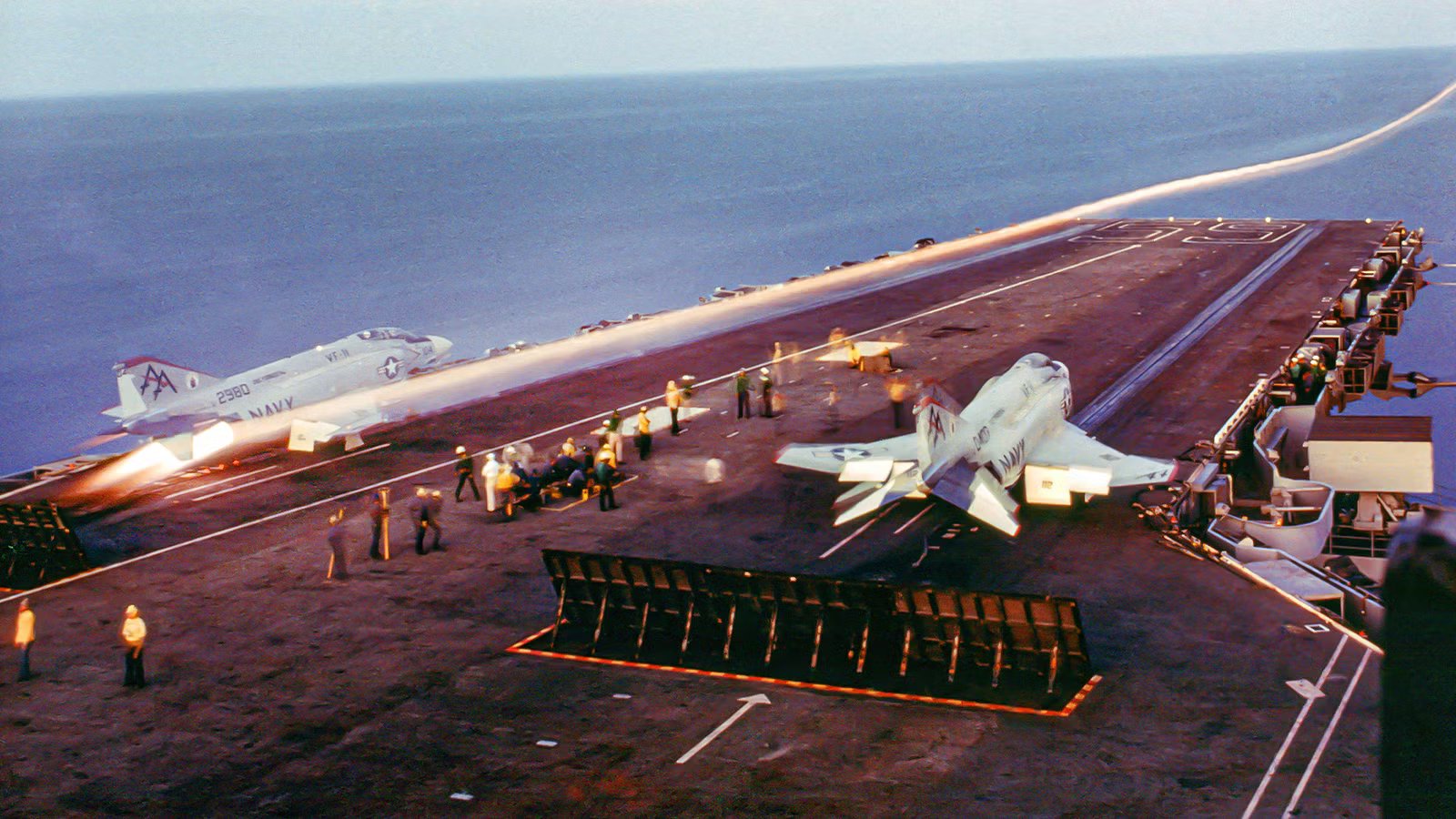
The McDonnell Douglas F-4 Phantom II is still one of the most mass-produced fighter jets in American history. While it is well remembered for pioneering the role of ‘Wild Weasel’ in the US Air Force, its critical influence on the US Navy is overshadowed. Even though the Grumman F-14 Tomcat earned its place in history as the face of American Naval Aviation thanks to the Top Gun movie series, much of its technology and tactics were born from the F-4.
The F-14 is still the fastest and best dog-fighting jet to fly off the US Navy aircraft carrier, but the F-4 pioneered the ‘missileer’ strategy employed by the Tomcat’s long-range air-to-air missile systems. The F-14’s emphasis on beyond-visual-range, high-speed tactics is also derived from the strategy developed when the F-4 debuted as the first Navy fighter without a gun. What the Phantom lacked in agility, it made up for in flexibility, proving to be a reliable and capable platform for virtually any mission.
In fact, the successor to the F-14, the McDonnell Douglas F/A-18 Hornet, dropped many of the aerial-superiority characteristics of the Tomcat in favor of more multirole features that hark back to the F-4. The Lockheed Martin F-35C, the Navy’s first stealth fighter is also a ‘spiritual successor’ to the F-4, both tactically and strategically, as a universal platform for the US Armed Forces and America’s allies.
DNA of a Gunfighter: The Phantom’s Crucible

Known as the ‘Lead Sled’ by many, the F-4 couldn’t compare to the F-8 Crusader of its own era in a dogfight, and led the Navy to pursue a more agile fighter. Yet its adaptability to a variety of mission sets, even capable of switching from air-to-air to air-to-ground on the same sortie, proved to be a constant in modern tactics. Still, compared to the F-8, which was known as the last gunfighter, the F-4 suffered severe air-to-air losses due to unreliable missiles.
In WWII, US Navy pilots enjoyed a kill ratio of 14:1 against Imperial Japan and a similar ratio of 12:1 over Korea. Yet when the hostilities broke down in Vietnam, that number dropped to an abysmal 2.5:1 in the early years, as MHN wrote. A Navy investigation led by Captain Frank Ault concluded that the issue was not the lack of a gun but inadequate training in missile systems and dogfighting. This led to the creation of the Navy Fighter Weapons School, also known as TOPGUN, in 1969.
This is the watershed moment that led to the Navy’s dramatic jump in kill ratio later in the Vietnam conflict, while the US Air Force continued to struggle to move the needle. Phantom pilots learned to fly their jet as if it were a gunfighter to keep their missiles on target until they successfully downed enemy fighter jets. The Navy also developed external gun pods as backup weapons, and these combined improvements led to its kill ratio climbing back to 12:1 before the American withdrawal.
Sharing the Cockpit: Two Seats, One Fight

Although the F-4 Phantom showed the vulnerabilities of deploying a fighter jet without an internal gun, it also highlighted the strengths of having an air superiority platform with two seats. Combat in Vietnam showed that while the pilot was ‘yanking and banking’ to maneuver the fighter jet at high speed under heavy g-forces, having a radar intercept officer in the back to operate the weapon systems for the complex radar and missiles was a powerful force multiplier. When the Tomcat was built, a two-man crew was adopted from the outset, and no single-seat variant was ever constructed.
Maximizing crew resource management was one of the greatest strengths of the F-4, and the tactics of the Naval Aviation community have continued to emphasize CRM as a decisive factor in any engagement. The F-14 did, however, incorporate an internal 20 mm cannon to eliminate the vulnerability that Phantom crews experienced. The Tomcat’s swing wings and bubble canopy also solved agility and targeting problems experienced by F-4 pilots in combat, making the Carrier Air Wing even more lethal.
The Navy also insisted on producing twin-seat models when the Hornet, and later Super Hornet, was developed to succeed the F-14. While there are some single-seat F/A-18s, these jets are rarely launched on their own, and any sortie typically includes at least one twin-seater in the mix. Although the Navy’s first stealth fighter did not follow this doctrine, it does incorporate the most advanced pilot-assistance technology ever created to reduce the pilot’s task burden, allowing focus on the mission rather than the mechanics of flying.
The F-35C Joint Strike Fighter is an exception only because the weapon systems have been automated so extensively that the pilot no longer has to perform many of the tasks required to operate them. As a ‘flying supercomputer,’ it has a display built into the helmet and even voice command functions.
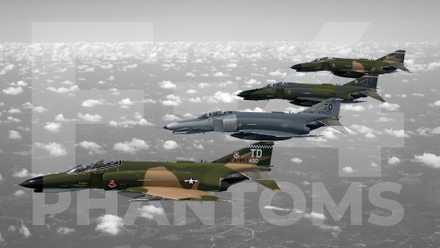
How Many F-4 Phantoms Are Left?
Almost 100 McDonnell Douglas F-4 Phantom IIs are still in service around the world today.
21st Century Tactics: Information Dominance

Top Gun tactics taught the Navy that a fighter jet must be lethal at all distances, not just one. Despite the fact that the F-35C looks completely different from the fighter jets that came before it and uses a completely different technological approach to accomplish this mission, the philosophy is the same. Just as the F-4 did not use a gun as its primary weapon, the F-14, F/A-18, and F-35C have steadily moved away from the cannon while retaining the tactical skills and concepts of the F-8 gunfighter.
The transition of naval aviation tactics over the decades reflects a shift from manual maneuvering to automated network-centric warfare, yet the core principles remain unchanged. F-8 pilots contributed aggressive energy management, while F-4 crews mastered the weapon envelope ‘basket’ to know exactly when a missile would track or fail. They created the ‘Loose Deuce’ formation, switching between offensive and defensive roles, as the Aviation Geek Club wrote. The Tomcat and Hornet essentially use the same tactics, with refinements for higher performance and longer weapons ranges.
The F-35C uses artificial intelligence instead of dividing the task of manipulating radar settings to build a mental picture of the sky. The JSF uses computers to leverage the power of the data link to engage targets spotted by other platforms or to pass its own data to another unit. As the stealthy ‘quarterback’ of the kill web, it can find the enemy with complete immunity and allows it to be lethal from any distance, without even firing a shot.
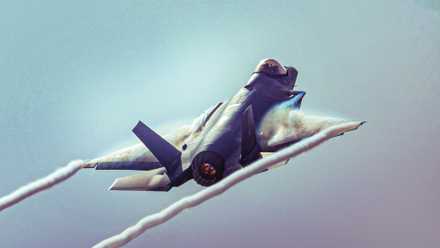
Why Some Of The Most Advanced Stealth Fighters Don’t Have Guns
The next-gen weapons replacing machine guns.
Adapt to Overcome: The Phantom’s Lesson

When the F-4 Phantom debuted, it was far from an ideal dogfighter. It was heavy, bled energy rapidly in tight turns, and completely lacked an internal gun. Over Vietnam, the same aircraft that was intercepting MiGs at high altitudes was also diving into the weeds to deliver devastating close air support to troops on the ground. Heralded as the ‘Triumph of thrust over aerodynamics,’ the Phantom could not outturn a Soviet MiG, but it could simultaneously perform fleet defense, tactical bombing, reconnaissance, and suppression of enemy air defenses.
Catch what other flight trackers miss
Emergency squawks, holds, NOTAMs — live signals, no signup.
Open tracker
Catch what other flight trackers miss
Emergency squawks, holds, NOTAMs — live signals, no signup.
Open tracker
When the Tomcat arrived, the Navy temporarily swung the pendulum back toward pure air superiority. Its primary mission was fleet air defense using the massive, long-range AIM-54 Phoenix missile, and its multirole capability was initially sidelined. However, toward the end of its service life, the Navy retrofitted the Tomcat with the LANTIRN targeting pod, transforming it into the ‘Bombcat’ to finally take up the mantle that the Phantom held before it.
The Super Hornet fully embraced the multinational role from conception, being described as a ‘strike fighter’ from day one. The F/A-18 was a step backward in performance as an air superiority fighter, but it is a much more reliable and rugged workhorse for every other mission set. That compromise enables a flight of Super Hornets to fight their way through enemy aircraft using long-range AMRAAM missiles, then drop precision-guided bombs in enemy territory and return to the ‘boat.’
The JSF follows in the footsteps of the F-4 as a universal platform, or a flexible jack-of-all-trades. As the sensor node in a system of systems, the F-35C fills the apex position in the hierarchy of the Carrier Air Wing’s new ‘high-low’ fleet structure. What that means is that the JSF is the ‘exquisite’ platform that penetrates deep behind enemy air defenses and then coordinates with Super Hornets loaded with standoff munitions to strike enemy targets that the F-35C paints using its sensors, all while flying undetected through hostile airspace.
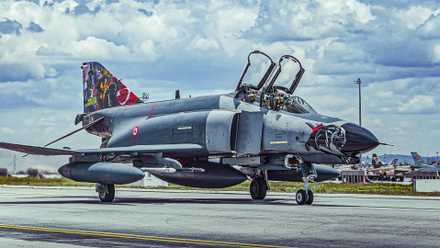
How Fast Can The F-4 Phantom Fly?
A closer look at what made the McDonnell Douglas F-4 Phantom II so special.
Beast Mode: The Indelible Mark of the F-4

Perhaps the most glaring evidence of the continued influence of the F-4 Phantom on Naval Aviation is the F-35C’s ability to ditch its deltiness and instead reconfigure for what has been dubbed ‘beast mode.’ When it comes down to the wire, the JSF can carry over 16,000 pounds of weapons on external wing pylons just like the Phantom did. In permissive skies where anti-aircraft weapons are scarce, but troops need support, this is an invaluable capability for the exquisite stealth fighter.
Looking ahead, the F-35C will carry the torch once held by the F-4 as the fleet’s multirole strike fighter alongside the Super Hornet until the next-generation F/A-XX fighter enters service. When it does, the F/A-XX will reclaim the top spot as the apex predator of the fleet. When the last Super Hornet is sunset, the F-35C will persevere as the ultimate jack of all trades, strike fighter for the US Navy on the battlefield of tomorrow.