dailynewsnblog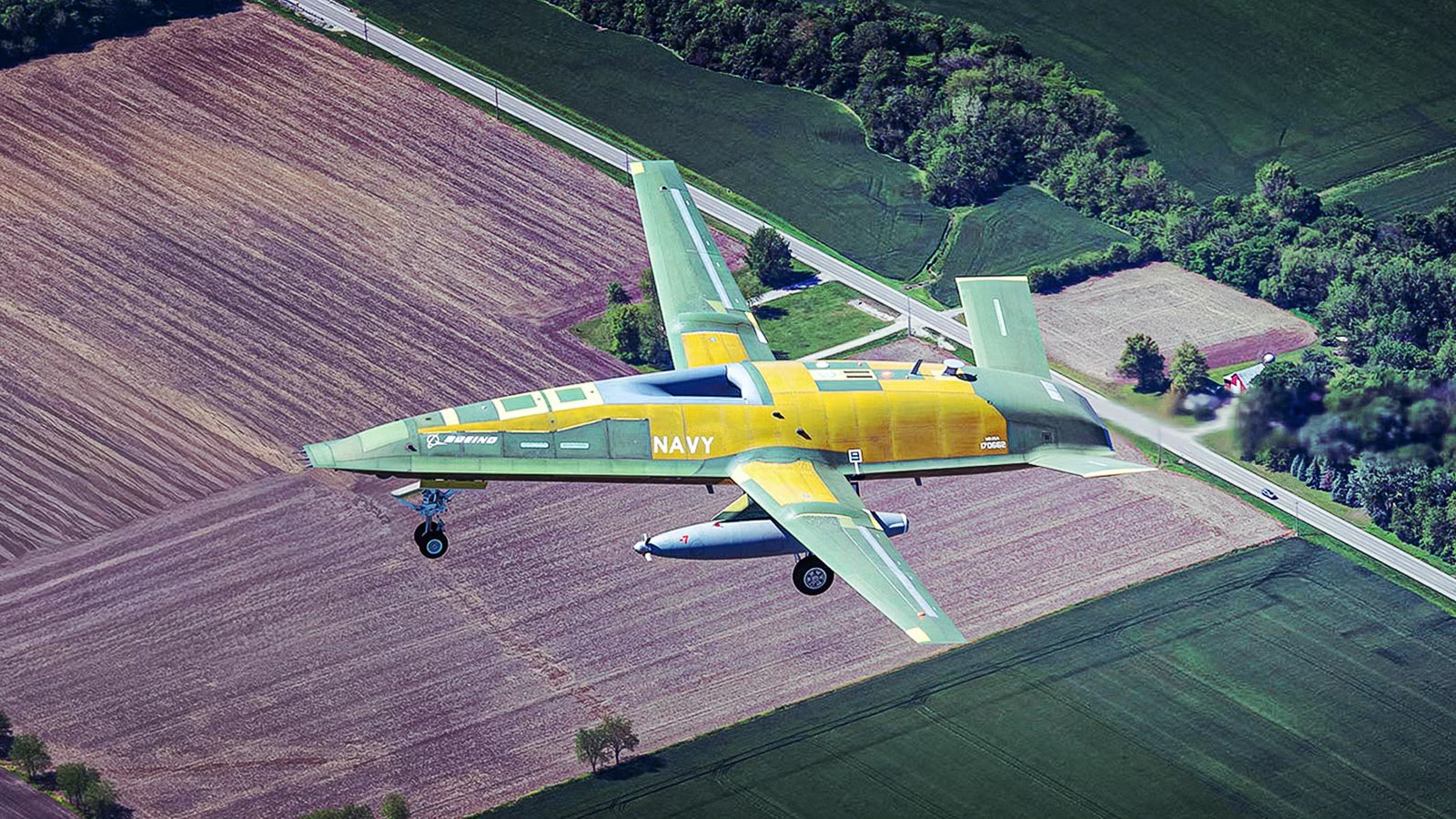
The  Boeing MQ-25 Stingray is beginning low-rate production following the first successful flight of a production-grade example in April. As it enters the final stages of testing before joining the fleet as the first uncrewed aircraft in US Navy Carrier Air Wings, the technology that has made it possible represents a generational leap in autonomous flight, going far beyond simply remote piloting.
While there are Air Vehicle Pilots who can fly the Stingray, it is designed to operate with very little input and fly under supervised onboard autonomy. A human is always in the decision-making loop when the MQ-25A launches, but autonomous software greatly reduces the workload required to navigate. Instead of concentrating on stick and rudder skills, AVPs can focus on the mission while the Stingray handles the flying.
AVPs create the flight path for every sortie and send commands to the Stingray from the unmanned carrier aviation mission control system. The aircraft then translates those commands into control-surface movements and other flight control inputs. That advanced autopilot will allow the Stingray to improve the safety and efficiency of one of the most complex missions in the US Navy: buddy tanking with the carrier air wing.
The Road To Uncrewed Naval Aviation

Testing conducted since 2019 with the Prototype T1 Stingray has refined the design and engineering that have gone into the first production-grade MQ-25A variants rolling off the line. The T1 served to prove the aircraft’s fundamental design principles and pave the way for the upgrades introduced with the first mission-capable examples. From 2021 to 2022, the T1 made history as the first uncrewed aircraft to conduct aerial refueling with piloted planes, including the Boeing F/A-18 Super Hornet and Lockheed Martin F-35C Lightning II, as well as the Northrop Grumman E-2D Advanced Hawkeye.
Software development began three years before the prototype Stingray passed its buddy tanking trials with flying colors. Boeing and US Navy teams worked together to refine the Vehicle Management System computers onboard the T1, which perfectly flew the drone with surgical precision during trials. Years of laboratory testing were vindicated when the Stingray made its own inflight decisions, allowing the crewed fighter jets and turboprop AWACS planes of the Air Wing to safely rendezvous for a fill-up in the air.
A large number of emergency situations were considered during the development of the VMSC that keeps the Stingray safely in the sky. The development team considered everything from communication or GPS navigation failure to engine power loss. Juan Cajigas, MQ‑25 chief engineer, put it:
“We had to consider all the possible scenarios the aircraft could experience in flight and ensure the airplane would autonomously react as we intended.”
The T1 was subjected to over 200,000 hours of lab tests and more than 1,000 hours of ground tests on the prototype airframe to validate its safety-of-flight software, which includes more than 600,000 lines of code. Looking forward, initial operating capabilities are expected to be reached in 2029. The first three planes in Lot 1 will conduct the next round of flight deck tests on active aircraft carriers at sea later this year. Lots two and three are expected to deliver three and five more Stingrays, respectively.
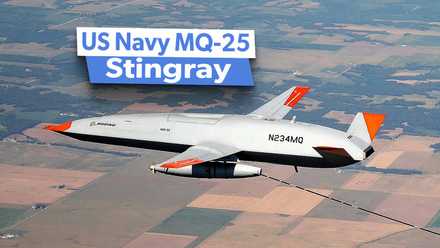
What To Know About The US Navy’s MQ-25 Stingray Aerial Refuelling Drone
The Boeing MQ-25 Stingray is a US Navy refueling #drone designed to extend the operational range of aircraft carriers, reshaping naval operations.
Automating Flight Deck Ops And Air Wing Support

The MQ-25A Stingray represents one of the most extreme engineering challenges in modern aviation history. It takes carrier aviation, historically the most dangerous and unforgiving environment in military flight, and combines it with aerial refueling, a high-precision mission where two aircraft fly just feet apart at 300 knots. The flight deck of a carrier is a tightly packed jigsaw puzzle of roaring jet engines, turning rotors, and human deck crews. The drone will need to maneuver within inches of millions of dollars on the flight deck before a ‘cat shot’ and after every ‘trap,’ and that is the simplest task it will be asked to perform.
To take off, a drone must survive a steam or electromagnetic catapult that accelerates it from 0 to 150 mph in 2 seconds, subjecting the electronics to massive G-forces of the cat shot. Once the Stingray meets up with a fighter jet in the sky, it must navigate a ballet of aerodynamic forces conspiring against it. As the fighter jet works its way through swirling winds to the drogue with its refueling probe, the MQ-25A must maintain the steadiest possible flight path while the pilot of the Super Hornet or Joint Strike Fighter dances with the basket until they connect.
Refueling the F-35C poses a significant financial risk if anything goes wrong. The most challenging airframe in the Air Wing to buddy tank with is actually the E-2D, aka the Hummer. The huge turboprop aircraft with its large radar dome on top experiences far more air turbulence than either of these sleek Navy strike fighters. The Stingray VMSC can recalculate flight surface movements in milliseconds to compensate for air pressure produced by the bow wave that leads in front of the wing’s planes.
To land, it must essentially ‘crash’ into a moving deck, catching a steel cable with an arresting hook. The MQ-25A’s flight computer has to calculate a precise glide slope toward a pitching, rolling flight deck in heavy seas. To successfully ‘trap’ the wire, the VMSC must adjust the throttle autonomously in milliseconds to ensure it hits the exact landing wire without smashing into the carrier’s stern. While all of this is going on, AVPs supervise the Stingray by standing by at the ready in UMCS or an MD-5 Ground Control Station, but will only step in if an emergency unfolds.
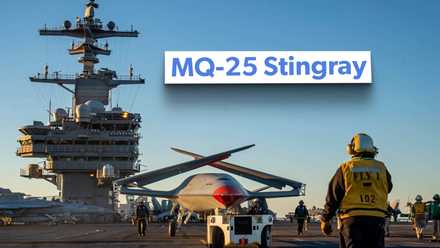
How The US Navy’s MQ-25 Stingray Drone Would Support Carrier Strike Groups
US Navy’s MQ-25 Stingray drone enhances naval aviation with unmanned aerial refueling and flexible support to project power from sea to the shore.
The Stingray’s Endless Evolution

Because a carrier-based drone operates without a pilot to sense crosswinds or handle dynamic engine failures, the onboard hardware and flight software must act as both pilot and navigator. The testing pipeline for the VMSC, alongside the software platforms that power it, highlights several major breakthroughs by Boeing and the Navy. The production-grade MQ-25A Stingray will have an even more advanced form of integrated computer modules being developed in partnership with BAE Systems.
The T1 was built strictly as a rapid prototype to prove a concept, whereas the production computer is built to handle the complex, multi-mission demands of carrier warfare. New systems designed by BAE will replace the federated computer network in the T1, linking multiple modules into a single integrated system with a quad-core processor. In addition to improving computing power, the new system will reduce weight, power usage, and production costs. The simplified avionics will also improve the resilience and ruggedness of the Stingray and even slightly improve payload capacity.
Specification | Boeing MQ-25A Stingray | Boeing F/A-18E/F Super Hornet (Buddy Tanker) |
|---|---|---|
Fuel Transfer Store | 1 x Under-Wing Cobham 31-301-7 ARS Pod | 1 x Under-Wing Cobham 31-301-7 ARS Pod |
External Fuel Tanks | None (All Fuel Stored Internally) | |
Total Give-Away Fuel | 15,000 lbs (6,804 kg) at 500 nautical miles (926 km) | Max 11,000 lbs (4,990 kg) at 300 nautical miles (556 km) |
Fuel Delivery Rate | 400 gallons per minute (1,514 liters per minute) | 400 gallons per minute (1,514 liters per minute) |
Combat/Loiter Radius | 500+ nautical miles (926+ km) with extended loiter | 300 nautical miles (556 km) (High fuel burn rate) |
The production-grade MQ-25A also incorporates more advanced artificial intelligence software than the T1 prototype featured. Using lessons learned by the Joint Boeing and Navy development mission systems teams, the production software will be able to automatically build its own flight plans. This will even further reduce the basic tasking required of AVPs and make the Air Wing more flexible, more capable, and ultimately more lethal.
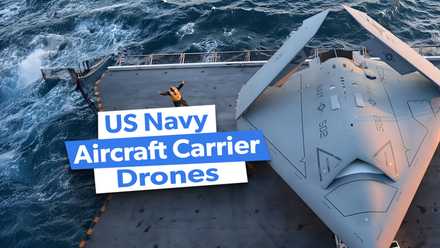
What Are The US Navy’s Plans For Drones On Aircraft Carriers?
The US Navy is planning the next big leap for carrier aviation with unmanned combat air systems as a part of the carrier strike group’s already mighty
Empowering Naval Aviators At Sea

The Stingray is fundamentally intended to be a force multiplier for the carrier strike group by freeing up crewed jets from mundane missions, improving mission performance and safety for those aircrews, and reducing wear and tear on valuable planes. Currently, the Navy relies heavily on its frontline strike fighters to refuel other jets. The buddy tanking mission currently requires every Air Wing to dedicate around 20% to 30% of its Super Hornets that could otherwise be used for fleet defense or strike missions. The Stingray completely eliminates this burden.
The Air Wing essentially gains a huge boost in available airframes for any given mission thanks to the Stingray, without adding a single new crewed jet to the hangar deck. The MQ-25A can deliver up to 15,000 pounds of fuel at a range of 500 nautical miles from the carrier. By meeting fighters halfway, the Stingray extends the strike radius of the Carrier Air Wing to over 1,000 nautical miles. It is also being made to perform intelligence, surveillance, and reconnaissance tasks as a secondary mission to further augment the combat capability of the CVW and CSG.
To perform autonomous aerial refueling, the MQ-25A Stingray combines the standard Cobham Air Refueling Store Pod with its highly advanced digital automation system. The missionized, self-contained pod is mounted under the drone’s left wing while its internal bladders also carry a transferable fuel payload. The ARS contains an internal fuel pump, a hydraulic-driven hose reel, a 90-foot braided hose, and a lighted refueling drogue, called ‘the basket.’ The drone’s advanced fuel management system, combined with the ARS, allows it to deliver 400 gallons per minute to aircraft during rendezvous, while its VMSC can respond to throttle and control surface adjustments faster than any human.