dailynewsnblog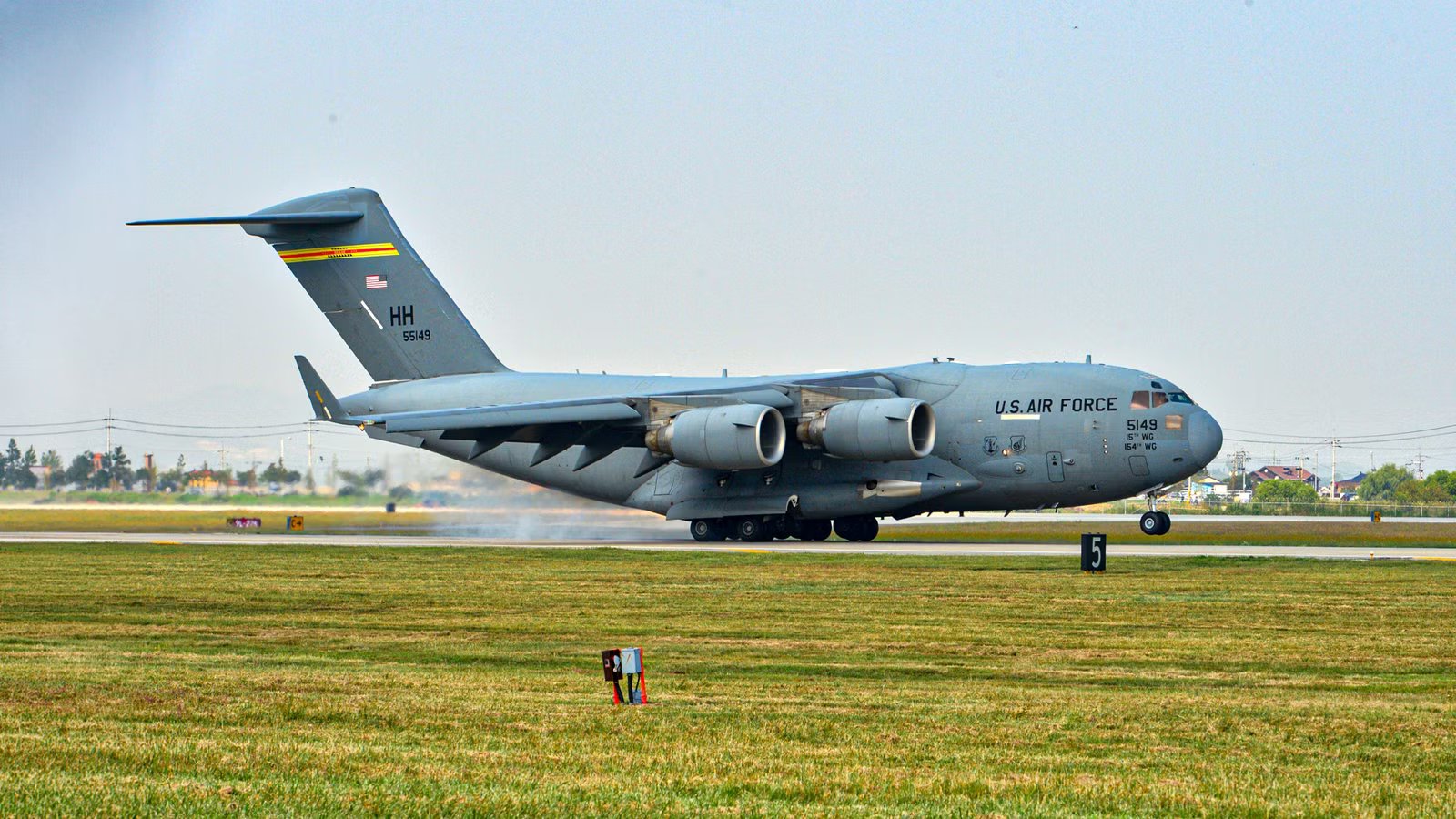
The Boeing C-17 Globemaster III has a maximum takeoff weight of 585,000 lb (265,352 kg), which is heavier than a fully loaded Boeing 747-400. Despite this massive weight, it can land on a runway 3,500 feet (1,067 meters) long and just 90 feet (27.4 meters) wide. We will try to explain why that is physically possible: the C-17’s externally blown flap system doubles the lift coefficient available to the wing compared to a conventional jet transport, allowing the aircraft to approach at around 115 knots (132 miles per hour / 213 km per hour) rather than the 140-plus knots a conventional heavy transport would need at similar weights. That 25-knot difference in approach speed is the aerodynamic mechanism that separates a strategic airlifter that operates from unpaved forward strips in Afghanistan, Antarctica, and Kosovo from one that requires commercial airport infrastructure to function.
The technology behind that capability is not new, and that is part of what makes it interesting. The externally blown flap concept was studied at NASA‘s Langley Research Center in the 1950s, demonstrated on the McDonnell Douglas YC-15 experimental transport in the 1970s, and refined through years of wind tunnel testing before McDonnell Douglas applied it to the C-17 program. Four NASA centers contributed to the C-17’s aerodynamic development. The result is an aircraft that remains the only large Western jet transport capable of delivering a 70-ton M1 Abrams main battle tank directly to an austere forward airstrip under combat conditions — a capability that, as of 2026, has not been replicated in any Western strategic airlifter built since.
The Externally Blown Flap System: How Engine Exhaust Becomes Lift

The conventional high-lift system on a commercial jet, such as slats at the leading edge and flaps at the trailing edge, all generate additional lift by increasing the wing’s camber and chord area, producing more pressure differential between the upper and lower surfaces. On an aircraft the size and weight of a jumbo jet, those systems work adequately because the aircraft approaches at relatively high speeds and the airflow across the wing is fast enough to generate the required lift.
The problem with a heavy tactical airlifter is that you cannot approach at high speed when the runway you are landing on is less than 4,000 feet (1,219 meters) long. You need to slow down substantially, and at lower speeds, conventional flap systems run out of lift authority before they have generated enough force to support the aircraft’s weight.
The externally blown flap system solves this by adding the engine exhaust to the equation. On the C-17, each of the four Pratt & Whitney F117-PW-100 turbofan engines produces 40,440 lb (179.9 kN) of thrust, totaling 161,760 lb (719.7 kN) of combined output. The engines are mounted on pylons placed unusually far forward and high on the wing. When the trailing-edge flaps are deployed into their approach position, they extend directly into the high-velocity exhaust stream. The exhaust, flowing over the wing’s upper surface and then deflected downward by the flap geometry, adds a powerful propulsive lift force to the aerodynamic lift the wing itself generates.
According to Vintage Aviation News’s detailed analysis of NASA’s role in the C-17 program, aircraft using this system achieve approximately twice the lift coefficient of conventional jet transport aircraft at the same speed, meaning the C-17 can fly as slowly as 115 knots (132 mph / 213 km/h) on final approach and still generate enough force to support its substantial operating weight.
The double-slotted titanium trailing-edge flaps are central to this design. Unlike the aluminum flaps used on commercial airliners, the C-17’s flaps are titanium, specifically to survive the sustained exposure to high-temperature, high-velocity turbine exhaust during approach and landing phases. They are slotted, which allows the exhaust to pass through specific gaps in the flap structure, maintaining attached, controlled airflow across the lower wing surface rather than allowing the turbulent exhaust to disrupt the aerodynamic picture. That controlled flow prevents the wing from stalling even at the slow speeds the approach demands.
The YC-15 Demonstrator: How McDonnell Douglas Proved The Concept In The 1970s

The C-17’s externally blown flap (EBF) system was not a new concept. It had already been validated by the McDonnell Douglas YC-15. As Simple Flying has detailed in its analysis of the C-17’s four-engine requirement, the McDonnell Douglas YC-15 was a four-engine experimental short takeoff and landing transport built for the Air Force’s Advanced Medium STOL Transport (AMST) program in the mid-1970s. Although the AMST program was canceled, the YC-15 became the direct aerodynamic predecessor of the C-17.
When the Air Force launched the Cargo-Experimental (C-X) competition in 1979, McDonnell Douglas scaled the YC-15’s proven EBF concept for a strategic airlifter nearly three times heavier. That required extensive redesign and testing, with support from four NASA research centers before the C-17 ever flew. Every component of the EBF system had to be rescaled, retested, and reoptimized, which is why all four NASA centers were involved, and why the C-17 program benefited from an unusually thorough pre-production aerodynamic database before the first aircraft was built.
The C-17 entered service in 1993, and it demonstrated from its first operational deployments that the scaled-up EBF system worked as intended. In the most extreme STOL demonstration ever recorded for the type, according to The Aviationist’s documentation of C-17 performance records, a C-17 carrying a payload of 44,000 lb (19,958 kg) took off in less than 1,400 feet (427 meters) and subsequently landed in less than 1,400 feet (427 meters)on the same sortie. While normal assault operations with full payloads require about 3,500 feet (1,067 meters), the demonstration highlighted the considerable performance margin built into the aircraft‘s high-lift system.
What 3,500 Feet Actually Enables: The Operational Case For Short-Field Performance

A 3,500-foot (1,067-meter) runway may sound restrictive, but for a strategic airlifter, it dramatically expands where the aircraft can operate. The Antonov An-124 Ruslan requires roughly 9,900 feet (3,018 meters) at maximum weight, while the Lockheed MartinC-5 Galaxy needs about 8,300 feet (2,530 meters). Those requirements largely confine both aircraft to major military bases and international airports. By contrast, the C-17 can deliver heavy cargo directly to forward operating bases, austere airfields, gravel and unpaved strips, and damaged runways much closer to the front line.
As previously documented on Simple Flying’s analysis of the BC-17 commercial program, this capability was the reason Boeing retained the externally blown flap (EBF) system despite its weight and drag penalties. Those same design compromises that make the C-17 exceptionally capable on short, improvised runways also made it unattractive to commercial operators. For example, McMurdo Station in Antarctica has a compacted ice runway measuring approximately 10,000 feet (3,048 meters) that the C-17 uses routinely for Operation Deep Freeze resupply missions, but the aircraft has also operated from considerably shorter and less-prepared surfaces in active conflict zones. Kandahar Airfield in Afghanistan still received C-17 deliveries when its shorter auxiliary strips were used, and the aircraft’s ability to land heavy equipment directly on a contested airfield is the operational reason it was specified in the first place.
Runway width is just as important as runway length in many deployed environments. The C-17 requires a strip only 90 feet (27.4 meters) wide, which is narrower than many commercial airport taxiways. Combined with nose-wheel steering and a power-back capability that uses engine thrust reversers to reverse under its own power, the aircraft can turn around and reposition on remote airstrips without taxiways, turnaround loops, or other ground infrastructure.
Catch what other flight trackers miss
Emergency squawks, holds, NOTAMs — live signals, no signup.
Open tracker
Catch what other flight trackers miss
Emergency squawks, holds, NOTAMs — live signals, no signup.
Open tracker
The Wing, The Controls, And Everything Else That Makes It Work

The EBF system works in combination with a complete aerodynamic package that was designed from the outset around the short-field performance requirement. The C-17’s wing is a supercritical design, a term referring to an airfoil profile specifically optimized to delay the formation of shock waves at transonic speeds, which in practice means the wing generates lift more efficiently across a wider range of speeds than a conventional swept wing. At the C-17’s operating speeds, the supercritical wing provides a foundation of efficient aerodynamic lift onto which the EBF system’s propulsive lift adds its contribution. The combination allows the aircraft to be simultaneously fuel-efficient at its cruise altitude of approximately 35,000 feet (10,668 meters) and aerodynamically capable at the slow approach speeds assault landings demand.
The winglets at the tips of each wing address a separate efficiency challenge. Large aircraft at slow speeds generate significant vortex drag. The C-17’s winglets redirect that vortex energy into a forward thrust component, reducing induced drag and improving the aircraft’s overall lift-to-drag ratio, particularly at the lower speeds where the EBF system is operating. The digital fly-by-wire flight control system handles the additional complexity of managing the interaction between aerodynamic control surfaces and the powered lift forces from the engines, which can vary rapidly during approach as power settings change. Without fly-by-wire, a pilot managing a C-17’s landing configuration would be handling aerodynamic feedback from six different control axes simultaneously; the digital system reduces that to a manageable control input that the flight computers translate into the correct combination of surface deflections and engine responses.
Direct lift control spoilers on the wing’s upper surface provide a final element of the picture. These surfaces deploy asymmetrically in coordination with the ailerons to generate roll authority without changing the aircraft’s pitch attitude, which is particularly useful during a steep, slow approach where conventional aileron inputs would disturb the carefully managed lift balance between the wing and the EBF system. The net result of all these systems working together is an aircraft that, according to the USAF’s official C-17 fact sheet, can carry its maximum payload of 170,900 lb (77,519 kg) onto tiny rustic airfields that aircraft of similar size cannot consider.
The Combat Descent: When The EBF System Becomes A Brake

The EBF system’s operational role extends beyond the landing approach. As Simple Flying has reported in its analysis of the C-17’s tactical descent capability, the same thrust reversers that stop the aircraft after landing can be engaged in flight to create a steep, high-speed descent from cruise altitude into a forward airfield. This maneuver allows the C-17 to remain at safer altitudes until the last possible moment before entering the threat envelope around the landing zone. With all four thrust reversers deployed, the aircraft can descend roughly 25,000 feet (7,620 meters) in about two minutes without accelerating to unsafe speeds. The EBF system makes this possible by redirecting engine exhaust over the deployed double-slotted flaps, maintaining controlled airflow over the wing despite the unusually steep descent.
The interaction between the reversers and flaps also helps the aircraft remain controllable at descent angles of up to 22 degrees, compared with the 3-degree glide slope used for a standard ILS approach. After touchdown, the same reverse-thrust system redirects exhaust downward, increasing the load on the landing gear and improving braking effectiveness on gravel, dirt, or other semi-prepared surfaces where tire grip is limited.
The operational logic of the entire EBF system, from slow-speed approach to in-flight reverse thrust combat descent, resolves to a single engineering principle: the C-17’s engines are active components of the lift and control system, contributing to lift generation during approach, braking force after touchdown, and controlled drag during tactical descents. The aircraft is designed to use its propulsion system as a flight control effector that makes use of energy that would otherwise be discarded as jet exhaust.
Why No Western Airlifter Built Since Has Replicated It

The C-17’s EBF system produces a set of capabilities that every subsequent Western military transport program has chosen not to replicate, even as those programs have overtaken the Globemaster in other performance dimensions. The Airbus A400M Atlas, which entered service in 2013, achieves impressive STOL performance through large-diameter turboprop engines whose high disk area generates exceptional propeller-induced airflow over the wing, but it does not use the EBF concept, and its minimum runway requirement is approximately 2,950 feet (900 meters) for austere operations at reduced loads. The A400M is arguably more capable on very short strips at lighter weights, but it cannot deliver the outsized, overweight cargo that the C-17’s EBF system enables at those distances.
No new jet strategic airlifter has adopted the EBF concept because it imposes a cruise-efficiency penalty. The forward, high-mounted engines required for EBF increase drag and noise compared with conventional engine placements, leading to higher fuel consumption. The C-17 burns more fuel per ton-mile than comparable commercial freighters, a major factor in the failure of Boeing’s BC-17 commercial program despite industry interest. In essence, EBF is an aerodynamic trade-off: superior short-field performance comes at the cost of cruise efficiency, making it worthwhile primarily for military operations.
The EBF system roughly doubles the C-17’s maximum lift coefficient by directing the exhaust from its four engines, rated at a combined 161,760 lb of thrust, over the flaps. This allows approach speeds as low as 115 knots instead of the roughly 140 knots or more typical of conventional heavy jet transports. That 25-knot reduction, maintained under full control to touchdown on unpaved surfaces, turns a 585,000-lb airlifter into an aircraft capable of operating from austere airfields that no other Western jet transport of comparable size can routinely use.