dailynewsnblog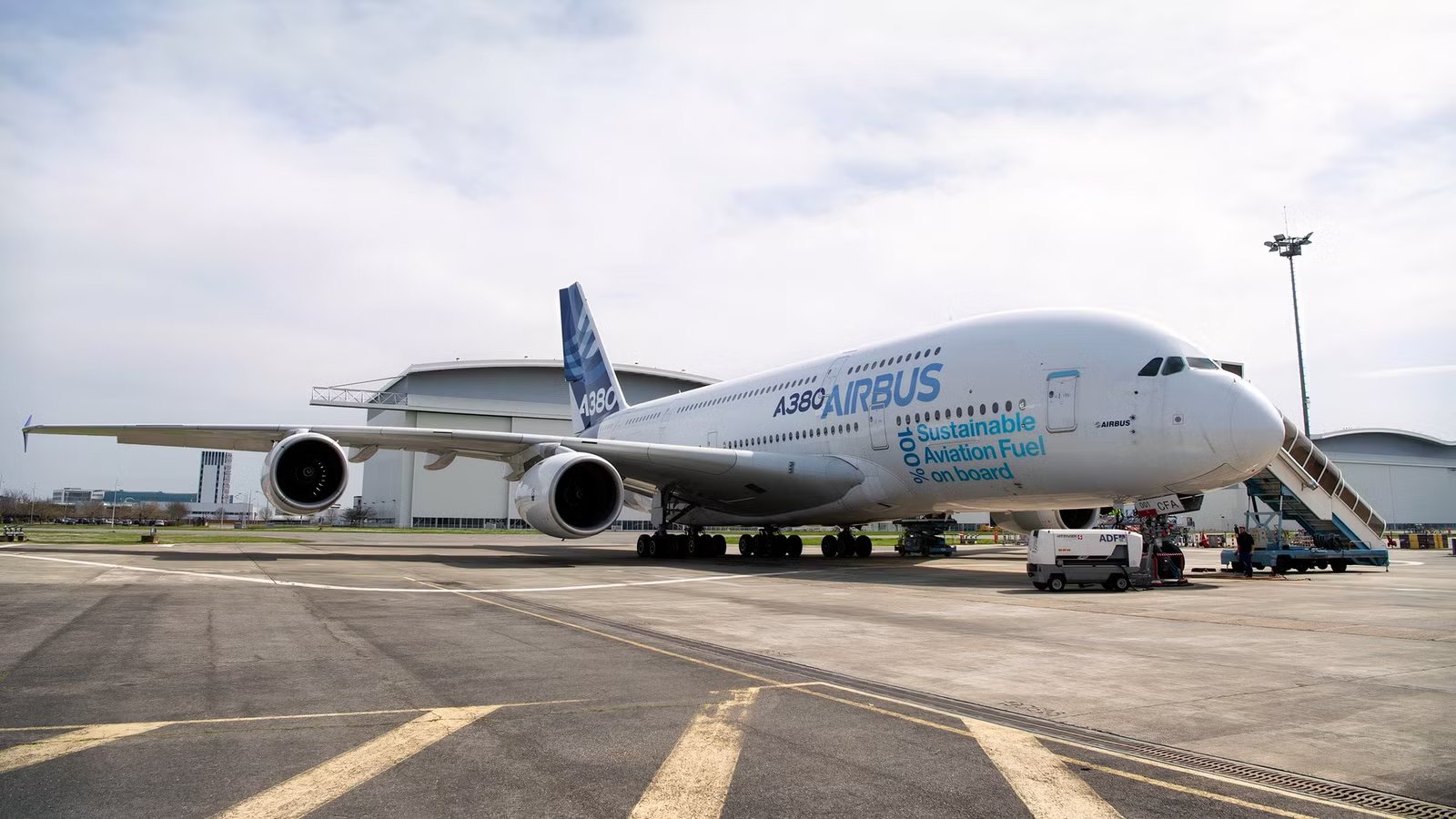
The Airbus A380 is one of the largest aircraft ever built. With two full-length decks and a maximum takeoff weight exceeding 1.2 million pounds, the quadjet was designed for ultra-high-capacity, long-haul travel between major international hubs. Airbus launched the aircraft to address anticipated congestion at slot-restricted airports.
The type entered commercial service with Singapore Airlines in 2007, and while it briefly reshaped expectations for global air travel, its long-term viability has steadily declined. Nearly two decades after its debut, the A380 is aging across the fleets that once championed it. In addition, limited fuel efficiency, high operating costs, and shifting airline strategies have pushed carriers to adopt more flexible, twin-engine widebodies. Airbus ended production in 2021, and airlines have since turned to a range of replacements, not to match the size of the A380, but to serve long-haul routes with better economics.
The Rise And Fall Of The A380 Program

When Airbus formally launched the A380 program in December 2000, it was positioning the aircraft as a direct challenge to Boeing’s long-standing dominance in the high-capacity market with the 747. The A380 was developed with the belief that global passenger demand would increasingly concentrate at major hub airports, creating a need for ultra-large aircraft that could transport more people per slot.
It was the first full-length double-deck airliner and offered a maximum certified capacity of 853 passengers in an all-economy configuration, although most carriers opted for three-class layouts closer to 500–550 seats. The aircraft made its commercial debut in October 2007. In its early days, the A380 gained traction with a small but high-profile group of global airlines.
 Emirates, Qantas, Singapore Airlines, Lufthansa, British Airways, and Air France adopted the aircraft to serve dense long-haul routes connecting their major international hubs. Its cabin spaciousness, capacity, and quiet onboard experience were widely praised, and Airbus positioned the A380 as a flagship product for the 21st century.
However, it became increasingly clear that the aircraft’s operating economics posed challenges. The four-engine configuration resulted in higher fuel burn compared to newer twinjets, and airlines began shifting toward more efficient alternatives. By the early 2010s, new orders had slowed significantly.
In 2019, Emirates, the A380’s largest operator, reduced its backlog by canceling around 39 units and adjusted its long-term strategy in favor of more efficient twin-engine aircraft such as the A350 and the 777. With limited demand remaining, Airbus confirmed it would end the program. The final A380 was delivered to Emirates in December 2021, which concluded the production run of the world’s largest passenger aircraft.
Who Still Flies The A380 In 2025?

Although production has ended, the superjumbos remain in active service with a select group of international carriers. As of mid-2025, according to the ch-aviation data, a total of 157 Airbus A380s are in active service, including a single test and demonstration aircraft operated by Airbus.
Emirates remains by far the largest A380 operator, with 118 aircraft on its books. Of these, 94 are currently flying, while 24 are undergoing maintenance and cabin retrofitting. The airline’s average fleet age stands at 10.5 years, with its oldest aircraft now over 19 years old, according to Planespotters.net.
Besides, the A380 is still in scheduled operation with British Airways, Etihad Airways, Korean Air, Lufthansa, Qantas, Qatar Airways, and Singapore Airlines. Some carriers resumed limited A380 operations after grounding the type during the pandemic, while others, including Air France, Malaysia Airlines, and Thai Airways, retired their fleets entirely.
Airline | Total Fleet | Average Age |
|---|---|---|
All Nippon Airways | 3 | 6.3 Years |
Asiana Airlines | 6 | 10.3 Years |
British Airways | 12 | 11.2 Years |
Emirates | 118 | 10.5 Years |
Etihad Airways | 10 | 9.9 Years |
Korean Air | 7 | 11.6 Years |
Lufthansa | 8 | 13.2 Years |
Qantas | 10 | 15.8 Years |
Qatar Airways | 10 | 9.9 Years |
Singapore Airlines | 12 | 11.4 Years |
The aircraft are aging, and the economics of operating four-engine widebodies have become increasingly unstable. With high fuel burn and rising fuel prices, the double-decker continues to present cost challenges that many airlines are no longer willing to absorb.
Even among current operators, the trend is shifting: the aircraft are being scaled back or confined to select high-demand routes, while carriers are increasingly investing in newer twin-engine widebodies that offer comparable range and capacity with significantly improved efficiency and economics.
The A350-1000 Is One Of The Top Choices For Replacing The A380

The A350-1000 has emerged as one of the most prominent successors to the A380, particularly for carriers seeking more flexible, fuel-efficient solutions on long-haul routes. It is the largest variant of the A350 family and entered commercial service in 2018 with Qatar Airways. Since then, it has become a key part of the global widebody fleet.
The aircraft can accommodate around 375 to 480 passengers (depending on the configuration) and has a range of up to 8,700 NM. This positions the A350-1000 to operate the same city pairs once dominated by the A380 but with far better economics and reduced environmental impact.
According to Airbus, the -1000 burns approximately 25% less fuel per seat compared to previous-generation aircraft, including the A380. This efficiency comes from a combination of advanced aerodynamics, a composite fuselage, and two Rolls-Royce Trent XWB-97 engines, which deliver both lower emissions and operating costs.
Furthermore, the A350 family also includes a long-range variant, the A350-900ULR, which currently operates the longest nonstop routes in the world. Singapore Airlines is the only carrier using the ULR variant, currently deploying it on routes such as Singapore–New York and Singapore–Newark. The A350-1000, meanwhile, has gained broader appeal across the industry. Airlines, including Qatar, Etihad, and British Airways, have already incorporated the type into their long-haul operations.
Boeing’s 777X Is Also Lined Up As A Successor

The other leading contender positioned to replace the A380 is Boeing’s latest generation widebody family, the Boeing 777X. The program includes two stretched twin-engine variants: the 777-9, which will become the world’s longest passenger aircraft by fuselage length, and the slightly shorter but longer-range 777-8.
Catch what other flight trackers miss
Emergency squawks, holds, NOTAMs — live signals, no signup.
Open tracker
Catch what other flight trackers miss
Emergency squawks, holds, NOTAMs — live signals, no signup.
Open tracker
Together, they represent the American manufacturer’s response to increasing demand for aircraft that combine capacity, range, and fuel efficiency without the overhead of a four-engine layout. Although the 777X has yet to enter service due to an extended certification timeline, it has already become the preferred long-haul aircraft for several of the world’s largest carriers.
Emirates, British Airways, Singapore Airlines, Etihad Airways, Qatar Airways, and Lufthansa, all current A380 operators, have placed substantial orders for the type. The aircraft is built around General Electric GE9X engines and features new composite wings with folding wingtips, which allow for aerodynamic efficiency improvements.
According to Boeing, the 777-9 will seat around 426 passengers in a standard two-class layout and offer a range of approximately 7,285 NM. The 777-8, while shorter, is expected to fly up to 8,745 NM and carry just over 384 passengers. This places the 777X family squarely in the high-capacity, long-range segment that airlines once relied on A380s or 747s to serve.
The A380’s Role Is Now Split Across Multiple Aircraft Types

While the A350-1000 and 777X are the most obvious successors to the A380, many airlines are addressing the type’s retirement by turning to a mix of other long-haul aircraft. These alternatives may not match the A380’s scale, but they do offer the efficiency, flexibility, and route adaptability that current operating models demand.
For instance, the Boeing 787 Dreamliner family has been widely adopted by former A380 operators. Air France retired its superjumbo fleet during the COVID-19 pandemic and now relies on the 787-9, 777-300ER, and A350-900 to maintain its long-haul operations. Similarly, Thai Airways International, which also retired its A380s, now utilizes its Boeing Dreamliner, 777-300ER, and -200ER fleets for long-haul operations.
This shift is not just limited to the former A380 operators. Several current operators have also invested heavily in newer widebodies to modernize their long-haul fleets. Emirates, for example, aims to integrate the A350-900 and 777X, both of which are expected to take over a significant portion of its long-haul operations in the coming decades.
According to ch-aviation, the UAE flag carrier is awaiting deliveries of over 300 aircraft, including 59 A350-900s, 170 Boeing 777-9s, and 35 777-8s. Similarly,  British Airways operates the A350-1000 and 787-9 alongside its A380s. Meanwhile, Singapore Airlines has maintained a mixed fleet of A350 variants and 787-10s.
The A380’s Legacy Lives On, But The Industry Is Moving Forward

Even as some carriers continue to operate the A380 alongside more modern aircraft, the broader direction of the market is clear. Airlines are steadily moving away from the ultra-large quadjets in favor of long-haul twin-engine aircraft that offer better efficiency and operating costs. There is no denying the scale and ambition of what the French manufacturer built.
The A380 will forever be remembered as one of the most ambitious aircraft ever built, a double-deck, four-engine widebody that reshaped long-haul flying and pushed the limits of commercial aircraft design. But it came with compromises. High operating costs, rising fuel prices, and limited flexibility made the aircraft increasingly difficult to justify in an environment where efficiency drives every fleet decision.
The aircraft is aging, but has not yet reached full retirement age. Emirates is actively retrofitting, and British Airways is planning to retrofit its A380 fleet, which suggests the type will remain in use for several more years. However, that doesn’t change the broader trajectory.
Airlines are aligning future strategies around aircraft like the A350-1000 and Boeing 777X, which offer similar capacity with improved economics, extended range, and next-generation systems. As more carriers transition to these models, the A380 will gradually follow the 747 into long-haul aviation history.