dailynewsnblog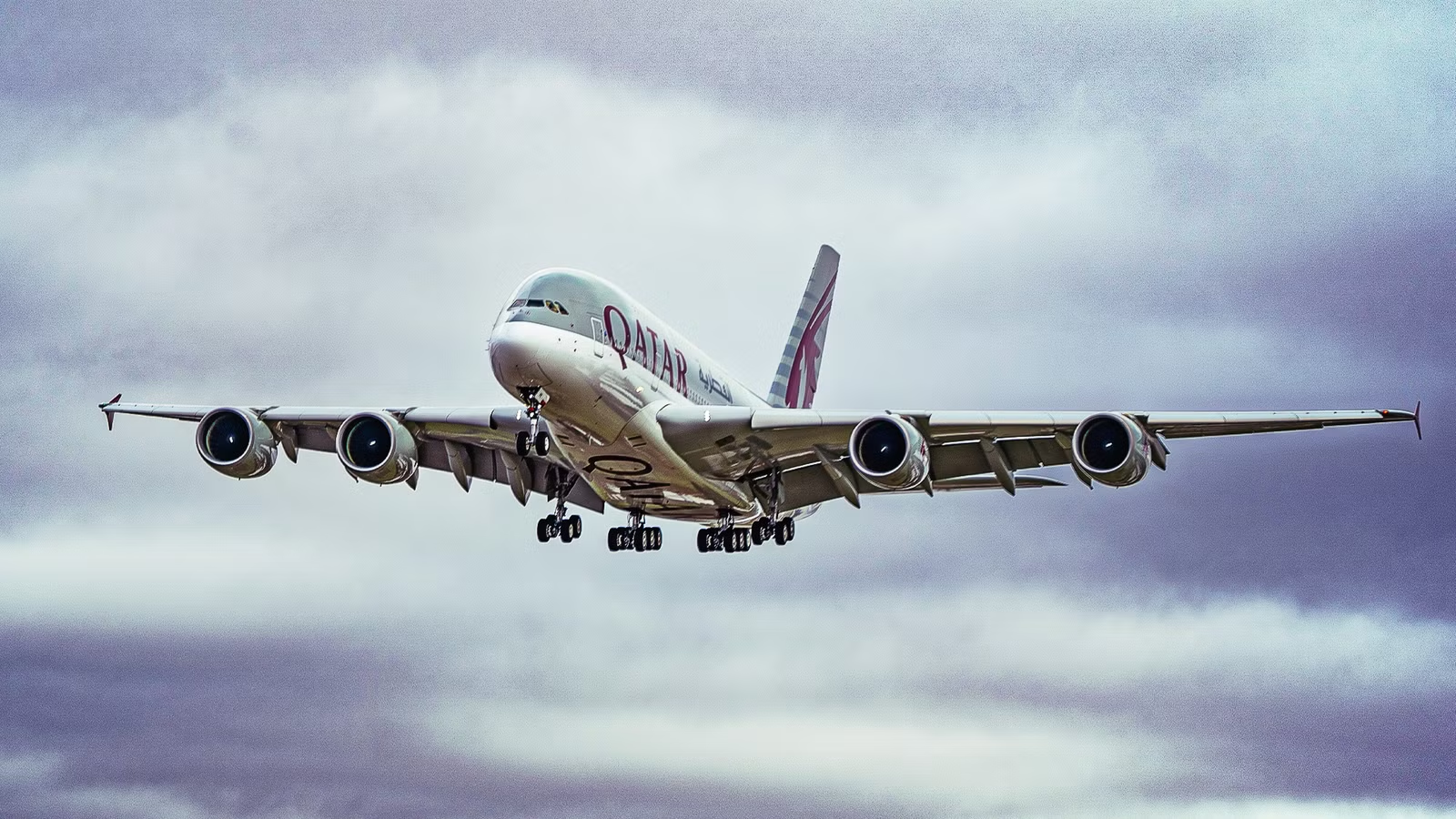
Few global airlines have leaned on stored and semi-retired widebody aircraft as heavily as  Qatar Airways. Facing an unprecedented operational deficit that threatened its core hub-and-spoke model at
  Hamad International Airport in Doha, the Qatari flag carrier chose an aggressive tactical path to reactivate long-haul airframes it had previously written off or scheduled for permanent phase-out.
The catalyst for this unusual fleet movement was a high-profile legal and regulatory standoff between Qatar Airways and European airframer Airbus. When the Qatari Civil Aviation Authority declared the immediate grounding of a massive portion of the carrier’s Airbus A350 fleet over severe fuselage surface-degradation concerns, the airline suddenly lost tens of thousands of daily long-haul seat-miles. Unable to plug this massive capacity void with narrowbody aircraft, planners had to look backward. Bringing back legacy Airbus A330s and the quad-engine Airbus A380 transformed a fleet planning crisis into a masterclass in strategic asset elasticity.
Nowhere Left To Turn

The operational shockwave hit in mid-2021 when local aviation inspectors identified accelerated paint cracking and peeling across the composite fuselages of Qatar Airways’ flagship A350 fleet. Regulatory oversight intensified after inspections revealed exposed expanded copper foil, a critical anti-static mesh bonded directly to the carbon fiber reinforced polymer airframe to disperse lightning strikes safely. Citing potential airworthiness hazards caused by severe desert temperature swings and material expansion rate mismatches, the regulator ordered the immediate withdrawal of 13 A350s, a number that quickly climbed toward 29 grounded airframes.
Losing nearly 30 frontline widebodies created an immediate crisis for Qatar Airways’ network design, which relies on connecting passengers through its Doha hub. High-yield long-haul connections linking North America, Europe, East Asia, and Australasia suddenly faced severe schedule trimming or complete cancellation. Long-haul international corridors depend on heavy belly-freight capacity alongside premium cabin volume, so canceling daily widebody frequencies threatened both passenger ticket revenue and lucrative cargo contracts. The carrier, therefore, needed an immediate, high-volume capacity solution to prevent competitor airlines from capturing its market share.
Planners quickly realized that narrowbody jets like the Airbus A320 family were not enough to fill in for the lost aircraft. Single-aisle aircraft can handle short regional sectors, but they lack the range, cargo volume, and premium seating capacity required to sustain trunk routes linking Qatar to major international financial centers. Furthermore, purchasing new widebody aircraft on the spot market was impossible due to multi-year manufacturer backlog queues and tight global delivery schedules. Consequently, Qatar Airways turned inward, evaluating its stored fleet of legacy widebodies to build an emergency in-house replacement fleet.
Return Of The Superjumbo

In December 2021, Qatar Airways, to the surprise of many, returned the Airbus A380 to commercial service. Executive leadership had previously stored the 10-strong superjumbo fleet during the early stages of the global pandemic, with senior officials publicly labeling the massive quad-jet as the biggest financial mistake in the airline’s history. However, the reality of the A350 grounding forced a pragmatic reversal with few options left on the table. Planners realized that despite its high hourly fuel consumption, the A380 was the only airframe in storage capable of restoring massive passenger volume with a single flight crew.
Pulling five superjumbos out of deep desert storage was not an easy task and meant an intensive engineering and logistical push to make the return possible. Maintenance teams performed rigorous C-checks, landing gear inspections, and full engine un-preservation protocols on the massive powerplants. Simultaneously, flight operations began training flights on the aircraft, ready to bring in new crews to get the A380 airborne once again. By winter 2021, the first reactivated superjumbos took to the skies, initially connecting Doha to slot-constrained mega-hubs like London Heathrow and Paris Charles de Gaulle.
Using the 517-seat superjumbo instantly stabilized passenger throughput on the carrier’s most congested European and Asian routes. Replacing smaller twin-engine aircraft with double-deck A380s on London and Paris sectors, Qatar Airways opened up hundreds of extra revenue seats per flight without needing additional airport slot pairs. Fortunately, the massive seat capacity offset the loss of grounded A350s, allowing the airline to protect its critical connecting passenger traffic across Hamad International Airport as normal.
A Secondary Revival

Superjumbos were the best option for absorbing high-density long-haul traffic, but Qatar Airways actually deployed a second layer of defense by making a comeback for its retired Airbus A330-200 and Airbus A330-300 fleet. The carrier had previously slated these older twin-engine widebodies for complete retirement in favor of modern Boeing 787s and Airbus A350s. However, as the A350 dispute dragged on into courtrooms, planners recognized that the versatile A330 offered a reliable, low-risk platform to absorb short-to-medium-haul operational strains.
Engineering divisions pulled a sub-fleet of A330s out of storage, putting them through thorough airworthiness inspections and system checks. Once cleared for line flying, these twin-jet widebodies were assigned to high-frequency feeder corridors across the Middle East, South Asia, and North Africa. By taking over regional sectors between Doha, Dubai, Cairo, and India, the reactivated A330s freed up larger Boeing 777-300ERs and 787s to step in on ultra-long-haul intercontinental routes previously served by the grounded A350 fleet.
The issue for Qatar was that passengers booking long-haul flights expected the award-winning Qsuite business class cabins found on modern A350s and select 777s. Instead, those traveling on reactivated A330s experienced older-generation lie-flat seats and legacy inflight entertainment hardware. Ground staff and customer service teams had to actively manage passenger expectations, offering rebookings and cabin upgrades to minimize customer friction on premium routes. Despite these product compromises, keeping passenger volumes moving through Doha proved far more valuable to corporate survival than parking seats to maintain product uniformity.
Why Bring These Back In The First Place?

After the Qatari regulator pulled dozens of A350s from active service, Qatar Airways faced a choice that confronts any long-haul carrier in crisis: to commit capital to bring fully owned, stored aircraft back to airworthy status or pay premium market rates for third-party ACMI (Aircraft, Crew, Maintenance, Insurance) charter capacity. The airline realized that owning depreciated widebody airframes provided a crucial financial safety net.
Contracting external ACMI providers for long-haul widebody capacity incurs astronomical variable outlays, with spot-market rates routinely hitting upwards of $8,000 per block hour during peak travel periods. For a major network carrier needing to cover thousands of monthly flight hours across intercontinental corridors, reliance on wet-leased aircraft destroys operating margins. Conversely, removing owned Airbus A330 or A380 airframes from storage requires significant upfront cash for heavy C-check maintenance, engine un-preservation, and crew requalification, but it avoids recurring lease fees. Qatar Airways owned these legacy widebodies outright, which meant the long-term unit cost of flying in-house reactivated jets proved vastly lower than contracting external charter fleets.
Holding fully paid-off widebodies provided Qatar Airways with balance sheet flexibility that rival airlines lacked during sudden market shocks. The capital depreciation on these legacy A330s and A380s had already been accounted for on corporate ledgers, and their standing fixed ownership costs were virtually zero while sitting on the ground. Once reactivated, every additional passenger seat mile generated by these airframes contributed directly to covering variable operating costs without adding monthly debt obligations.
Catch what other flight trackers miss
Emergency squawks, holds, NOTAMs — live signals, no signup.
Open tracker
Catch what other flight trackers miss
Emergency squawks, holds, NOTAMs — live signals, no signup.
Open tracker
Hiding During Crisis

A dedicated widebody reserve functions as a powerful emergency patch during localized groundings, but managing that fleet elasticity becomes far more complex when regional geopolitical crises erupt. Maintaining dozens of large widebodies requires continuous maintenance oversight from the carrier, as well as engine preservation routines and strategic parking allocations. When external security environments destabilize, an airline’s widebody backup fleet can quickly transition from a flexible revenue generator into a high-value operational asset vulnerable to regional airspace shutdowns.
This exact operational reality manifested dramatically in early 2026, when escalating geopolitical conflicts and airspace closures across the Middle East disrupted flight operations at Hamad International Airport. Facing severe schedule reductions and regional flight suspensions, Qatar Airways ferried 20 of its largest widebody aircraft out of the Gulf region to Teruel Airport (TEV) in the Aragon mountains of eastern Spain. Data from flight tracking services showed a steady stream of long-haul jets, including Airbus A380s, A350-900s, A330s, and Boeing 787s, departing Doha and secondary outstations in Africa to enter long-term storage under the care of TARMAC Aerosave.
Transferring nearly two dozen flagship aircraft to European storage facilities highlights the tactical advantage of using dry-climate aviation havens like Teruel. Located more than 3,000 miles (4,828 kilometers) from Doha, the high-altitude Spanish facility offers semi-arid, salt-free climate conditions that naturally suppress airframe corrosion and seal sensitive electrical components from humidity. By positioning these widebodies at a specialized maintenance and storage hub in Europe, Qatar Airways avoided hundreds of millions of dollars in potential damage to capital assets.
A Lesson To All Airlines

The saga of Qatar Airways’ reactivated widebody fleet provides fundamental insights into modern airline risk management and fleet elasticity. Historically, commercial airlines viewed legacy widebodies strictly through the lens of phase-out schedules and disposal deadlines, rushing to retire older jets to capture minor fuel efficiency gains. However, Qatar Airways demonstrated that maintaining an in-house reserve of fully owned, depreciated widebodies can neutralize catastrophic supply chain failures, manufacturer disputes, and sudden geopolitical crises.
Ultra-modern twin-engine widebodies, of course, deliver superior fuel burn metrics during normal operations, but relying entirely on a single airframe architecture leaves an airline vulnerable to regulatory groundings or airworthiness directives. Retaining three or four secondary widebody platforms, even those with higher fuel consumption profiles, gives network planners the operational agility required to protect core hub connectivity when primary long-haul lines fail.
The eventual arrival of next-generation widebody deliveries will gradually close this historic chapter of emergency fleet reactivation. As new Airbus A350-1000, Boeing 777-9, and single-aisle Airbus A321neo aircraft join the mainline fleet, Qatar Airways will phase out once more these comeback heroes. Still, the legacy of this tactical widebody reserve will permanently shape global fleet strategies, showing to the world that in an industry governed by thin margins and unexpected disruptions, capacity flexibility remains the ultimate competitive shield.