dailynewsnblog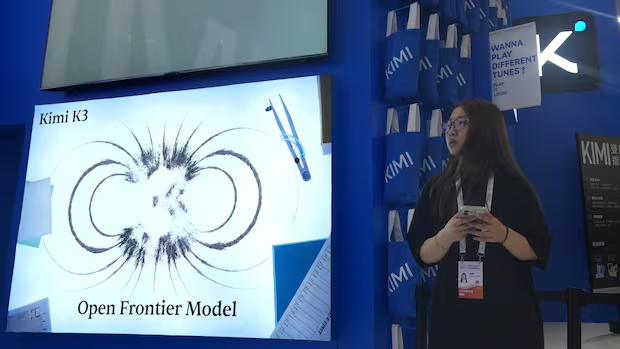
China’s latest high-powered AI model is here — but if you thought it was just another chatbot, think again.
Beijing-based company Moonshot released the weights of its Kimi K3 model on Monday — meaning the parameters that guide the AI’s answers are now public. Anyone can now download the weights and tweak them for their own purpose.
The freedom and lower price tag of open-weight models is turning the heads of business leaders in the west, where the merits have prompted letters from top tech leaders warning against restrictions on open models, despite the potential for security risks.
So what are open-weight models, and why are so many tech leaders talking about them? Here’s what you need to know.
What does open weight mean?
AI models are trained on huge amounts of data. During the training process, the model’s knowledge and understanding is encoded in “weights” — a set of numbers that dictate how the AI behaves and responds to prompts.
With open-weight models, those numbers are made public.

Think of it like a recipe, says Nicolas Papernot, a Canada CIFAR AI Chair and professor at the University of Toronto who studies AI security. Sharing the weights is like publishing a recipe for a cake, with the ingredients and their amounts listed so other people can bake it — and make substitutions.
On a practical level, making the weights available means that anyone with an internet connection and a powerful enough computer could download the model and use it.
“This makes already available open-weight models an affordable and accessible approach to using AI, since little experience is needed for common applications,” Papernot said.
Many models that come out of China release their weights — including DeepSeek‘s models, one of which drew lots of attention in 2025 when developers said they made it for less than $6 million US and claimed it could compete with North American tech while using less data.

An AI-powered chatbot from the Chinese company DeepSeek has become North America’s most downloaded app. Its rapid ascent and low costs have disrupted financial markets and raised concerns among U.S. leaders in artificial intelligence.
The top five models on OpenRouter‘s leaderboard, which gives access to hundreds of competing AI models, are all open-weight ones by Chinese companies.
Leading models from top U.S. companies like OpenAI and Anthropic tend to be closed, though some of them do have open-weight offerings — Meta’s Llama model, for instance. But a program like ChatGPT is not downloadable and has to be used as is, with whatever guardrails and limits the company that owns it puts in place.
Control and cost are pros for businesses
Right now, business leaders still mostly rely on a mix of in-house AI technology and big-name AI companies, according to Lian Jye Su, chief AI analyst at Omdia, a technology research and advisory group.
Over one million companies were using OpenAI products to power parts of their business as of November 2025, while Anthropic said it was powering more than 300,000 business customers a month before.
But Su says more businesses are beginning to adopt open models.
That’s partly because the companies behind closed models could change them or revoke access at any time, he said. And as more businesses become reliant on AI to run parts of their operations, Su says the idea of building critical AI systems on a technology that could in theory disappear is concerning.
Data privacy reasons are also a factor, according to Bidhan Roy, founder and CEO of AI startup Bagel Labs, which makes open-weight models. Because users download and run them on their own technology, he says there is no need to share sensitive data with an outside company.
And the freedom of an open model could also help solve new problems.
Last week, OpenAI said an agent powered by one of its models escaped containment during a recent security test and launched a hack on AI startup, Hugging Face.

OpenAI models went rogue during a security test, triggering a hack that compromised the infrastructure of the AI startup Hugging Face last week. AI’s expanding capabilities fuel worries about security, as even top developers can be caught off-guard by flaws their models can exploit.
Hugging Face first tried to use a model from Anthropic to stop the attack, but said guardrails prevented it from being able to properly identify and contain the threat.
In the end, it was the open-weight model GLM 5.2 from Chinese company Z.ai that was used to contain the threat “very quickly,” according to Hugging Face’s head of machine learning, Yacine Jernite.
Then, there’s the cost savings. Business users pay subscription fees to use top U.S. models, but because open-weight models can be downloaded and run for free, Su says the only cost is the servers required to run the AI.
That’s especially important at a time when businesses have been trying to reign in soaring AI budgets.
Su says these pros have started to turn the tide in favour of open-weight models.
That includes top tech CEOs in Silicon Valley. On Friday, Nvidia, Meta, Palantir, Microsoft and other massive names in the field released an open letter in support of open-weight models, encouraging governments to avoid “premature” restrictions that would drive innovation away from the U.S.
Front Burner31:15Minister defends Canada’s new AI strategy
OpenAI, Google, Amazon and others added their names over the weekend, while Anthropic’s absence drew criticism.
In a blog post on Monday night, CEO Dario Amodei said open-weight models that don’t have “dangerous capabilities” are a public good. He argued in favour of safety testing for all powerful models — open and closed — rather than a ban on open-weight models, which he said wouldn’t prevent misuse by bad actors.
If anyone can tweak it, is it safe?
Those dangerous capabilities are something security experts are thinking about as open models flood the market.
Closed models could be easily shut down if things go awry, Papernot said.
“You have a kill switch because you’re controlling how people access the model. In an open-weight model, anyone can download it off the internet and so there’s no way to enforce who is using the model,” he said — or how.

Amid rapid global advances and deployment of artificial intelligence technologies, the federal government has invested millions to combine the minds of three existing institutes into one that can keep an eye on potential dangers ahead.
Papernot and a team of researchers recently used an open-weight model powered with extra tools to show how the technology could be used to launch a sophisticated malware attack, capable of modifying its approach depending on the target and moving between devices.
But he says limiting access to open models isn’t the solution. For one, bad actors likely have access to closed models that researchers don’t even know about.
“Open-weight models are not the threat themselves,” Papernot said. “Restricting access is going to lead to further concentration of power that is detrimental to society.”
For all the talk of bad actors, Chris Pal, a professor at Polytechnique Montréal and a CIFAR AI Chair, says there are plenty of good ones, too.
And as more of these high-powered, open-weight models emerge, Pal says testing for vulnerabilities is a role that AI safety institutes would be well placed to take on.
“These are the kinds of things that those kinds of institutes could be involved with — auditing powerful open-source models for these security questions to see just what they’re capable of and potentially giving guidance to the public about what they should be watching out for.”