dailynewsnblog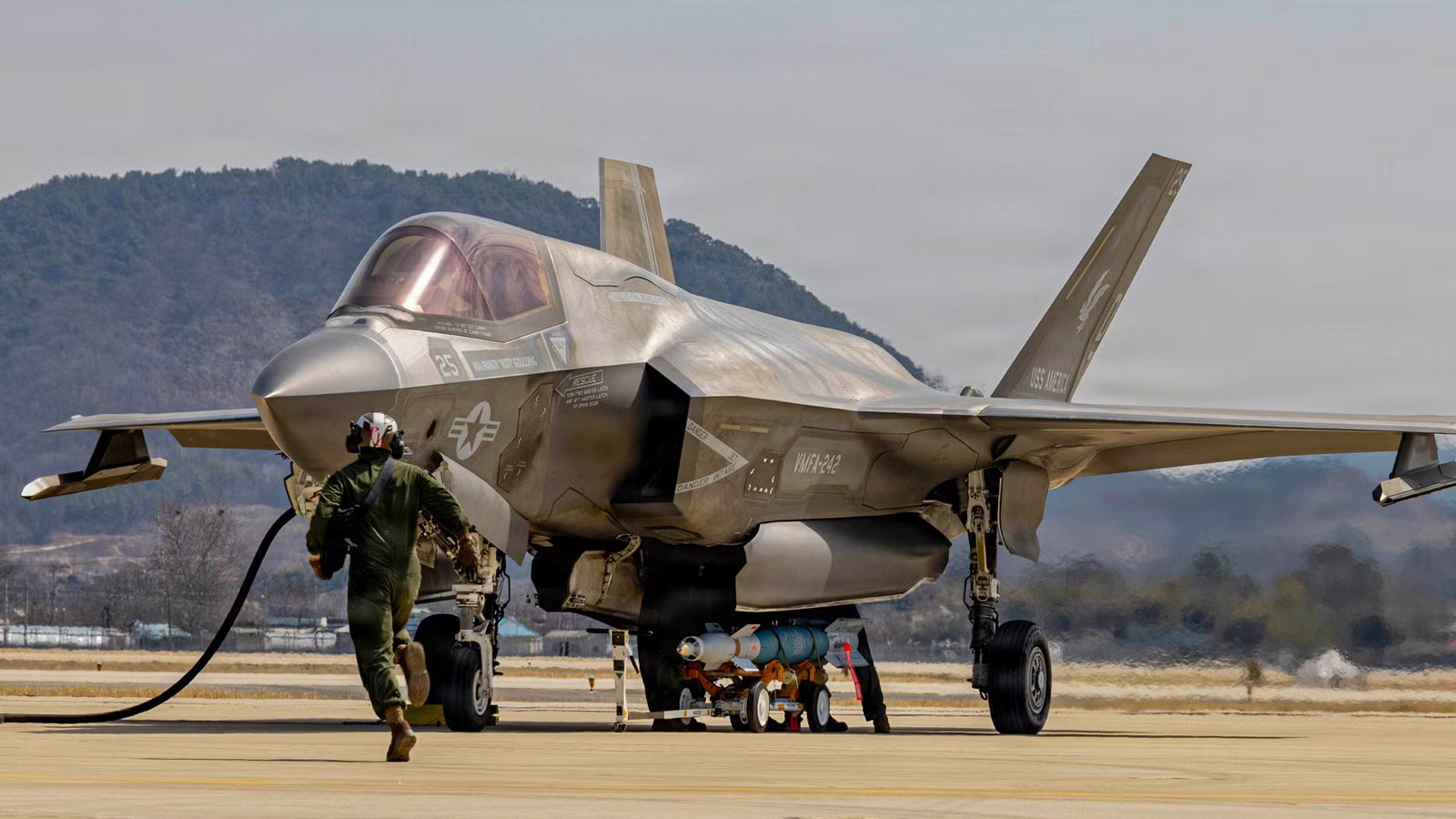
All United States Air Force fighter jet pilots are required to be commissioned officers. This is also true of the US Navy, the Marine Corps, and many US allies (such as the Royal Air Force). The main exception is the Army, where helicopter pilots may be warrant officers. Fighter pilots operate with a high level of responsibility and decision-making and often have to make independent, split-second decisions in combat that can have major strategic or political consequences.
In rare instances, a pilot’s decision (such as in a tense border standoff or violation) could spark a war. Pilots also bear leadership roles and need to be educated (including a bachelor’s degree) to understand their complex aircraft and much more. This is true for all F-35 and F-22 pilots.
Fighter Pilots Normally Fly One Aircraft Type

In the United States, as well as other professional Western air forces, pilots are not paid based on the aircraft they fly. Instead, they are paid based on their rank and their years of service. This is at least somewhat similar to the commercial sector, with important differences. At major airlines (such as Delta and United), pilots are primarily paid based on their seniority and rank (Captain vs First Officer), not on the aircraft that they fly.
However, in practice, widebody aircraft captains flying thick routes tend to get paid the most. This is not because of flying the widebody aircraft per se, but rather because flying widebodies is a position typically reserved for the most senior captains. There is no equivalence with fighter jet pilots in the Air Force. Fighter jet Lieutenants, Captains, Majors, and Colonels all fly the same aircraft that they are certified to fly.
There is no Air Force counterpart to career progression between aircraft types. For example, it’s common for commercial pilots to fly regional aircraft, then progress to narrowbodies, then to widebodies. Air Force pilots do not start with A-10s, then move to F-16s, then F-35s, and then F-22s.
As such, an F-35 fighter pilot with the same rank and years of service as an F-22 pilot should earn the same, all else being equal (such as deployments). This said, the Air Force is currently rapidly developing the F-47 to complement/replace the F-22 starting in the early 2030s. There may be opportunities for some Raptor pilots to start transition training on the upcoming F-47 in the years ahead.
The Caveats: Where Things Can Differ

As stated, pilots are assigned to a particular aircraft type, and they generally stick with it throughout their military careers, although crossing to other platforms is possible and does happen. However, what differs is that while base pay may remain the same, the quality of life, deployment tempo, and the aircraft prestige differ with the internal cultures flying specific fighter jets.
Some aircraft may tend to be combat deployed more than others, and so pilots of some aircraft types may net more deployment and combat pay than others. Test pilots, demo teams, and some high-visibility roles may have some minor additional pay incentives. Again, this is not strictly speaking tied to whether a pilot is flying an F-22 or F-35, but whether one aircraft tends to be used more for roles that attract higher incentives or allowances.
Perhaps the most notable distortion in the baseline that pilots are paid based on rank and years of service is the retention bonuses. The main program here is the US Air Force Aviation Bonus, which offers up to $50,000 per year in lump-sum payments for those who extend their contracts.
This is mostly for Lieutenant Colonels and below. The Air Force prioritizes fighter and bomber pilots, but doesn’t distinguish between fighter jet types (such as F-22, F-35A, and F-15EX pilots). They are all treated as 11F career field pilots.
F-35A & F-22 Fighter Pilot Pay

The typical compensation for entry-level fighter pilots (O-1 Second Lieutenant to O-2 First Lieutenant) is around $50,000 to $65,000 in annual base pay. This rises to $80,000 to $100,000 for mid-career O-3 Captains and then to $110,000 to over $150,000 for O-5 Majors and O-6 Colonels.
This is just base pay, and pilots will typically receive additional flight pay and allowances. Flight pay and allowances boost Lieutenants’ compensation to around $75,000 to $95,000, Captains to $100,000 to $140,000, and Majors and above to $150,000 to over $200,000.
USAF pilot ranks | Base pay range (per USAF) | Total compensation range |
|---|---|---|
Second/First Lieutenant (O-1, O-2) | $50,000 to $65,000 | $75,000 to $95,000 |
Captain (O-3) | $80,000 to $100,000 | $100,000 to $140,000 |
Major/Colonel (O-4, O-5) | $110,000 to $150,000+ | $150,000 to $200,000+ |
Retention bonuses alone can add $25,000 up to $50,000 in extra compensation, with the average retention bonus being around $33,781 per year for fighter jet pilots. There are other benefits that don’t neatly show up in total compensation figures, like pensions, insurance, and sometimes grants for university studies.
None of these hinges on whether the pilot is flying an F35 or an F-22. Overall, US fighter jet pilots are among the best paid in the world, although they still typically lag behind their commercial pilot counterparts. One of the major issues the USAF faces is pilots not renewing their contracts and instead opting to fly commercial, where senior widebody pilots at Delta, United, and American can earn up to $450,000 annually.
More F-35 Pilots Than F-22 Pilots

The Air Force initially conceived of purchasing 750 F-22 Raptors. However, the cost of the program and de-prioritization due to the collapse of the principal adversary (the USSR) saw the procurement eventually slashed to just 187 serial production examples. Of these, around 32 are Block 20 training variants, and only around 145 Raptors are combat-coded.
Whereas the F-22 was built as a highly specialized air dominance fighter, the F-35 was designed as a true multirole fighter with an emphasis on stealth penetration and striking high-value targets (like enemy radars). This makes the F-35 overall more flexible and operationally useful.
The US Air Force has a program of record to eventually purchase 1,763 F-35As, the Marines’ program of record is for 420 F-35B/Cs, and the US Navy’s is for 273 F-35Cs. By mid-2026, the USAF had taken delivery of around 550 F-35As and had around 183 F-22s remaining in inventory.
The USAF has not disclosed how many qualified pilots it has for each fighter jet type. However, extrapolating from the number of fighter jets in service and assuming it has 1.25 to 1.5 pilots per aircraft, it should have a total of 220-280 qualified Raptor pilots. The number of F-35 pilots is now likely to be somewhere in the ballpark of 650 to 850.
Catch what other flight trackers miss
Emergency squawks, holds, NOTAMs — live signals, no signup.
Open tracker
Catch what other flight trackers miss
Emergency squawks, holds, NOTAMs — live signals, no signup.
Open tracker
The Costs Of Training F-22 & F-35A Pilots

While the pay for Raptor and Lightning II pilots may be the same, that doesn’t mean the cost of those pilots to the Air Force is the same. One of the best reports estimating the costs of training US fighter jet pilots is from a 2019 Rand report using 2018 numbers.
Unfortunately, this is a little dated and reflects the F-35 early into its entry into active service, but still, it is useful. According to the report, the cost of training an A-10 pilot was $6.0 million, an F-15E pilot $5.6 million, an F-16pilot $5.6 million, and an F-22 Raptor pilot $10.9 million.
The report provided two numbers for F-35As, with the F-35A pilot transition at $9.5 million and the F-35A basic at $10.2 million. If these numbers are adjusted for generic US-wide inflation, then the cost of training an F-22 pilot is $14.1 million in 2026, with the costs of F-35A being $12.2 million (transition) or $13.1 million (basic).
Military expenditures tend to inflate faster than overall national inflation. Using a defense inflation adjustment, the cost of training a Raptor pilot would be $16.9 million in 2026 and $14.7 to $15.7 million for F-35A pilots. This said, it is unclear if real costs have gone up or down as the F-35 program has matured. These numbers are better understood as a reasonable best guess based on reported 2018 costs.
Single-Seat Fighters Are Mostly Flown By Captains

With all else being equal, F-22 and F-35 pilots earn the same, with even certain bonuses and incentives not distinguishing between the types of fighter jets flown. Notably, both of these aircraft only exist in single-seat variants. China and Russia have recently developed two-seat variants of their respective J-20 and Su-57 fighter jets, but this is not something the US has done.
The dominant rank flying the Raptor and Lightning II fighter jets on combat missions is that of Captain. Captains form the bulk of operational pilots. These earn $80,000 to $100,000 in base pay (depending on the years of service) and $100,000 to $140,000 after incentives and allowances are accounted for. With that being said, higher ranks can sometimes fly combat missions, mostly majors but also sometimes Colonels.