dailynewsnblog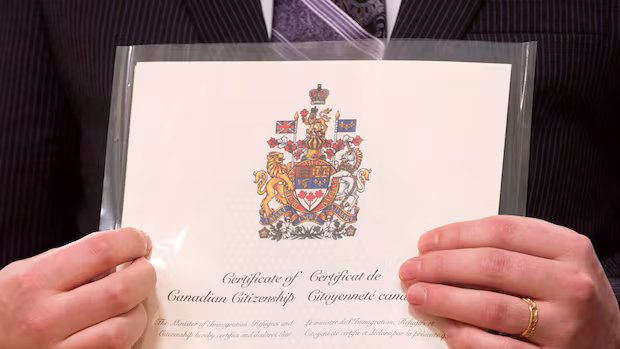
The federal government has suddenly suspended a number of Canadian citizenship certificates issued to people around the world who became eligible for citizenship late last year.
In a notice emailed Saturday to an unknown number of people who successfully applied for and obtained citizenship certificates based on having a Canadian ancestor, Immigration, Refugees and Citizenship Canada ordered them to return their certificates pending a review of their files.
“The purpose of this letter is to inform you that I have information in my possession that indicates that you may not be entitled to hold a Canadian certificate of citizenship,” wrote the notice signed Peggy Sun, registrar of Canadian citizenship.
Multiple copies of the letter have been shared online as recipients voiced their frustration. The letters don’t provide reasoning for the move beyond potential problems with documentation not being from original source authorities or, failing that, an explanation of why original source documents couldn’t be obtained and the efforts made to obtain them.
“As this documentation was not submitted with your proof of citizenship application, I am requiring the surrender of your certificate of citizenship,” Sun writes in what appears to be a form letter, adding that those who received the notice will have an opportunity to submit additional evidence and their certificates will be returned if the review finds they are eligible.
Immigration, Refugees and Citizenship Canada has yet to respond to questions first submitted to it by CBC News on Sunday.
Immigration lawyers say it appears to be a mass suspension, but just how many have been suspended is not yet known.
Many of those who received the letter — like Valerie Campbell of Bucksport, Maine — are in shock.

Campbell and her son Morgan received their citizenship certificates based on her family roots in Quebec and Ontario. After she received her certificate in March, Campbell put her home up for sale, began packing and started planning a move to New Brunswick or Nova Scotia.
Campbell said the suspension notice came out of the blue.
“It was a complete and total shock, I had no idea this was coming, that there were any problems at all,” she said in an interview, her Canadian citizenship certificate proudly framed and hanging on the wall behind her.
“I went into a blind panic. I didn’t know what to do.”
While Campbell received the notice Saturday, her son didn’t.
Campbell, a licensed mental health counsellor, said she has wanted to be in Canada for a long time, but the current political climate in the United States tipped the balance.
“It no longer feels safe to be in America, especially as a woman or if you’re on the spectrum or you’re a person of colour … there are so many different reasons that people are not wanted here,” she said.
“When I saw C-3 was happening, it seemed like such a wonderful opportunity to go someplace that would be better and more amenable to people like me.”
Now, she plans to put the sale of her house on hold and “go through every bit of information I have” to provide the records the Canadian government wants.
Campbell is one of an estimated 4,075 people from around the world — half whom were born in the United States — who received proof of citizenship by descent certificates following the adoption by Parliament in November of Bill C-3.
The change in the law allows people living in other countries who can trace their lineage from Canadian ancestors to qualify for Canadian citizenship, even if their Canadian ancestor left the country several generations back.
Prior to Bill C-3, Canadian citizenship by descent was limited to the first generation born or adopted outside of Canada to a Canadian citizen. However, that limitation was struck down by the courts as unconstitutional, and Ottawa was ordered to pass a law providing citizenship to those who became known as “lost Canadians.”
Estimates of how many people could qualify for Canadian citizenship under the change vary. While the Parliamentary Budget Officer has estimated that 115,000 people could be affected by the change, Immigration Minister Lena Metlege Diab told the House of Commons immigration committee that they didn’t expect a surge.
Since the change went to effect on Dec. 15, the wait times for IRCC to process applications for citizenship certificates has increased substantially from five months in May 2025 to 15 months.
While the backlog was in 56,000 applications in April and 70,400 in May, IRCC’s website shows 82,000 people are now waiting for their applications for citizenship certificates to be processed.
Lisa Middlemiss, a Montreal immigration lawyer, said it is very unusual for IRCC to suspend a citizenship certificate once it has been issued — let alone suspend so many of them at the same time.
“It’s very unfortunate and very concerning,” she said in an interview. “If IRCC had concerns about the documentary evidence submitted in favour of a proof claim, then they should have investigated that before making a positive determination and not be reopening people’s closed cases.”

Middlemiss said she doesn’t know what sparked the mass suspension of certificates.
“It’s almost as if they realized there were some errors made at some point in some files and they are not comfortable with the certificates that were issued.”
Middlemiss said she expects the mass suspension notices to trigger court action.
Vancouver immigration lawyer Amandeep Hayer said he has seen mass suspensions for permanent resident applications when there was a suspicion of fraud, but not for citizenship certificates that were already issued.
Hayer said reactions from recipients of the suspensions depends on their situations.
“If they’re in the U.S., they’re more angry and frustrated,” he said.
“If they’re in the country, they’re scared because a lot of them now have status in the country. They were depending on this to start work, they were depending on this to go to school, to get government services and all that’s up in the air.”