dailynewsnblog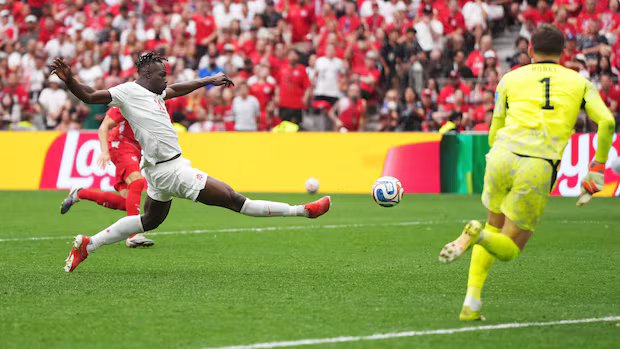
If there’s a reason for Canada’s men to believe they can beat Morocco on Saturday, it’s most easily found in Promise David’s singular moment against Switzerland.
His goal, from inception to completion, was one of this World Cup’s great goals. It also came against a better, more organized side, in the game that provided Canada with its best preparation for the Round of 16.
If David’s achievement was diminished by the eventual loss, it should now be remembered for its wonder.
That’s what separates belief from hope: Belief has corroborating evidence.
The Canadians had held the Swiss scoreless until halftime. If they were offered the same against sixth-ranked Morocco, they would take it. Head coach Jesse Marsch had thought about starting the second half with five back but decided against it, another lesson to carry into Saturday.
Five back might be the wiser plan against Morocco.
Switzerland scored early in the second frame and then again, capitalizing on a pair of defensive breakdowns, two mental errors rather than physical ones. Those are correctable, too. The game seemed lost for Canada.
That’s when Luc de Fougerolles, the ascendant 20-year-old defender, picked up the ball inside his own half. He was in the game only because Moïse Bombito was injured, and he looked down the field and saw 22-year-old Nathan Saliba, in the game only because Ismaël Koné was injured, too.
Opportunity beckoned for both, and the young reserves connected on a 40-yard pass.
“The centre back wasn’t quite covered over, and Saliba ran into the space,” de Fougerolles remembered before Thursday’s sweltering training session in Houston. “I think I overhit it a bit, but he managed to do unbelievably to take out his guy and then do another one touch to Promise.”
Saliba’s double touch was magnificent. The initial ball did travel over him, but he used his right foot to stop it and cut it back a little, shedding his momentum-doomed defender. He then delivered a pass with his left foot across to David, who began asking for the ball before Saliba even had chance to corral it.
“I see it coming pretty fast,” Saliba said, speaking about his defining moment in the present tense, as though he might never stop reliving it. “I see the defender tracking the ball at the same time as me. As soon as I felt it touch my foot, I just wanted to keep it close to me. It went up, and I had time to look at my options.”

Remarkable as it is instructive
It’s as remarkable as it is instructive that Saliba felt he had time in that instant. The ball was in the air for less than a second.
“If you don’t think too much, and just play instinctively, then many things can happen,” he said.
“I saw Promise on the opposite side just waiting for the ball.”
David, who has been used only as a substitute but has made the most of his time on the field, accelerated toward the net, slipping behind his marker, who tried to intercept Saliba’s pass instead. The towering 24-year-old had predicted that he’d score in Vancouver, and now he saw the ball and his chance to make his prophecy come true.
“You just know every opportunity you’re going to have, you might not have it twice,” Saliba said. “You want to make sure you take all of them.”
David took his. The Swiss goalkeeper had been drawn toward Saliba, and before he could make his correction, David ran for daylight. He didn’t have the time or space to take a touch, but he didn’t need to. He lunged at the ball with his right foot and redirected it toward the open net.
His first touch of the game was a goal. Canada couldn’t complete its miracle comeback, but after, David was reminded of his prediction and still managed to let out a loud laugh.
“I called it,” he said.
There, perhaps, lies the most important lesson of this young side’s educational night.
Yes, Canada’s men can withstand and frustrate a difficult attack. Yes, they might have to make some tactical adjustments against fearsome Morocco. Yes, they can still make their own opportunities if they play quickly and instinctively and decisively. Yes, they can score against anyone, so long as they let the ball lead them.
And yes, finally: Their destiny is up to them.
Only they don’t need to imagine what they might do anymore. They just need to remember what they’ve already done.