dailynewsnblog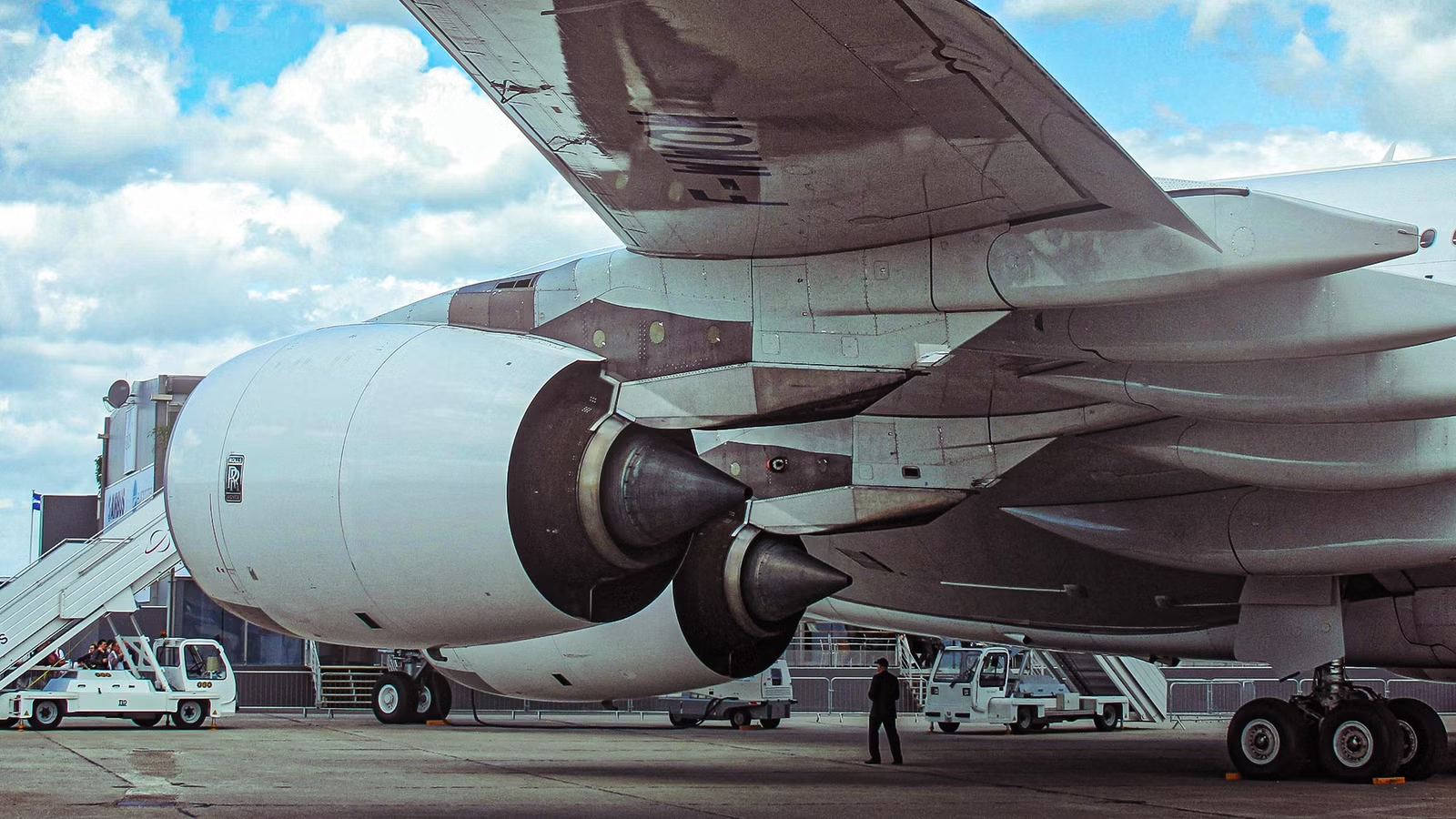
The Airbus A380 is the largest passenger airliner ever built. Airbus launched the double-decker to compete directly with Boeing’s 747 and targeted airlines that needed a high-capacity aircraft for long-haul routes between major hubs. The aircraft entered commercial service in 2007 with Singapore Airlines, and several major carriers later added the A380 to their long-haul fleets.
Today, more than 100 double-deckers remain in service and continue to play a key role in the long-haul operations of multiple airlines. That being said, the A380’s development faced numerous setbacks, and even after entering commercial service, the aircraft continued to face several technical challenges.
Airbus Discovered Wing Cracks On The A380 In 2012

One of the major challenges Airbus faced after the A380 entered service came in 2012, when cracks were discovered in the aircraft’s wing rib feet. The wing rib feet are structural components located inside the wing that connect the internal wing ribs to the wing skin panels. At the time, nearly 80 A380s were operating with airlines around the world, and Airbus found cracks on around 40 aircraft, affecting roughly half of the active fleet.
According to reports at the time, aircraft operated by Air France, Emirates, and Singapore Airlines were among those found to have additional cracking. The European planemaker’s investigation found that the issue was linked to the way different materials were used in this part of the wing. The rib feet were made from aluminum alloy, while the brackets attached to them were manufactured from carbon composite materials.
The difference between these materials, combined with stresses introduced during the manufacturing process, created conditions that could lead to cracks developing over time. The findings prompted the European Aviation Safety Agency ( EASA) to require inspections across the A380 fleet. In its airworthiness directive, the regulator warned that the issue, if not detected and corrected, could potentially affect the structural integrity of the aircraft.
How Airbus Solved The A380 Wing Crack Issue

The European planemaker had originally used carbon-composite brackets as part of its effort to reduce the A380’s weight. The aircraft has the largest wings ever fitted to a passenger airliner, measuring nearly 262 feet (80 meters) in span. They were designed to support an aircraft with a maximum take-off weight of more than 575 tonnes while also providing enough structural margin for a potential stretched variant. Using carbon-composite components in the wing structure saved around 660 lb (299 kg) per wing, which made them an attractive option as Airbus looked to reduce weight wherever possible.
However, as noted previously, the combination of carbon-composite brackets and aluminum rib feet, along with stresses introduced during the manufacturing process, created conditions that led to the cracking issue. The European planemaker then worked to develop a permanent solution to address the cracking and prevent it from occurring again. Later in 2012, it introduced a redesigned wing rib foot assembly that replaced the carbon-composite brackets with conventional aluminum components. At the time, other Airbus aircraft already used aluminum brackets in their wing structures, which made it a proven solution rather than a new design.
Rather than grounding the A380 fleet, the planemaker worked with EASA to keep the aircraft in service under the regulator’s airworthiness directive while the permanent fix was developed, certified, and introduced. Ultimately, it incorporated the redesigned aluminum components into aircraft already in service, as well as those still on the production line. The retrofit program, which reportedly cost the manufacturer around $330 million, began in late 2012 and covered approximately 120 aircraft. From 2014 onwards, newly built A380s were delivered with the updated wing structure as the production standard.
Additional Wing Crack Issues Have Been Found Over The Years

Even though Airbus resolved the original wing rib foot issue, the double-decker has continued to be the subject of other wing-related inspections over the years. It is worth noting that these cases involved different parts of the wing and were not related to the cracking discovered in 2012. Back in 2019, Airbus identified tiny cracks around the outer rear wing spar on a number of early-production A380s. A total of 25 aircraft required inspections, including aircraft operated by Qantas, Air France, Lufthansa, Singapore Airlines, and Emirates, as reported by Forbes.
Catch what other flight trackers miss
Emergency squawks, holds, NOTAMs — live signals, no signup.
Open tracker
Catch what other flight trackers miss
Emergency squawks, holds, NOTAMs — live signals, no signup.
Open tracker
At the time, EASA published a proposed AD requiring inspections of the affected area. According to the regulator, the issue involved “relatively minor cracking” in the outer wing spars. Notably, there wasn’t any significant impact on aircraft operations as the inspections and any necessary repairs could generally be completed during scheduled heavy maintenance checks. Furthermore, as operators continued reporting additional findings, EASA issued several more directives over the following years.
By 2024, the regulator expanded the inspection program to cover all A380 aircraft and additional areas of the wing, including sections of the outer front spar, inner front spar, and outer rear spar. It also revised when inspections should take place. Rather than relying only on the aircraft’s age, EASA introduced criteria that also considered how long an aircraft had spent parked or in storage after data showed a clear link between time on the ground and the severity of the cracks.
EASA Recently Issued A New Directive For A380 Wing Inspections

Furthermore, the issue related to wing cracks has continued. Just last month, EASA issued emergency airworthiness directive 2026-0119-E, requiring urgent inspections of the wing mid-spars on 16 Airbus A380s, effective June 24. The directive applied to 15  Emirates A380s and one operated by Qantas. The table embedded below shows the A380s affected by the latest directive.
Five of the aircraft (operated by Emirates) were required to undergo inspections before further flight, while the remaining 11 were given a compliance period of 25 flight cycles. Qantas’ only affected aircraft, VH-OQI, was already undergoing heavy maintenance in Dresden, Germany. The airline confirmed to The Guardian that the directive had no impact on its flight schedule.
Operator(s) | Affected Aircraft (aircraft age) |
|---|---|
Emirates | A6-EOO (11 years), A6-EOP (10 years), A6-EOS (10 years), A6-EOY (10 years), A6-EUP (nine years) — Immediate inspection; A6-EDK (16 years), A6-EDM (16 years), A6-EDN (16 years), A6-EDX (14 years), A6-EET (12 years), A6-EOK (11 years), A6-EOM (11 years), A6-EOX (10 years), A6-EUO (nine years), and A6-EUS (nine years) |
Qantas | VH-OQI (16 years) |
According to EASA, the latest directive followed a review of inspection results from aircraft that had already undergone checks, which found that cracks on certain aircraft could reduce the structural integrity of the wing. To address the issue, Airbus developed an additional special detailed inspection program focusing on the wing mid-spars, which are key structural components located within the wing box.
The latest directive followed another airworthiness directive issued in 2025 after cracks were identified in the wing middle spars of several A380s. That directive focused on aircraft returning to service after extended periods of storage. However, after reviewing the inspection results, EASA concluded that additional inspections were necessary and expanded the requirements.
The A380 Continues To Play A Key Role In Long-Haul Operations

Despite these challenges, the A380 has revolutionized long-haul passenger travel since entering commercial service. The European planemaker launched the program at a time when airlines were looking for larger aircraft to serve slot-constrained airports and meet growing demand on major international routes. However, the aircraft’s economics soon became increasingly difficult to justify.
Its four-engine design resulted in higher operating costs and fuel burn than newer twin-engine widebodies; airlines increasingly favored more efficient aircraft. As a result, orders slowed significantly during the 2010s and, in 2019, Emirates, the type’s largest operator, reduced its remaining A380 order book by canceling around 39 aircraft as it shifted towards the Airbus A350 and Boeing 777.
With demand continuing to decline, Airbus concluded the program after delivering the final A380 to Emirates in 2021. In recent years, many airlines have retired the double-decker from their fleets. That said, the A380 continues to play a key role in the long-haul operations of airlines like Emirates, Singapore, British Airways, Etihad Airways, Qantas, Lufthansa, Qatar, and remains one of the most recognizable aircraft in commercial aviation. According to aviation analytics company Cirium, airlines have scheduled more than 83,000 flights using the A380 in 2026.
Airbus Successfully Addressed One Of The A380’s Biggest Challenges

Indeed, the A380 program has faced several setbacks over the years. During development, Airbus dealt with major wiring issues that delayed the aircraft’s entry into service. After entering commercial operations, the manufacturer also had to address a number of technical issues, including the wing rib foot cracking discovered in 2012.
Rather than grounding the entire fleet, Airbus worked with EASA to develop and certify a permanent solution while the aircraft continued operating under the regulator’s airworthiness directive. The manufacturer replaced the carbon-composite brackets with a redesigned aluminum assembly.
It incorporated the modification into aircraft already in service and those still on the production line, and made the updated design the production standard from 2014 onwards. Although the A380 has continued to be the subject of additional airworthiness directives covering different parts of the wing, the A380 remains an important part of the long-haul fleets of several airlines.