dailynewsnblog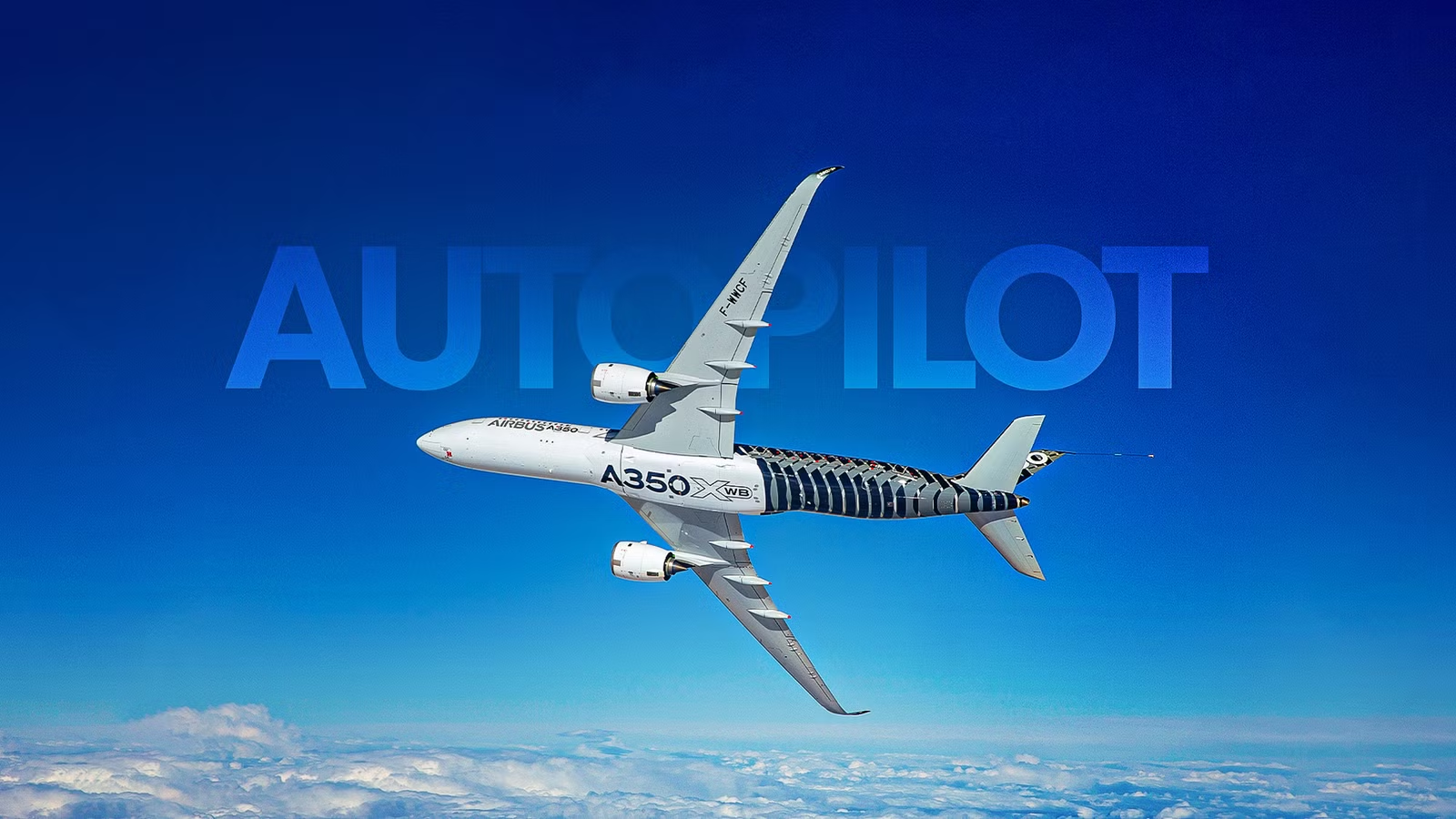
Modern jet airliners are more automated than ever, and the Airbus A350 is one of the best examples of how advanced flight technology has transformed commercial aviation. The aircraft’s autopilot can be engaged shortly after takeoff and manage much of the journey, but many pilots still choose to hand-fly the aircraft during the initial climb. We will explore why that practice continues, how airline procedures influence the decision, and why manual flying remains an important part of operating one of the world’s most sophisticated airliners.
Although automation has significantly improved efficiency and safety, it has also raised concerns about the long-term impact on pilots’ manual flying proficiency. The loss of  Air France Flight 447 in 2009 brought those concerns into sharp focus, prompting regulators and airlines to re-evaluate the balance between automation and hands-on flying. Understanding why some A350 crews continue to fly manually beyond 10,000 feet (3,048 meters) provides valuable insight into how modern pilots maintain the skills they may need when automation is no longer available.
Why A350 Pilots Sometimes Hand-Fly Beyond 10,000 Feet
.jpeg?q=49&fit=crop&w=500&dpr=2)
Airline Standard Operating Procedures vary by carrier, but on most A350 operations, autopilot engagement typically follows once the aircraft has established a clean configuration with flaps retracted, somewhere between 1,500 and 10,000 feet (457 to 3,048 meters), depending on the airline and the captain’s preference. The lower limit is set by certification; the upper limit is set by judgment. Pilots who choose to hand-fly to 10,000 feet do exist. They are doing the only thing that keeps their manual flying skills calibrated against the actual aircraft in actual air, not a simulator rendering of it.
According to Ask Captain Lim’s analysis of manual flying frequency, Airbus autopilots can technically be engaged just 5 seconds or 100 feet after takeoff, but many pilots prefer to hand-fly the aircraft up to 10,000 feet (3,048 meters) to maintain their “stick and rudder” proficiency. On the A350 specifically, this means flying under Normal Law, Airbus’ envelope protection mode, where the sidestick inputs translate to load factor rather than control surface deflection. The aircraft cannot be stalled, cannot exceed structural load limits, cannot roll beyond 67 degrees, even with full sidestick deflection. Hand-flying an A350 is not the same as hand-flying a Boeing 737. The control laws do significant work beneath the pilot’s input, and practicing within them is both easier and less representative of raw manual skill than it might appear.
The distinction between flying within envelope protection and flying without it matters enormously in a specific scenario: when the protection system itself is compromised. And on June 1, 2009, over the South Atlantic, that scenario involving the Airbus A330 automated systems became one of the most studied accidents in modern aviation history.
What Happens After The A350 Autopilot Takes Over In Cruise

Once the autopilot is engaged, the sidestick goes quiet. The aircraft is now managed through the Flight Management and Guidance Computer (FMGC), which is programmed by the crew via the Multi-Function Control and Display Unit (MCDU) on the A350’s center console. As Simple Flying has detailed in its analysis of what pilots actually touch during automated flight, the FMGC is the primary workstation during cruise: routing updates, wind entries, altitude adjustments, speed target changes, oceanic clearances, and approach preparation all run through it. The aircraft may be flying itself physically, but the crew is continuously programming the system that tells it what to do next.
On a 14-hour flight, a realistic MCDU interaction count runs into the dozens of separate inputs: step climbs as the aircraft lightens with fuel burn and can sustain higher altitudes more efficiently, reroutes around developing weather systems, updates to the destination approach, fuel checks against planned burn, and SELCAL monitoring across oceanic control sectors where continuous VHF contact is not possible. According to Avi-8’s technical analysis of autopilot operations, during cruise the autopilot manages the profile, but pilots are constantly interacting with the FMS to adjust for weather, routing, and efficiency — the automation manages the physical aircraft while the crew manages the automation.
Above 29,000 feet (8,839 meters), autopilot use becomes mandatory under Reduced Vertical Separation Minimum (RVSM) rules. This is the international framework that allows aircraft to fly 1,000 feet (305 meters) apart vertically rather than 2,000 feet (610 meters) by requiring autopilot precision that manual flight cannot reliably achieve for sustained periods. From that point until the descent, the hands-off period is essentially enforced by regulation as well as practice. What changed after 2009 is the awareness of what that extended automation dependency was costing.
How Air France 447 Changed The Understanding Of Automation Reliance

Air France Flight 447, an Airbus A330, was cruising at 35,000 feet (10,668 meters) over the Atlantic on the night of June 1, 2009, when iced pitot tubes fed conflicting airspeed data to the automation system. The autopilot and autothrust disconnected. The crew, who had been monitoring rather than flying for the cruise portion of the sector, now had the aircraft in their hands in Alternate Law, without envelope protection, at night, over the ocean, with unreliable airspeed indications. According to the Risk Engineering Society’s analysis of AF447, less than 3.5 minutes elapsed between autopilot disconnect and water impact. The crew flew into a fully developed stall they did not recognize, pulled back continuously to correct it, and never recovered.
The investigation identified skill fade, the degradation of manual flying ability through extended non-use, as one of the contributing factors. The crew was not incompetent. They were simply unequipped for the specific scenario of recognizing and recovering from an unusual attitude on a type where automation ordinarily prevents those attitudes from developing. The Alternate Law the aircraft fell into on autopilot disconnect is a degraded mode in which the pitch axis continues to use computer-augmented load factor (G-load) demand, but the roll axis reverts to direct control, and where the crew’s responses must be calibrated to physics rather than to software-mediated load factors they had been accustomed to commanding.
The findings from AF447 prompted regulators to examine whether increasing dependence on automation was eroding manual flying proficiency across the industry. The resulting guidance from both the FAA and EASA now encourages airlines to create opportunities for pilots to hand-fly during appropriate phases of flight, even on highly automated aircraft such as the A350.
How FAA And EASA Guidance Is Reshaping Manual Flying Practices

In 2017, the FAA issued Safety Alert for Operators 17007 (SAFO 17007) specifically addressing manual flying skill maintenance. The document is addressed to air carrier operators and recommends that airlines review their policies and procedures to ensure pilots maintain manual flying proficiency. Its core recommendation reads: Operators should make provisions to use appropriate opportunities to practice and maintain manual flying skills.
As Simple Flying’s detailed analysis of what long-haul crews actually do during extended automation makes clear, the SAFO’s practical effect has been uneven. Some airlines responded by amending their SOPs to specifically permit, and in some cases encourage, hand-flying during the climb and initial descent phases in benign conditions. Others continued to emphasize early automation engagement as a standardization measure, arguing that consistency reduces error risk more than manual practice improves response capability. The tension between those two positions is ongoing, and it plays out differently on every airline’s A350 operation.
According to Flight Safety Foundation’s “Maintaining Manual Skills” analysis, the practical challenge is that modern aircraft like the A350 make it structurally difficult to practice the scenarios where manual skill is most needed, such as high-altitude unusual attitudes and degraded control law operations, because Normal Law prevents those scenarios from developing during normal operations. The skills most worth maintaining are the ones least accessible to practice.
How Experienced A350 Crews Balance Automation And Manual Flying

The result is a quiet cultural shift in how experienced A350 crews approach the parts of the flight where they have discretion. The pop-culture image of autopilot engagement at 1,000 feet and a 14-hour monitoring exercise is not accurate for what the most skilled long-haul crews now do with the window of discretion they have between takeoff and the RVSM altitude where automation becomes mandatory.
Hand-flying to 10,000 feet (3,048 meters), disconnecting the autothrust briefly to manually manage the speed transition through flap retraction, or flying the initial segment of the descent manually to keep the approach parameters live in the pilot’s spatial awareness — these are choices within policy, made deliberately, with the AF447 case study as the background context.
As Simple Flying’s review of the most technologically advanced aircraft pilots currently fly notes, the A350’s automation is designed to act as a partner, and not a replacement, a distinction that requires active management from the human side to remain true. The “5 seconds or 100 feet” certification limit for autopilot engagement is a design parameter, and not an obligatory instruction. How crews use the space between the minimum and what the aircraft can technically do is where the skill actually lies.
The A350’s Normal Law will not let a pilot stall the aircraft, overstress it, or bank beyond 67 degrees. But it cannot prevent skill fade from accumulating across hundreds of hours of monitoring. That problem has no technical solution, only behavioral ones, applied by flight crews who understand what the automation is protecting them from, and what it is quietly leaving them less prepared to face.
Why The Remaining 10% Of Flight Matters More Than The Automated 90%

The 90% automation figure that defines modern long-haul flying is not the problem regulators identified after AF447. The problem was the assumption that the 10% — the takeoff, the climb, the descent, the approach, and the unexpected failures in between — could be managed effectively by crews who had spent the preceding hours doing none of it. The manual phases of an A350 flight are short, but they are disproportionately consequential, and the skill required for them does not maintain itself through inactivity.
What the FAA’s SAFO 17007 and EASA‘s parallel guidance established is that the automation-heavy cruise model is only safe if it is bookended by active, intentional manual flying practice at the margins where the autopilot is not yet engaged or has just been disconnected. The 14-hour flight in which a crew hand-flies purposefully to 10,000 feet on departure and flies the initial descent manually to 5,000 feet on arrival is not more dangerous than one where autopilot is engaged at 100 feet. It is the mechanism by which the crew remains qualified to handle the version of the 14-hour flight where the automation disconnects unexpectedly at hour seven over the ocean and gives the sidestick back without warning.
Air France 447 taught us an important safety lesson. The A350 crews flying the same oceanic routes today are flying a more capable aircraft, with better systems and better training, and the best of them are also making sure the 10% of the flight where those systems step aside does not come as a surprise.