dailynewsnblog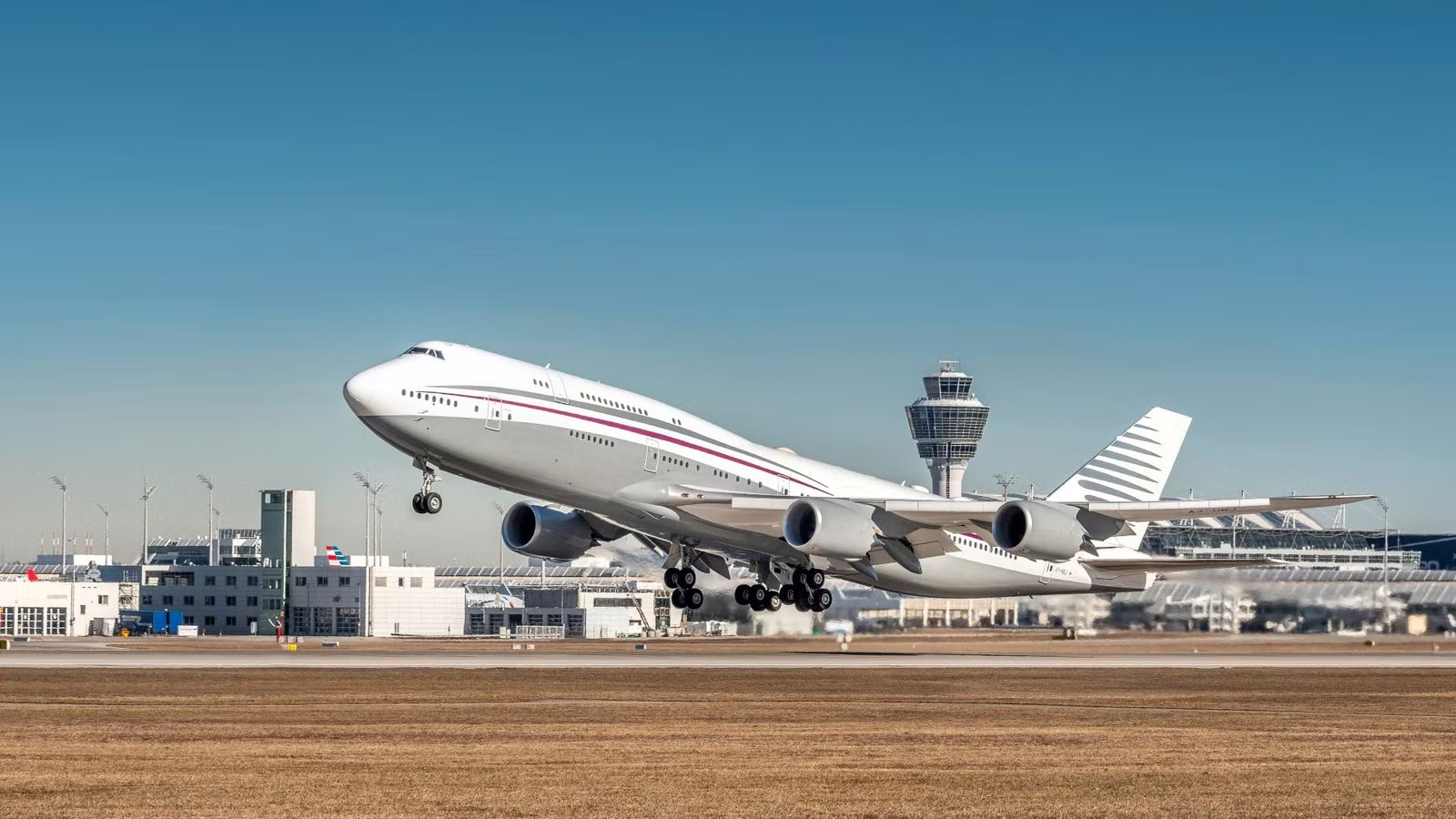
After extensive speculation, it has now been confirmed that a lavish former Qatari Boeing 747-8I model will serve as a temporary presidential transport aircraft while Boeing’s purpose-built next-generation Air Force One jets remain years behind schedule. The Air Force notes that the aircraft, which has been described as the VC-25B Bridge Aircraft, has entered flight testing. After passing these flight tests, the aircraft will be eligible to begin serving as a presidential jet.
The aircraft is thus expected to be delivered to the Presidential Airlift Group no later than summer 2026, according to TWZ. That makes it less a symbolic curiosity than a real operational workaround. The plane is a fast-tracked modified jumbo jet intended to bridge a capacity gap created by the repeated delays affecting the official VC-25B replacement program.
Real Long-Term Air Force One Replacements Are Not Arriving Anytime Soon

As things stand, the real long-term Air Force One replacements are still nowhere near entering service with the presidential airlift group. The Air Force’s most recent public schedule says that the first of the two new VC-25B aircraft is now expected in mid-2028, an improvement from worst-case projections that had drifted toward 2029. This is still four years behind the original operational target for the multi-billion-dollar program.
What is notable is that the latest official update publicly pins down only the first aircraft’s service entry date. The Air Force did not provide a fresh public delivery target for the second jet that will be entering service. Thus, it is safe to conclude that true replacements are not going to be flying as Air Force One until at least mid-2028, and the entire replacement fleet may not be operational until years after.
How Do These Jets Work As A Stopgap Solution?

The mechanics of the stopgap plan are straightforward in concept but rather confusing in practice. Rather than wait for the fully bespoke and up-to-date VC-25B jets to enter service, the Air Force is taking a low-hours luxury 747-8I and modifying it quickly enough to cover at least part of the presidential airlift mission in the interim.
The aircraft is already in the test flight process, with visible changes reportedly including added aerials and high-frequency satellite communications hardware. However, the entire point of using this aircraft as a bridge or stopgap solution is that it is not expected to be a full substitute for the eventual VC-25Bs. Those are going to be purpose-built for the role of serving as Air Force One, and there is a good chance that they could be flying for decades. Some have even speculated that they could be the last Boeing 747s to ever fly.
Analysts have also raised open questions about how much hardening, defensive equipment, and mission-system integration the jet will actually receive, something which suggests it may be best suited to lower-risk missions rather than the full global, wartime-capable Air Force One standard. In other words, the plane buys both time and prestige, but it is not a complete like-for-like replacement.

The New Boeing 747-8 Air Force One: What’s The Latest?
Will we see a new Air Force One before the end of the decade?
A Look At The Operational History Of These Qatari 747-8I Models

The Qatari aircraft’s backstory is a big part of why the plane has drawn so much attention. This is not an ordinary secondhand airliner. It comes from the ultra-exclusive world of Qatar’s VIP transport fleet. Boeing delivered the first 747-8 Intercontinental VIP aircraft in 2012, and Qatar Amiri flight was quickly identified as the launch customer for the type.
The Qatari government used the aircraft extensively for royal transport. Qatar Amiri Flight is effectively the government’s elite air arm for the royal family and senior officials, so the plane spent its early life in exactly the kind of high-end, head-of-state environment that requires a lavish baseline onboard cabin configuration.
This made it a very good candidate to serve as a bridge platform for the Air Force One program. The plane began life as a prestigious aircraft with long range, low utilization, and an interior built for VIP movement, even if it was never designed from the outset to meet the uniquely hardened United States Air Force One mission.