dailynewsnblog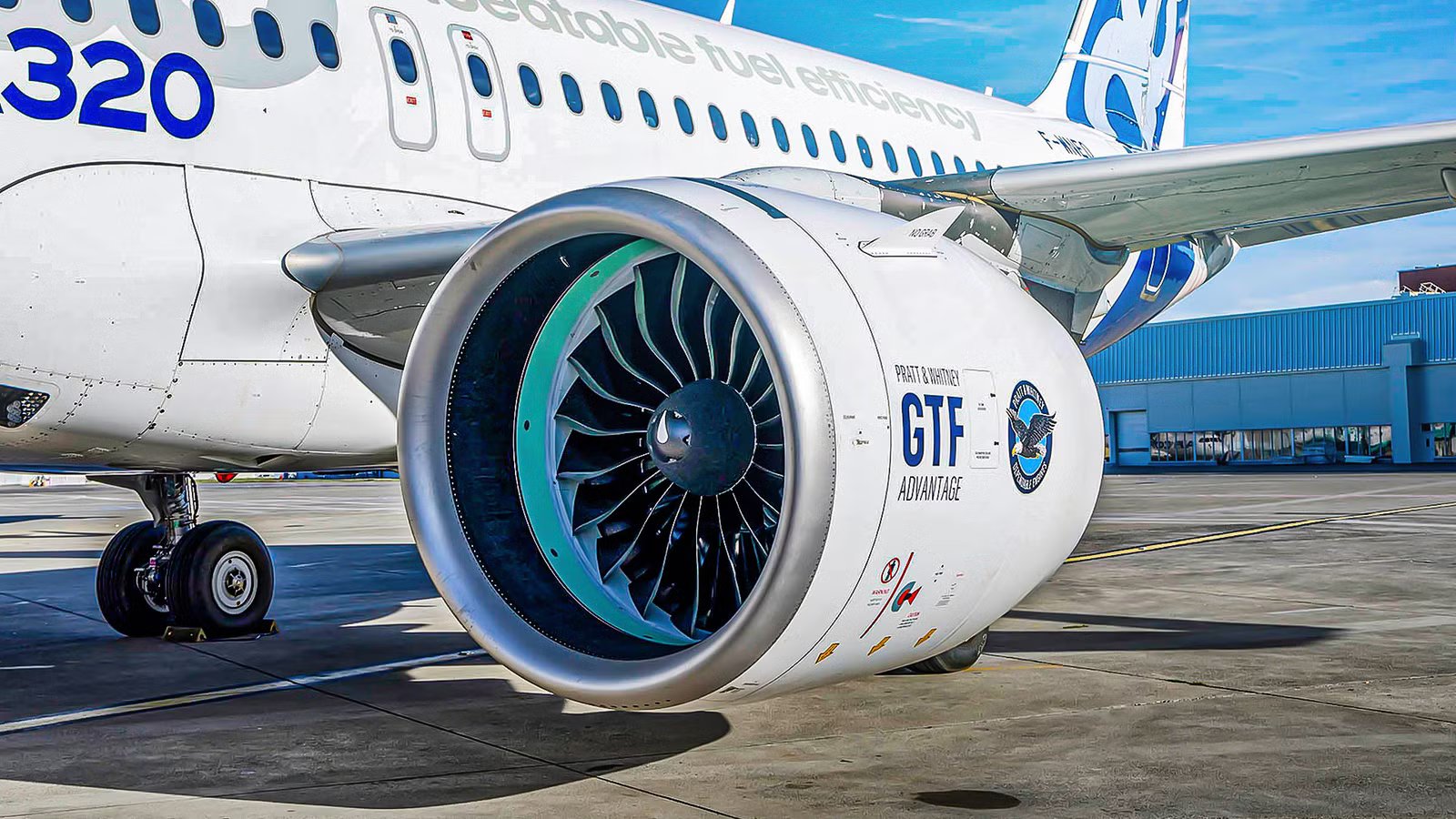
Aircraft engines are among, if not the most valuable, component of any commercial aircraft. However, amid the ongoing shortage of GTF engines, which power nearly half of the world’s Airbus A320neo family fleet, some nearly new Airbus jets are being harvested for their engine parts. With the A320neo having entered service just ten years ago, in some cases a working pair of Pratt & Whitney GTF engines has become more valuable than the aircraft itself, especially given maintenance lead times of 250 to 300 days.
It isn’t all bad news, however. Pratt & Whitney identified the root cause of the issue several years ago and, in recent months, unveiled both an updated engine and upgrade solutions for existing GTF engines. These improvements hope to help alleviate the pain felt by the nearly 835 aircraft globally powered by GTF engines.

When Pratt & Whitney launched the PW1000G geared turbofan (GTF) engine, it was supposed to deliver incredible performance results for Airbus’s A320neo and A220 families. Developed as the successor to the Pratt & Whitney PW6000 engine for the Airbus A318 and as a competitor to the CFM International LEAP-1A for the A320neo family aircraft, the GTF promises enhanced fuel efficiency, reliability, and reduced noise due to its unique gearbox mechanism. This design allows the front fan and low-pressure spool to rotate at different speeds, increasing the bypass ratio while reducing stress on engine components.
However, some of the powder-metal parts used because of their allowance for precise, high-strength disc geometries were flawed in a way that seeded microscopic cracks within the engine. During normal operation, the heat and stress from the engine expanded those cracks, creating the risk of uncontained disc and engine failures. This issue was first discovered in 2020 and affects engines manufactured between 2015 and 2021. The issue was initially identified as 1,200 potentially affected engines, which later resulted in 600 to 700 immediate engine removals from service.
In response, several regulatory agencies, including the FAA and EASA, mandated accelerated engine inspection cycles for the GTF engine. This reduced the time before inspection from around 5,000 or 7,000 cycles to just under 3,000, effectively cutting the service life in half. With hundreds of engines requiring visits to maintenance shops simultaneously, global GTF maintenance facilities were overwhelmed, resulting in maintenance times of 250–300 days rather than the typical 60-90 days. Since then, Pratt & Whitney has expanded the number of maintenance facilities worldwide, helping to reduce this time significantly. However, a large portion of the world’s GTF-equipped aircraft fleet remains affected by these defects.
How Many Aircraft Are Affected Worldwide?

In total, up to 835 aircraft had been grounded due to the original GTF crisis. This figure represents about 38% of the global GTF-equipped A320neo family fleet. Between the A320neo and A321neo, the A320neo represents the largest proportion of grounded aircraft, with the A321neo following closely behind. The issue has disrupted operations across nearly every major airline operating GTF-powered narrowbody fleets.
Some airlines have been hit particularly hard. In 2025, Wizz Air grounded over 40 A320neo aircraft until mid-2026, representing about 15% of its total fleet. Meanwhile, Indian low-cost carrier  IndiGo currently has 64 grounded A320neo family aircraft according to planespotters.net, accounting for around 17% of its fleet capacity.
While the A320neo family has been most affected, many A220s with PW1000G family engines have also been grounded. In fact, in late 2025, SWISS grounded its entire fleet of Airbus A220-100 aircraft, reallocating the GTF engines installed on those aircraft to its larger Airbus A220-300s, allowing its higher capacity aircraft to continue flying through the long maintenance waits. Additionally, Air Australretired its entire fleet of A220-300 aircraft in the fall of 2025 as a result of GTF engine issues, with the A220s being just 4.5 years old on average.

These Are The Most Affected US Airlines By Pratt & Whitney Engine Groundings Today
Spirit Airlines faces the biggest impact.
Why GTF Engines Are Worth More Than Young A320neo Planes

The sight of aircraft being scrapped for parts is not new to aviation, with older, out-of-production aircraft at the end of their service lives often parted out to support remaining fleet maintenance. However, today, A320neo family aircraft with only a few years of service, a fraction of their designed service lives, are being taken apart for their engines. According to Reuters, more than a dozen Airbus aircraft have already been dismantled after only a few years of service, with dozens more potentially facing the same fate.
These valuable pieces of aircraft represent a pool of scarce, high-demand parts that can keep other aircraft flying. In 2026, a single GTF engine could earn lease rates of around $200,000 per month, according to data from aviation analytics firm Cirium. When multiplied by two engines per aircraft, the revenue potential can quickly exceed the value of operating the aircraft itself, equating to about $4.8 million per year. This becomes especially relevant given the ongoing shop-visit waits that have extended to nearly a year, providing airlines with a way to generate revenue without aircraft being grounded while waiting for maintenance.
This dynamic has created a situation where airlines and lessors view spare engines as strategic assets. Aircraft unable to secure replacement engines can remain grounded for nearly a year waiting for maintenance slots. By contrast, removing engines from one aircraft and leasing or selling them to another can allow airlines to regain some capital for an aircraft that otherwise would be sitting empty.
The GTF Advantage & Hot Section Plus: Pratt & Whitney’s Solution

In April 2026, Pratt & Whitney reached a major milestone in their effort to end the GTF engine crisis. The company’s upgraded GTF Advantage engine achieved EASA certification for the Airbus A320neo and Airbus A321neo. Production of the GTF Advantage has already begun, with entry into service expected later this year and a complete production transition to the GTF Advantage by the first half of 2028, according to a Pratt & Whitney spokesperson in a comment to Simple Flying.
The Advantage model will provide numerous benefits over older GTF engines. This includes up to 4% more takeoff thrust at sea-level airports and 8% more at high-altitude airports. Most notably, the GTF Advantage offers up to twice the time on wing compared to current GTF configurations, hopefully helping alleviate repair backlogs that currently exist. The Advantage is also fully interchangeable with existing GTF engines, allowing airlines already operating the type to easily switch from the legacy GTF to the Advantage model.
Additionally, the GTF Advantage features a redesigned hot section that targets the area of the engine exposed to the highest temperatures and mechanical stress, improving durability and reducing maintenance requirements. For airlines already operating current-generation GTF engines, Pratt & Whitney is also introducing the “Hot Section Plus” as an upgrade option for existing PW1100G-JM engines. As explained by Pratt & Whitney, the Hot Section Plus is expected to provide 90% to 95% of the durability improvements of the full GTF Advantage engine, nearly doubling time on the wing. First installations of this upgrade are expected later this year, with the package designed to remain fully interchangeable with both existing GTF engines and future GTF Advantage models.
Hot Section Plus: Pratt & Whitney Reveals New Aftermarket Upgrade For GTF Engines
Pratt & Whitney has rolled out a ‘GTF in a box’ upgrade kit.
Could Spirit’s Shutdown Help Relieve Some Of The Pressure?

With Spirit Airlines ceasing operations on May 2, 2026, the American low-cost carrier’s collapse could potentially provide short-term relief to the constrained GTF engine market. Spirit operated sizable fleets of both the A320neo and A321neo in the years leading up to its collapse. This included approximately 114 Airbus A320 family aircraft (66 leased) before shutting down operations, a figure about half of what it was two years prior.
According to Reuters, lessors and aftermarket suppliers believe many of Spirit’s aircraft may ultimately be dismantled for parts rather than returned directly to service. While some aircraft could eventually find new operators, functioning GTF engines, many of which are less than five years old, remain the most valuable assets attached to those jets. In a statement, the CEO of Willis Lease Finance Corp, Austin Willis, told Reuters:
“We are seeing some of the GTF engines from Spirit A320s being removed from the airframes and leased out to customers to support (aircraft on the ground). This is providing some limited temporary relief from the supply/demand imbalance.”
In practice, however, it remains to be seen if Spirit’s former fleet of GTF-equipped aircraft will provide substantial relief to the market. While Spirit has received permission from a US bankruptcy court to accelerate its liquidation plan, many of these planes may not land on the market for at least a few months. Despite this, some Spirit aircraft that were sold or transferred prior to the carrier’s May shutdown have already been dismantled for parts. This includes plans by EirTrade Aviation and RESIDCO to strip two ex-Spirit A320neos and KP Aviation’s plans to dismantle less than five-year-old Spirit aircraft.
What Recovery Looks Like For Airlines, Airbus, and Pratt & Whitney

There are early signs that the industry is beginning to recover from the worst of the GTF engine shortage, though the process remains slow and expensive. According to Pratt & Whitney, the number of grounded GTF-powered aircraft has already fallen by roughly 15% compared to the end of last year. Maintenance output increased by 23% year-over-year, while heavy shop visit turnaround times improved by approximately 20%.
In addition, RTX, Pratt & Whitney’s parent company, has also committed more than $400 million in investments during the first four months of 2026 alone. These include a $200 million expansion of forging capacity in Georgia, a $100 million expansion of production in Poland, and more than $100 million across MRO facilities in Texas, Florida, and Arkansas.
For airlines, recovery will ultimately depend on how quickly upgraded GTF engines and Hot Section Plus retrofits can return reliability to expected levels. If the GTF Advantage performs as promised, almost half of the world’s A320neo and A321neo fleets will resume stabilized operations. Until then, the sight of airlines dismantling nearly new aircraft for engines remains one of the clearest signs of the severity of the crisis today.