dailynewsnblog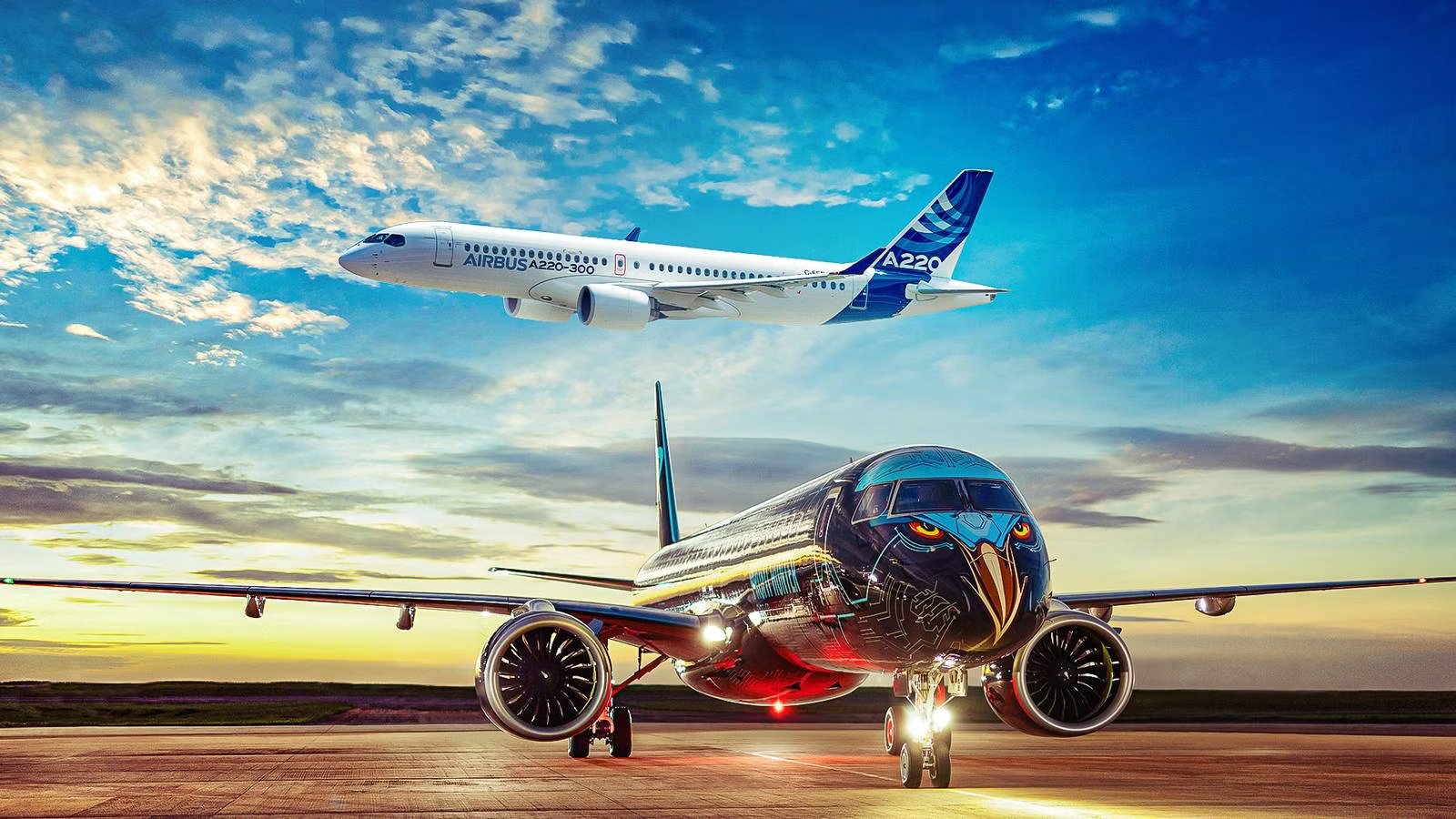
The Airbus A220 and the Embraer E195-E2 compete for the same orders in the 120-160 seat segment, and both are powered by Pratt & Whitney geared turbofans that place them among the most fuel-efficient narrowbodies in service. The A220 holds the larger order book, having passed 1,000 firm orders in May 2026. The E195-E2 has won a string of recent campaigns at LATAM, Finnair, SAS, Porter Airlines, and Avelo Airlines, frequently against the A220 directly.
Which aircraft costs less to fly depends on how the question is framed. The A220-300 lists for roughly $30 million more than the E195-E2, carries more passengers, flies approximately 800 nautical miles (1,482 km) farther, and burns less fuel per seat on longer routes. The E195-E2 is cheaper to buy, lighter, and less expensive per departure, which gives it the advantage on short routes where an airline cannot reliably fill 150 seats. The result comes down to route length, load factor, and whether an airline is measuring cost per seat or cost per trip.
Which A220 Actually Competes With The E195-E2?

The Airbus A220 family and the Embraer E195-E2 do not line up neatly by capacity. The E195-E2 seats up to 146 passengers. The A220-100 seats up to 135, and the stretched A220-300 seats up to 160. Embraer’s largest E2 sits between the two Airbus variants, bigger than the A220-100 and smaller than the A220-300, which means neither family offers an exact match for the other.
Airlines and analysts most often measure the E195-E2 against the A220-300, which is typically configured with 125-160 seats and competes for the same orders. The A220-100’s capacity overlaps with both the E195-E2 and the smaller E190-E2. Cabin cross-section adds a second difference. The A220 seats five abreast in a 3-2 layout with seat widths of 18.5-21 inches (47-53 cm), while the E2 seats four abreast in a 2-2 layout with a standard seat width of 18.3 inches (46 cm). Embraer’s cabin has no middle seat. Airbus places one on every economy row, which accounts for much of the A220-300’s capacity advantage.
That capacity gap shapes every cost comparison that follows. A cost-per-seat figure for a full A220-300 and a full E195-E2 compares two different capacity points rather than two versions of the same aircraft. An airline that reliably fills 140 seats is choosing between an E195-E2 near its limit and an A220-300 with unused seats. An airline that needs 155 seats has no Embraer option at all. The right answer depends on how many seats a route can actually fill, which is why the two aircraft keep winning different campaigns rather than one pushing the other out of the market. Delta, JetBlue, Air Canada, and airBaltic have built fleets around the A220. LATAM, Finnair, SAS, Porter, and Avelo have chosen the E195-E2.
The Acquisition Cost Gap

The two aircraft sit in different price brackets. The Airbus A220-100 carries a list price of approximately $81 million and the A220-300 approximately $91.5 million. Embraer’s E2 family lists between approximately $53 million and $60 million depending on the variant. On list price alone, an A220-300 costs at least $30 million more than an E195-E2.
Catch what other flight trackers miss
Emergency squawks, holds, NOTAMs — live signals, no signup.
Open tracker
Catch what other flight trackers miss
Emergency squawks, holds, NOTAMs — live signals, no signup.
Open tracker
Acquisition cost behaves differently from every other operating expense. Fuel, crew, and landing fees scale with how often and how far the aircraft flies. Ownership cost arrives every month regardless of how many seats are sold. For a large carrier with a strong balance sheet and access to low-cost financing, a $30 million difference spread across a 20-25 year service life is manageable if the larger aircraft generates more revenue per departure. For a smaller regional airline or startup financing aircraft through operating leases, the difference shows up directly in the monthly lease payment and must be recovered from routes that may not reliably fill the additional seats. The A220-300’s advantage only materializes when its extra capacity is actually sold.
List prices overstate the real gap. Large orders routinely receive substantial discounts, repeat customers negotiate further, and actual transaction prices for both aircraft are confidential. Acquisition cost also interacts with purchase factors that rarely appear on a price sheet. Simple Flying’s review of recent campaigns identified delivery timing as one, noting that Embraer may be able to fulfill orders sooner than Airbus. Local support mattered in LATAM’s selection of the Brazilian-built E195-E2. Fleet commonality pushes existing operators of either type toward repeat orders, since adding a second type means new pilot training, spare parts inventory, and maintenance programs. An airline comparing the two aircraft weighs the price gap against all of those factors, and the cheaper aircraft does not always win.
Fuel Burn: Route Length Decides The Winner

Both aircraft are among the most fuel-efficient narrowbodies in commercial service. Each is powered exclusively by a Pratt & Whitney geared turbofan: the PW1500G on the A220 and the PW1900G on the E195-E2, both members of the PW1000G engine family. According to Simple Flying’s efficiency analysis, both routinely exceed 100 passenger-miles per gallon. Because the underlying engine technology is so similar, the fuel burn difference between the two comes primarily from the airframes: wing size, aircraft weight, and how many seats the fuel is divided across.
On longer sectors, the A220-300 generally comes out ahead. Several industry analyses estimate its per-seat fuel advantage over the E195-E2 at roughly 11% on longer routes. The larger wing and optimized airframe spread fuel consumption across more passengers, and a longer flight spends a greater share of its total time in cruise, where aerodynamic efficiency has the greatest effect. Each additional hour of level flight widens the A220-300’s per-seat advantage, which is why the aircraft is strongest on longer point-to-point routes that use more of its capability.
Shorter routes reverse the result. AirInsight found that the E195-E2 matches or beats the A220-300 on fuel burn per available seat mile, particularly where the A220’s additional range is not needed. The E195-E2 is the lighter aircraft, and on short sectors a larger share of total fuel is consumed during takeoff and climb, the phases where aircraft mass drives consumption most directly. A heavier airframe built for longer missions pays a proportionally larger penalty on a one-hour hop than on a four-hour flight. Route length decides which aircraft burns less. Airlines flying long, dense routes see the A220-300’s advantage in their fuel bills. Airlines flying short, thin routes often find the E195-E2 is the more efficient aircraft in day-to-day operation.
Trip Cost Versus Seat Cost

Airlines evaluate aircraft on two cost measures that often point in opposite directions. Trip cost is the total expense of operating a single flight, including fuel, crew, landing and navigation fees, maintenance, and the share of ownership cost allocated to that departure. Seat cost, usually expressed as cost per available seat mile, divides that trip cost across every seat on the aircraft. Larger aircraft typically carry a higher trip cost and a lower seat cost. The A220-300 fits that pattern against the E195-E2: each departure costs more to operate, but the expense is spread across more seats.
Load factor determines which measure matters. A low seat cost only pays off when the seats are sold. On a longer route, an A220-300 departing with every seat filled delivers the lowest cost per passenger of the two aircraft. The same A220-300 departing with 30 empty seats still incurs its full trip cost, and the rows earning no revenue push the effective cost per passenger upward. Where demand reliably fills the larger cabin, the A220-300 is the stronger aircraft. Where demand consistently falls short of it, the E195-E2’s lower trip cost produces a better financial result because the airline is not paying to fly seats it cannot sell.
That trade-off explains the recent pattern of campaign wins. Simple Flying’s analysis of recent orders found that Embraer routes tend to be shorter and thinner, where lower trip cost and precise capacity matter more, while the A220-300 is favored on thicker and longer routes. The E195-E2 has won recent campaigns at LATAM, Finnair, SAS, Porter Airlines, and Avelo Airlines. LATAM ordered its aircraft to expand regional connectivity, starting with its Brazilian operation. Each of these airlines is buying an aircraft sized to the demand on the routes it intends to fly, and on those routes the cheaper trip beats the cheaper seat.
Range And Engine Reliability

Range separates the two aircraft more clearly than fuel burn. The A220-300 has a range of approximately 3,400 nautical miles (6,297 km). The E195-E2 reaches approximately 2,600 nautical miles (4,815 km). The gap opens routes the Embraer cannot serve. Airbus’ 2026 Global Market Forecast describes the A220 as capable of US transcontinental, Europe to Middle East and Central Asia, and trans-Asia operations, and credits the aircraft with more than 400 new routes created across North America, Europe, and Africa. An airline that wants one small narrowbody for both short regional hops and longer point-to-point flying has only one option between these two.
Engine availability has been the A220’s largest operational liability. Durability problems with the PW1500G grounded a significant share of the A220 fleet, leaving operators with aircraft parked awaiting serviceable engines while lease and ownership costs on those airframes continued to accrue. An aircraft sitting on the ground earns no revenue regardless of how efficient it is in the air. Simple Flying reports that engine-related groundings on the A220 have since fallen to approximately 2-3% of the fleet, a substantial improvement from the levels operators dealt with over the previous year.
Embraer designed the E195-E2 with reduced maintenance requirements in mind, including fewer scheduled maintenance intervals. Maintenance cost, like ownership cost, accrues whether or not the aircraft departs full, which reinforces the trip cost advantage the E2 holds on thinner routes. The overall comparison comes down to mission. The A220-300 is the lower-cost aircraft per seat on long, dense routes and the only option of the two for sectors beyond the E195-E2’s range. The E195-E2 is the lower-cost aircraft per trip on short, thin routes, with a lower purchase price and a smaller cabin that is easier to fill. Airlines have ordered both in large numbers because neither one costs less to fly across every type of route.