dailynewsnblog
A runway is the operational lifeblood of global commercial aviation. For international hub airports handling thousands of daily flight operations, raw runway capacity determines peak arrival throughput, airborne queuing, and ground taxi times. Land footprint often grabs headlines, as it’s the metric most commonly used to compare airports. Often overlooked, airfield configuration and active runway count are really the definitive benchmarks for an airport’s ability to maintain efficient operations under heavy traffic demands.
This list takes a closer look at the world’s largest commercial airports strictly by total number of active, paved operational runways dedicated to scheduled commercial and general aviation traffic. Beyond raw counts, this analysis explores operational nuances such as simultaneous instrument approach capacity, crosswind configurations, end-around taxiways, and the separation required to prevent runway incursions.
Detroit Metropolitan Wayne County Airport
6 runways

 Detroit Metropolitan Wayne County Airport(DTW) is a major Midwestern hub for
  Delta Air Lines, spanning 4,850 acres (1,963 hectares) in Romulus, Michigan. The airfield features six active paved runways arranged in an efficient operational layout. Four parallel runways oriented in a 03/21 direction handle the bulk of daily traffic, ranging in length from 8,500 feet (2,591 meters) to 12,003 feet (3,659 meters), as per AirNav. Complementing the main parallel complex are two crosswind runways: 09L/27R, measuring 8,708 feet (2,654 meters), and 09R/27L, stretching 8,500 feet (2,591 meters). Detroit’s hybrid arrangement is essential for dealing with high capacity even during adverse weather shifts.
The strategic alignment of four parallel runways allows air traffic control to conduct simultaneous instrument approaches during peak traffic windows. Runways 03R/21L and 04L/22R measure 10,000 feet (3,048 meters) in length, providing ample landing distance for fully loaded wide-body long-haul flights. Meanwhile, runway 04R/22L stands as the longest strip at 12,003 feet (3,659 meters), easily accommodating heavy international departures bound for Europe or Asia.
Crosswind runways play a crucial role when strong weather systems sweep across the Great Lakes region. When prevailing winds shift out of the east or west, air traffic control transitions operations to the 09/27 runway pair. Although crosswind strips reduce simultaneous arrival capacity compared to quadruple parallel flows, they prevent wind shear hazards and excessive crosswind components for landing aircraft, as noted in research from Purdue University. The dual-axis airfield geometry makes Detroit one of North America’s most reliable winter hubs, keeping flight operations moving when poor weather compromises single-direction airfields.
Amsterdam Schiphol Airport
6 runways

 Amsterdam Schiphol Airport(AMS) operates at an elevation of -14.7 feet (-4.5 meters) below sea level, featuring a unique tangential six-runway layout to manage intensive European and intercontinental air traffic. According to official documentation published by Schiphol Group, the airport uses five main runways and one shorter secondary strip for lighter aircraft. Rather than using traditional parallel grids, the airfield spreads its runways across varying compass headings. This distinct radial geometry lets air traffic controllers continuously adjust arrival and departure vectors based on fluctuating Atlantic wind patterns.
The main commercial workload is handled by the five major runways, led by 18R/36L, locally known as the Polderbaan. Spanning 12,467 feet (3,800 meters) in length, it is the longest runway at the airport, specifically engineered to accommodate heavy wide-body aircraft such as the Airbus A380 and Boeing 777-300ER. Complementing the Polderbaan is 06/24, or the Kaagbaan, stretching 11,483 feet (3,500 meters), which handles significant long-haul traffic flow. Together with 09/27 (Buitenveldertbaan), 18L/36R (Aalsmeerbaan), and 18C/36C (Zwanenburgbaan), these five strips accommodate virtually all scheduled airline operations.
The sixth strip, 04/22 or the Oostbaan, measures 6,608 feet (2,014 meters) and primarily serves general aviation, corporate turboprops, and smaller regional aircraft. Also notable, Schiphol operates under strict noise-preferential runway-use policies enforced by Dutch aviation regulators, as reported by Simple Flying. To minimize jet noise over densely populated suburban neighborhoods, air traffic control rotates active runway combinations throughout the day. However, this environmental mitigation adds taxiing to remote strips like the Polderbaan, which can take up to 20 minutes, adding measurable fuel burn to flight plans.
Denver International Airport
6 runways

As detailed in Simple Flying analysis,  Denver International Airport(DEN) spans 33,531 acres (13,570 hectares), making it the largest commercial airport by land footprint in North America. The airfield operates six active, non-intersecting concrete runways arranged in a modern pinwheel pattern surrounding the central passenger terminal. Four parallel runways aligned north-south handle the main traffic flow, while two parallel crosswind runways aligned east-west aid seasonal wind shifts. No runways cross each other, so air traffic controllers can maintain continuous movement without waiting for intersecting pavement to clear.
Denver’s high field elevation of 5,434 feet (1,656 meters) creates distinct aerodynamic challenges, particularly during hot summer months when reduced air density reduces engine thrust and wing lift. To offset these density-altitude performance penalties, Denver features five runways measuring 12,000 feet (3,658 meters) each, plus runway 16R/34L, which extends to an impressive 16,000 feet (4,877 meters). Simple Flying analysis shows that 16R/34L remains the longest public-use commercial runway in North America, allowing fully loaded wide-body jets to take off safely on long-haul international routes.
The wide separation between Denver’s runway corridors allows simultaneous, independent instrument approaches on up to four parallel strips during instrument flight conditions. Aircraft arrivals and departures operate with minimal ground bottlenecks or wake turbulence delays. Furthermore, the site’s vast acreage was intentionally designed to accommodate future expansion, meaning the six-runway system could scale up to 12 runways as traffic demands increase.
Dallas/Fort Worth International Airport
7 runways
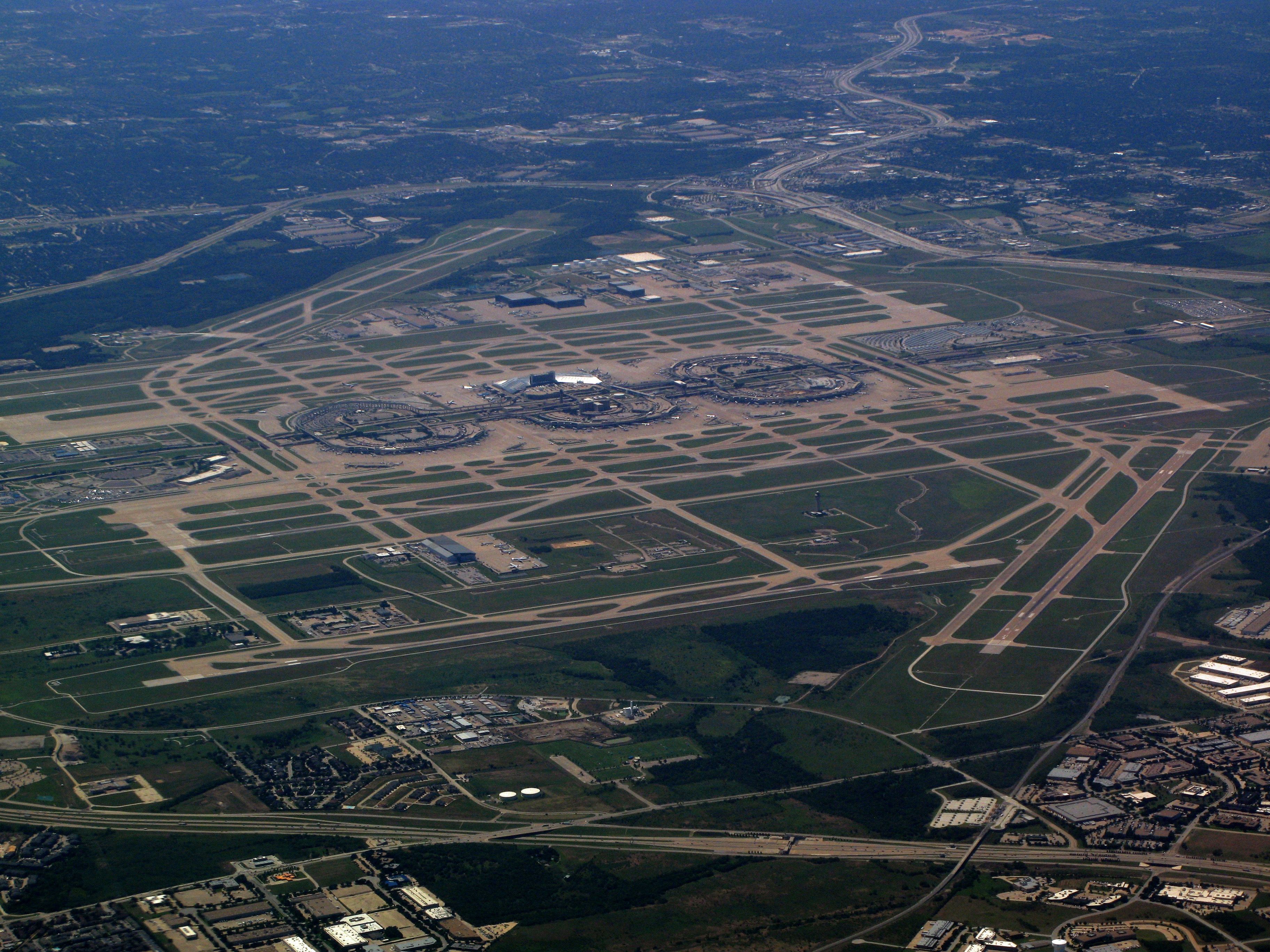
 Dallas/Fort Worth International Airport(DFW) stands as one of the world’s top airports by passenger traffic and is a key mega-hub for global operations. According to official airfield facts published by DFW Airport management, the facility spans 17,183 acres (6,954 hectares) and features seven active operational runways. The airfield uses a dominant north-south operational orientation consisting of five parallel runways, supplemented by two diagonal crosswind runways aligned in a 13/31 direction to handle strong wind shifts that can be detrimental to operations.
The airfield’s scale allows for four massive parallel strips, those being 17C/35C, 17R/35L, 18L/36R, and 18R/36L, which each stretch 13,400 feet (4,084 meters) in length. Federal Aviation Administration performance guidance highlights that these extended distances allow fully loaded wide-body commercial aircraft to depart safely during intense summer heat, when high temperatures reduce air density. To coordinate movement across this expansive land area, air traffic control operates out of three distinct towers, East, West, and Center, allowing simultaneous independent instrument approaches on up to three parallel runways, which allows the remaining strips to be used for departures.
Ground traffic flow across DFW is optimized using perimeter end-around taxiways (EATs), as per operations research conducted on the airport. Allowing landing aircraft to taxi around active runway thresholds rather than holding to cross active departure lanes reduces runway incursion hazards and taxi times. The combination of five parallel tracks, dedicated crosswind corridors, and end-around taxiways gives DFW unmatched peak hourly capacity and supports operational continuity even during regular convective weather delays across Texas.
Chicago O’Hare International Airport
8 runways

As detailed in airfield data published by the Chicago Department of Aviation and the Federal Aviation Administration,  Chicago O’Hare International Airport(ORD) covers 7,627 acres (3,087 hectares) and features eight active operational runways. O’Hare holds the distinction of operating more active runways than any other commercial airport in the world. Through the multi-billion-dollar O’Hare Modernization Program, the airfield has gone from a complex, intersecting layout into an ultra-efficient parallel orientation built around six east-west tracks and two diagonal crosswind strips.
O’Hare’s runway setup is split between the North Airfield Complex (Runway 09/27 designators) and the South Airfield Complex (Runway 10/28 designators). FAA documentation confirms that the longest runway at the airfield is 10L/28R, extending 13,000 feet (3,962 meters) to serve heavy long-haul international flights. The parallel configuration lets controllers manage three independent instrument arrival streams during peak traffic hours, drastically reducing arrival delays across North American airspace.
By decoupling arrival and departure corridors into streamlined east-west vectors, O’Hare minimizes runway crossings and reduces airborne holding times. This layout provides exceptional flexibility, allowing the airport to handle around 100 aircraft movements per hour even during the worst Midwest winter weather, as detailed in Simple Flying’s analysis.