dailynewsnblog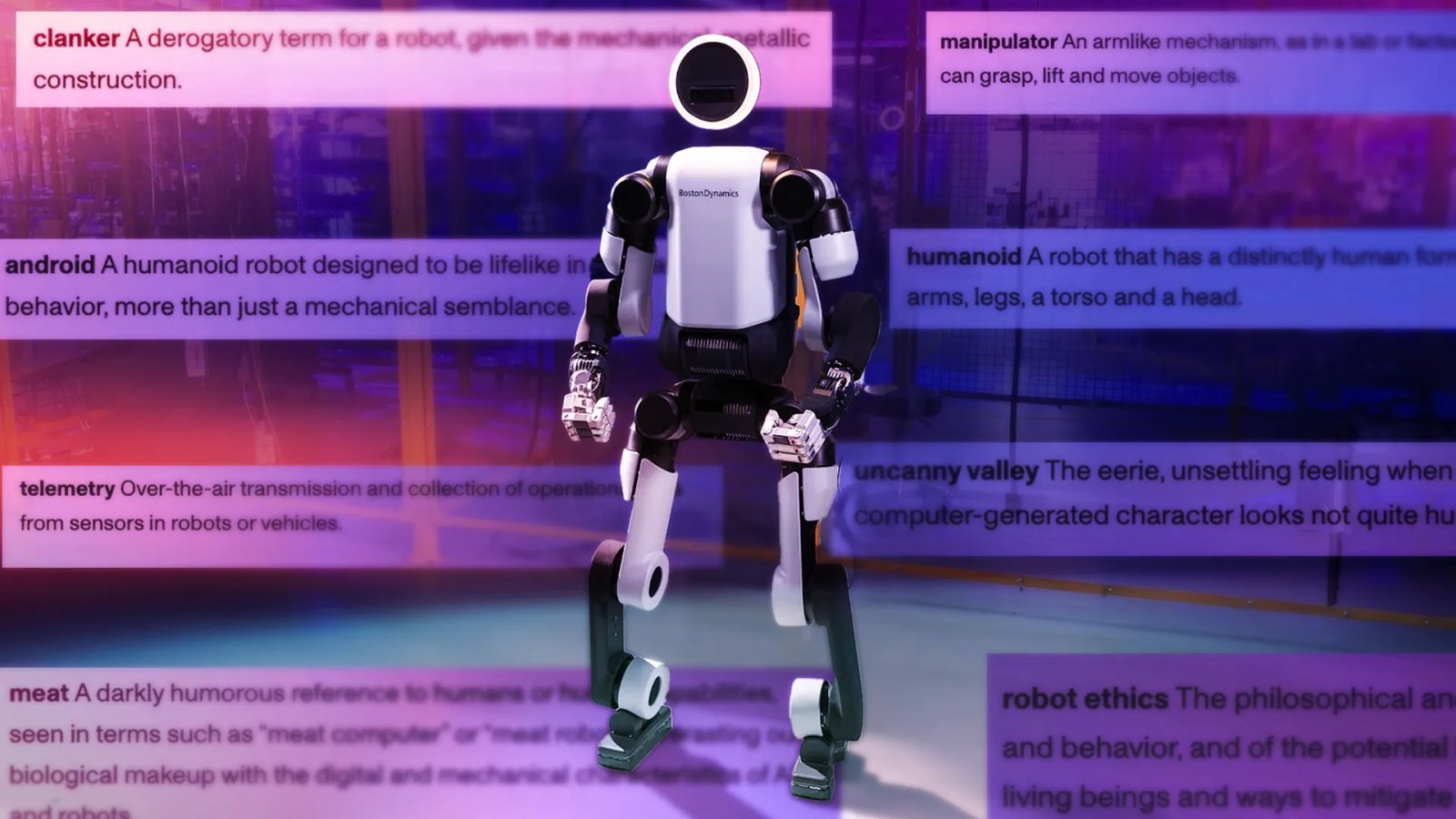
The age of robots is upon us. The machines of our sci-fi dreams may not be everywhere – yet – but you don’t have to look too hard or too far to spot one.
They’re cleaning our floors at home and delivering takeout in cities. They’re assembling cars in factories and moving inventory in warehouses. They’re making coffee in cafes, driving us around town and trying so very, very hard to fold laundry.
They’re decidedly utilitarian and typically designed to perform a single task. Mostly, they don’t look like us.
But there are humanoid robots, too, alternatingly klutzy and nimble, reassuringly familiar and eerily too close for comfort. We’re going to be seeing a lot more of them.
So we’ll all do well to gain a better understanding of how to talk about robots: what they’re made of, how they function and how they fit into our world. There’s a lot of technical terminology in the field of robotics, and this vocabulary list is all about making those terms at least a little more relatable.
The word robot itself is worth spending a moment on. It’s of Czech origin, referring broadly to work and workers, but with the connotation of compulsory labor. It came into English from a 1920 play by the Czech playwright Karel Čapek, titled R.U.R., short for Rossum’s Universal Robots, an industrial enterprise that manufactures artificial humans indistinguishable from real ones. They’re designed to be soulless, unquestioning workers, but eventually they get wise, rebel and wreak vengeance on humanity.
A lot of stories about robots end up that way. Not to imply that we’re ineluctably heading toward that fate, but let me just say that I, for one, welcome our robot overlords.
So that you’re fully up to speed for the times we’re living in, we’ve also got an AI vocabulary article that’s a companion to this one.
actuator A device that converts energy into physical movement, often found in robot joints paired with a servo motor. There are three main types: hydraulic, pneumatic and electric.
android A humanoid robot designed to be lifelike in appearance and behavior, more than just a mechanical semblance.
animatronic A robot-like system designed to look and move (in a very limited way) like a human or animal, typically found in theme parks or used as movie props. Think Disney World attractions or the shark in Jaws.
autonomous vehicle A car, truck or other conveyance that is fully self-driving, using sensors to independently assess its surroundings and algorithms or AI to control steering, braking and other functions.
biped A robot with two legs.
bot A virtual robot. Software that interacts with humans (or other bots) to perform tasks on their behalf, such as messaging or web crawling, or to provide information, as in a customer service setting.
clanker A derogatory term for a robot, given the mechanical, metallic construction.
degrees of freedom The number of different movements a robot can make, such as turning or spinning, associated with how many independent joints it has – and thus how versatile it is. A robot with 1 DOF does one movement only, such as lift/lower. A robot with 3 DOF can change positions along the X, Y and Z axes (forward and back, side to side, up and down); think of a 3D printer. A robot with 6 DOF can adjust for both position and angle, which is common for industrial robots. A robot with 7 DOF can adapt its movement more subtly and nimbly, in a human-like fashion. A humanoid robot might have 30-plus DOF, distributed across its arms, legs, torso and neck.
drone While these aerial devices historically have been remotely controlled or have followed preprogrammed instructions, many use sensors and on-board computers to fly autonomously.
end effector The manipulating device at the end of a robot’s arm. It can be a gripper, a tool or, especially in the case of humanoids, a hand-like design.
fall recovery The process by which a legged robot deals with a loss of balance and either avoids a fall to the ground or gets back to an upright position after a tumble.
humanoid A robot that has a distinctly human form and features such as arms, legs, a torso and a head.
kinematics The study of how a robot’s limbs move through space, ignoring the forces impelling that motion – think of it as a robot’s various poses and the sequences it follows to shift from one position to the next. Also known as the geometry of motion.
large behavior model, or LBM An AI system trained on a robot’s sensor data in order to predict physical actions, similar to how a large language model is trained on written material to predict sequences of words.
lidar A type of sensor that uses lasers to help self-driving cars and other robots gauge depth and distance.
manipulator An armlike mechanism, as in a lab or factory setting, that can grasp, lift and move objects.
meat A darkly humorous reference to humans or human capabilities, seen in terms such as “meat computer” or “meat robot,” contrasting our biological makeup with the digital and mechanical characteristics of AI and robots.
mechatronics A field of study that incorporates mechanical engineering, electrical engineering and computer science to design and manufacture smart automated devices, including robots, automobile components, control systems and medical instruments.
physical AI Artificial intelligence systems embedded in machines, such as robots and self-driving cars, that can perceive and assess the physical world and take action there, as opposed to AI software acting only in digital environments. Also known as embodied AI.
policy Guiding principles and rules for how a robot behaves, depending on the task, situation or interaction. It is what a robot relies on for decision-making and can be task-specific or broadly generalist.
quadruped A robot with four legs.
reinforcement learning The development and testing of robots via feedback from trial-and-error interactions in often unpredictable real-world environments. In LLMs, by comparison, reinforcement learning incorporates rewards for higher-quality output. (Compare with simulation.)
robot A programmable machine that carries out complex or repetitive tasks automatically or independently, typically with some degree of physical movement. They can take many forms, from armlike devices to wheeled or tracked carts or platforms to animal and humanoid dimensions.
robot ethics The philosophical and practical study of robot design, use and behavior, and of the potential to cause harm to humans and other living beings and ways to mitigate those harms.
robotics A field of science and engineering centered on designing, building, operating and understanding robots.
sensor A device that registers or measures input such as light, motion, force and range, providing information to a robot about its surroundings and its condition.
servo An electric motor plus sensors and controls that help to translate the motor’s raw power into precise motion, matching speed, position and torque.
sim-to-real gap The difference between how a robot performs during simulation training and how it performs when it encounters the messier real world.
simulation The software-focused training and testing of a robot’s capabilities in virtual environments rather than in real-world situations. (Compare with reinforcement learning.)
telemetry Over-the-air transmission and collection of operational data from sensors in robots or vehicles.
teleoperation Remote control of a robot by a human, either for training or because a robot isn’t yet capable of performing with full autonomy. This is commonplace with humanoid robots, which must deal with a high degree of complexity in their construction, performance and environment, but this fact may not always be disclosed.
three laws of robotics Fictional safety guidelines that appeared in the works of science fiction author Isaac Asimov in the middle of the 20th century. They have influenced subsequent sci-fi works as well as the field of robot ethics.
- A robot may not injure a human being or, through inaction, allow a human being to come to harm.
- A robot must obey the orders given it by human beings except where such orders would conflict with the First Law.
- A robot must protect its own existence as long as such protection does not conflict with the First or Second Law.
uncanny valley The eerie, unsettling feeling when a humanoid robot or computer-generated character looks not quite human.
vision-language-action (VLA) model A multimodal AI system that combines visual perception with language and reasoning skills and from that can create commands to drive physical movement and manipulation.
wetware In a biological entity such as a human, the equivalents of computer software and wiring (hardware), including the brain, the nervous system, the immune system and DNA.
whole body control A framework of algorithms that coordinate diverse and sometimes conflicting actions across various parts of a robotic system (e.g. arms and legs on a humanoid), rather than a single, task-oriented action.
world model A digital representation or mapping of a physical environment that incorporates spatial awareness and understanding of how that environment changes over time and in response to actions. Where the LLMs used by chatbots are trained on words, world models are often trained on video input.
zero moment point A highly technical reference to the application of force (gravity, inertia) in the foot of a bipedal robot such that a bipedal, humanoid robot does not tip. Roughly speaking, ZMP refers to a robot’s capacity for dynamic equilibrium: balance and stability while walking.

See full bio