dailynewsnblog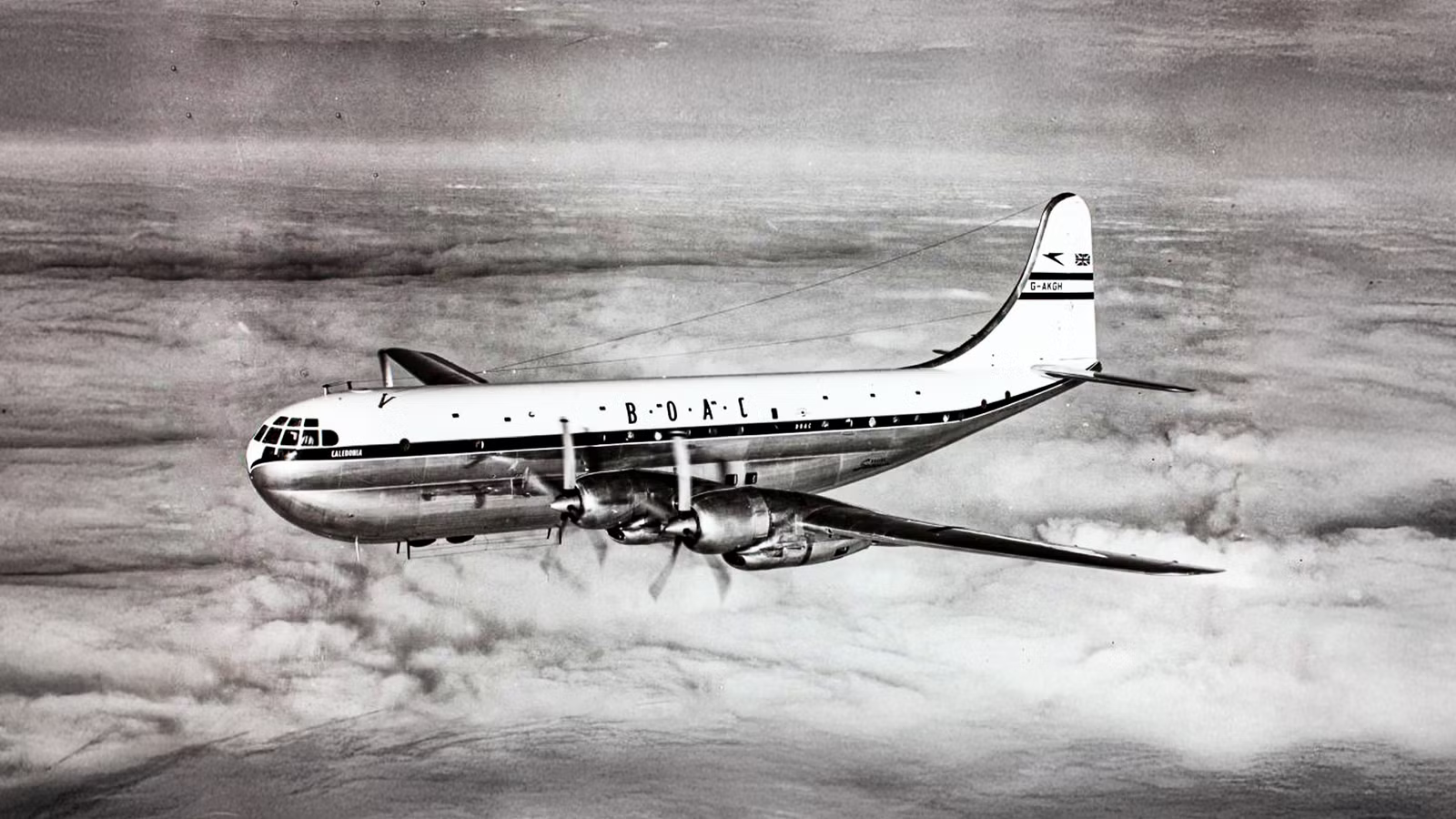
The most photographed feature of 1950s air travel wasn’t a seat, a menu, or a stewardess’ uniform. It was a spiral staircase, descending to a 14-seat cocktail lounge, 20,000 feet (6,100 meters) above the Atlantic. Pan American World Airways never designed that lounge as a marketable luxury amenity the way  Emirates or
  Singapore Airlines design a first class suite today. It existed because
  Boeing’s engineers had already solved a far less glamorous problem years later: how to keep a wartime bomber crew pressurized at altitude. The Boeing 377 Stratocruiser’s famous bar was a structural leftover the airline industry chose to sell as an experience.
That unusual arrangement raises the question this article is built to answer: how did a fuselage cross-section engineered for the B-29 Superfortress give Juan Trippe’s Pan Am a free deck it never had to justify on a balance sheet, and why did the arrival of the jet age make that same free deck financially impossible to keep? Getting to the answer means starting with an aircraft that was never meant to carry a single paying passenger.
A Bomber Fuselage Became A Double-Deck Airliner

The Stratocruiser’s double-deck shape didn’t originate with Boeing’s airliner division, but it was inherited from the Boeing B-29 Superfortress bomber’s own fuselage. According to whothatplane.com, the Boeing 377 was a direct commercial derivative of the B-29 bomber and the C-97 Stratofreighter military transport, combined with a new double-bubble upper fuselage of a much larger cross-section than the bomber it came from.
In other words, Boeing didn’t start by designing a double-deck airliner and then decide what to do with the lower deck. It took a proven military fuselage concept and expanded it into a passenger aircraft, creating a second, wider lobe above the structure that had already been developed for military use.
The result was 6,600 cubic feet (187 cubic meters) of pressurized interior volume, with an upper-lobe outside diameter of 132 inches (335 cm), noticeably wider than the 125 inches (318 cm) of a contemporary DouglasDC-6. That shape wasn’t chosen with passenger comfort in mind.
The Boeing C-97 military transport had widened its lower lobe to accommodate vehicles and cargo pallets that the B-29’s relatively narrow fuselage couldn’t carry. Building a second deck from scratch would have required a manufacturer to design and certify an entirely new pressure vessel at enormous cost. Boeing already had the basic structure. An empty, pressurized space beneath a passenger cabin still earns an airline nothing, however, unless someone finds a reason to use it. That decision came from an airline executive rather than an engineer.
Juan Trippe Turned Spare Fuselage Volume Into A Luxury Feature

Pan Am’s Juan Trippe wanted an aircraft capable of offering a level of luxury that could compete with the ocean liners he was trying to replace. According to historynet.com, it was Trippe who pushed Boeing to swap the B-29’s standard Wright R-3350 engines for the far more powerful Pratt & Whitney R-4360 Wasp Major, which had originally been developed for the B-50 bomber, a decision he would come to regret. The extra power made it possible to build the large, heavy aircraft Trippe wanted without sacrificing the performance needed for long-distance operations.
The specifications explain why the trade briefly looked reasonable: four 28-cylinder R-4360 Wasp Majors, each producing 3,500 HP (2,610 kW) at takeoff, according to ramrao.com, the most powerful mass-produced piston aircraft engines ever built. Pan Am’s launch order, placed on November 29, 1945, covered 20 aircraft for a combined $24.5 million; individual units ran close to $1.3 million apiece by the time deliveries began in 1949, according to historynet.com.
As Simple Flying has explored when pricing the operating economics of modern jumbo jet, keeping a very large aircraft in the air has never been cheap. The Stratocruiser was no exception: its enormous R-4360 engines gave it the power needed to carry its size and weight, but they also came with a substantial operating burden.
Only 56 of these enormously expensive aircraft were built. But what did devoting part of that airframe to leisure rather than revenue actually cost the airlines that operated them?
The “Free” Lower Deck Still Came At A Cost

In practice, the lower lobe housed the 14-seat lounge and cargo holds, while the upper passenger cabin could be configured with up to 28 sleeper berths reached through the aircraft’s signature circular staircase. According to mightytravels.com, it offered a social space with no rivals in the piston era, and it’s the single detail that still defines the Stratocruiser’s reputation 75 years later.
Main deck seating ran between 55 passengers, in the luxury configuration Pan Am used on the San Francisco-Honolulu route that launched Stratocruiser service in April 1949 and up to 100 in higher-density domestic layouts, according to designyoutrust.com. Pan Am, BOAC, Northwest AirlinesOrient and  United Airlines all eventually operated the type, and Simple Flying’s own rundown of Stratocruiser operators covers how each carrier used the aircraft differently.
Because Boeing had already amortized the pressurized shell’s structural cost on the military side of the ledger, the lounge was volumetrically free. Its real price showed up in yield: every lounge seat and sleeper berth was a revenue seat the airline chose not to sell, on a plane that was already among the most expensive in the sky to operate. The lounge’s true cost, though, wasn’t paid in forgone ticket revenue. It was paid in the same 28-cylinder engines that had made the whole aircraft possible in the first place.
The Engines That Made The Stratocruiser Possible Became Its Greatest Liability

The R-4360 packed 28 cylinders into four rows, with a huge number of moving parts that demanded intensive maintenance. The engine became notorious for mechanical problems, including valve failures and propeller-related incidents, turning what looked like an impressive engineering solution into one of the Stratocruiser’s greatest operational weaknesses, according to migflug.com. Repeated engine and propeller failures led to several serious incidents, including two occasions when Pan Am Stratocruisers were forced to ditch in the Pacific, making the engines one of the aircraft’s greatest liabilities.
Pan Am alone lost seven of its 56 Stratocruisers, roughly one every year between 1952 and 1959. The worst, Flight 202, went down in the Amazon jungle on April 29, 1952, after an engine and its propeller separated from the wing, killing all 50 people aboard. United, Northwest Orient, and BOAC each lost one Stratocruiser of their own to similar mechanical failures.
The irony was that the same brute-force engineering that made the Stratocruiser’s extraordinary cabin possible also made the aircraft expensive and demanding to operate. The R-4360 could deliver the power Boeing needed to turn a military-derived fuselage into a luxurious transoceanic airliner, but keeping four of those engines running became part of the price airlines paid for all that space.
Engine unreliability was a mechanical problem airlines could budget around with spare parts and overhaul schedules. What they couldn’t budget around was a wholly different kind of aircraft that made the entire idea of a non-revenue deck look irrational by comparison.
The Boeing 707 Made Spare Cabin Space Too Valuable To Waste

The Boeing 707 cruised at roughly 550 miles per hour (885 km/h), well above the Stratocruiser’s 340 miles per hour (547 km/h), according to historynet.com, and its four turbojets required far less maintenance per flight hour than four 28-cylinder radials ever could.
A jet could therefore cover the same transatlantic route in dramatically less time while carrying more passengers and making better use of the space inside its fuselage. The result was a very different set of priorities for airlines. The Stratocruiser had made it possible to sacrifice revenue space for luxury because its unusual double-deck structure provided room inherited from Boeing’s military designs. The 707 had no such spare volume. Every part of its cabin had to earn its place.
Boeing itself lost roughly $7 million on the Stratocruiser program overall. By the late 1950s, airlines were retiring their 377s not because passengers had stopped enjoying the lounge, but because the economics of the jet age made the trade increasingly difficult to defend. Giving up 14 potential seats for a bar made far less sense when a faster jet could carry passengers across the Atlantic in a fraction of the time. Simple Flying’s look at the new first-class suites airlines are rolling out for 2026 and 2027 shows just how long it took airlines to become comfortable sacrificing revenue-generating cabin space for premium experiences again.
Yet Boeing would eventually build an aircraft large enough to change that calculation once more. The Boeing 747 did not copy the Stratocruiser’s lower-deck lounge, and its upper deck was designed for passengers rather than as a leftover from a military fuselage. But its enormous size gave airlines something the 707 could not: enough cabin volume to accommodate hundreds of passengers while still leaving room for lounges, bars and other premium spaces in some configurations. In that sense, the 747 became an important link between the Stratocruiser’s postwar luxury and the return of dedicated social spaces aboard very large airliners. The lounge had disappeared because space had become too valuable; the 747 showed that, on an aircraft large enough, there could once again be enough of it to spare.
The Airbus A380 Brought The Lounge Back At Jumbo-Jet Scale

More than 50 years after the Stratocruiser left service, Emirates president Sir Tim Clark built almost exactly the same trade Trippe had made in 1949: a low-density social space, carved out of a double-deck jet’s upper lobe, that earns nothing in ticket revenue and everything in brand identity.
Emirates currently operates 118 Airbus A380s. The aircraft has enough upper-deck space to accommodate its famous onboard lounge without sacrificing anything like an entire conventional cabin. That is the same basic structural advantage that allowed the Stratocruiser to put a cocktail lounge beneath its main passenger deck three-quarters of a century earlier.
With A380 production now over and no new widebody currently being developed on a comparable scale, the future of this segment remains uncertain. The question is no longer simply whether passengers want an onboard bar or lounge. It is a question of whether the economics of modern widebody travel will ever again allow an airline to devote that much valuable cabin space to something that does not generate revenue per seat.
That may be why the next great onboard bar will be less a story about cocktails than about aircraft design. If one returns, it will likely be because a new generation of aircraft is large enough, efficient enough, or simply different enough to make it worthwhile to sacrifice a handful of seats. Until then, every square foot of cabin has a price.