dailynewsnblog
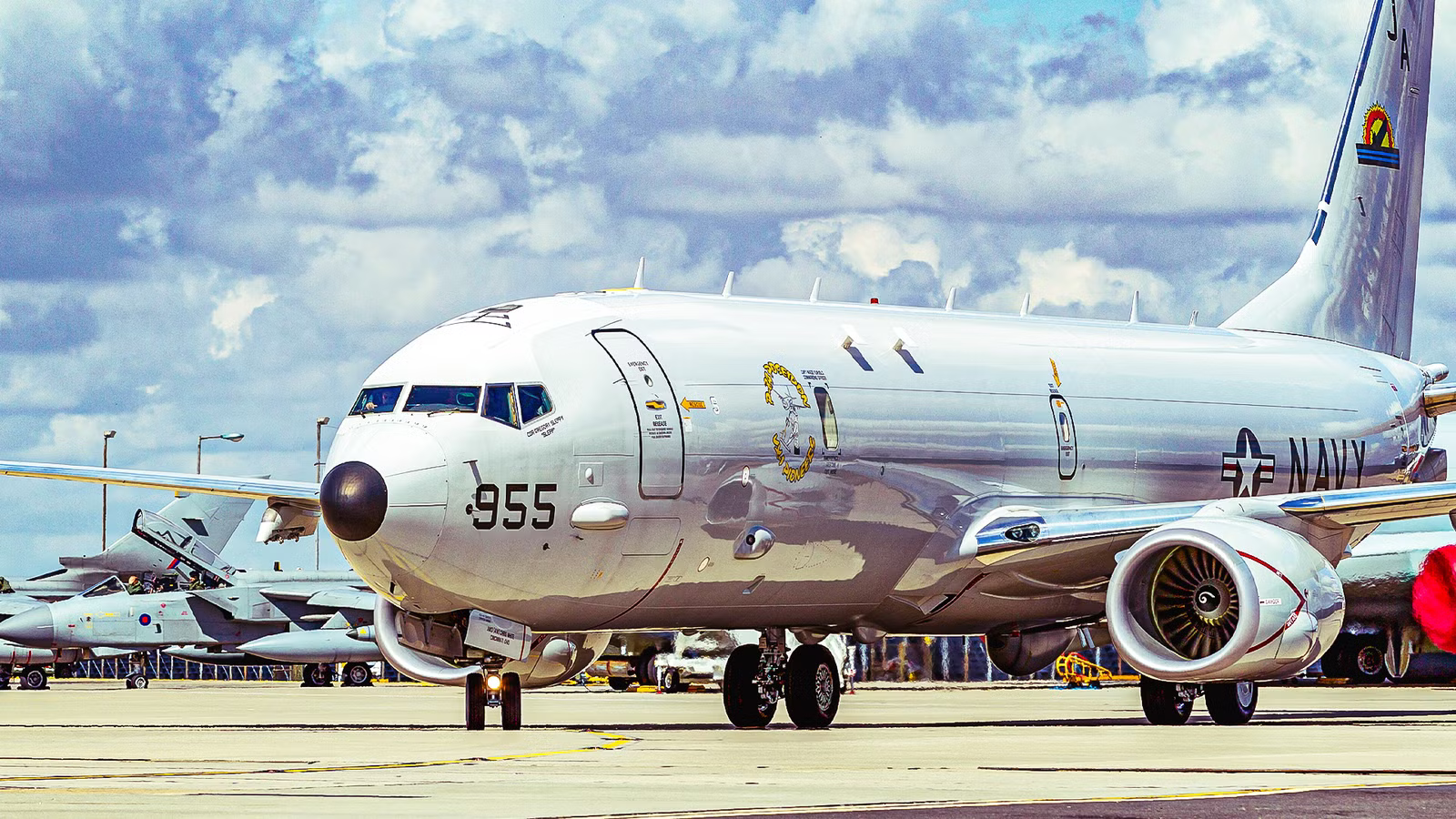
The  Boeing P-8A Poseidon is a military-grade 737-800 Next Generation airliner that is the latest and greatest ‘big wing’ anti-submarine warfare plane to patrol the waves for the US Navy. It is a significant upgrade in performance and technology over the decades-old Lockheed P-3 Orion that has succeeded in the maritime patrol mission. Its ability to fly at altitudes tens of thousands of feet higher than the Orion has reversed decades of ASW and intelligence, surveillance, and reconnaissance doctrine.
Dating back to 1962, the Poseidon replaced the Orion primarily because decades of low-altitude maritime flights in turbulent, salty air caused severe structural wing fatigue and corrosion. The P-8 combines components from the 737-800 to provide the core airframe with strengthened 737–900 wings to support missile pylons, extra fuel capacity, and specialized raked wingtips. The final platform is a unique hybrid: a passenger jet fuselage carrying a heavily networked mission suite and an internal weapons bay.
Unlike the low-flying P-3, the P-8 operates primarily at high altitudes, using its powerful Raytheon AN/APY-10 radar to scan, track, and destroy targets. The mission has shifted toward cloud-like data sharing and digital kill chains. The P-8 is built to act as a command hub, seamlessly integrating via data links with unmanned high-altitude aircraft like the Northrop Grumman MQ-4C Triton to cover vast expanses of ocean collaboratively.
Boeing’s Commercial Jet At The Tip Of The Spear

The USN began its sub-hunter search that would eventually spawn the Poseidon in 2000 under the Multimission Maritime Aircraft program. Ultimately, Boeing won the contract on June 14, 2004, for a modified 737-800ERX built directly on a standard commercial assembly line. The jet is put together with ‘off-the-shelf’ systems from the Everett factory before the military hardware and specialized mission equipment are added on, significantly reducing total production costs.
This design approach ensured the final combat-ready version, P-8, shares 86% commonality with the civilian 737 NG fleet. The Navy has immediate access to a well-established global logistical network, spare parts, and support infrastructure thanks to this extensive structural overlap. Beyond conventional ASW, the platform uses an adaptable open architecture to hunt enemy warships, support humanitarian relief, long-range search and rescue, and continuous overland surveillance.
The initial airframes that arrived in 2013 only partially satisfied the Navy’s requirements, despite the promising design. The Pentagon had to reconcile deliveries with shortcomings until the Poseidon met standards because early software merely replicated older P-3C Orion capabilities rather than surpassing them. The Navy treated these capability gaps as a rolling upgrade schedule, systematically adding features and enhancing equipment in stages to unlock the airframe’s true potential.
Outfitting An Icon Of Air Travel For Naval Service

The P-8 Poseidon operates as a cohesive flying command center where an integrated open-architecture mission system merges sensors and human operators into a single, high-speed digital kill chain. Behind the two pilots, the mission cabin houses five inline workstations managed by two Naval Flight Officers and three specialized aircrewmen.
Instead of working in isolated silos, the tactical consoles feature universal multi-function displays powered by BAE Systems CSMCW hardware. This allows any operator to pull up, manipulate, or hand off data from any sensor in real time. The Tactical Coordinator acts as the mission manager and quarterback to make ‘big picture’ tactical decisions based on the combined intel from each individual operator.
Specification | P-8A Poseidon | P-3C Orion |
|---|---|---|
Wingspan | 123.6 feet (37.6 meters) | 99.6 feet (30.4 meters) |
Maximum Takeoff Weight | 189,200 pounds (85,820 kg) | 139,760 pounds (63,394 kg) |
Service Ceiling | 41,000 feet (12,496 meters) | 28,300 feet (8,626 meters) |
Engines | 2 CFM56 turbofans, 27,300 pounds of thrust (121.4 kN) each | 4 Allison T-56-A-14 turboprop engines, 4,600 hp (3,430 kW) each |
Crew | 9 | 11 |
In-flight Refueling | Capable | Not Capable |
The P-8’s advanced synthetic aperture radar, electronic surveillance receivers, and acoustic sensor suites are optimized for high-altitude hunting rather than skimming low over the waves. Aircrewmen also monitor the underwater battlespace. They control the pneumatic sonobuoy launches, tune into hydrophone frequencies, and process active/passive sonar. When a contact is fixed, the jet is armed with high-altitude Mk 54 lightweight torpedoes and Harpoon anti-ship missiles for beyond-visual-range engagements.
Flying High Instead Of Skimming The Waves

The former champion of sub-hunting, the P-3 Orion, was famed for flying low and slow over the ocean on long patrols, even shutting down an engine to stretch endurance beyond its standard limitations. The jet-powered Poseidon can’t operate that way. Its CFM56 turbofans burn fuel much faster at low altitudes, so the P-8 flips this doctrine entirely. Its crews have adapted the sub-hunting mission to fuel-efficient altitudes typically above 28,000 feet.
The P-8’s new perch among the clouds gives the plane more range and crews superior patrols, but it demands redesigned weapons and sensor equipment to be employed from far greater heights. To address this, the Navy adapted the Mk 54 torpedo with specialized flight kits that allow release from high altitude and speed. This enables the Poseidon to leverage its 564 miles per hour (908 km/h) top speed to sprint to distant search boxes across the seas and survey every inch of the battlespace far faster than its predecessor.
Because the P-8’s engineering differed radically from the P-3, the program relied heavily on rolling software updates delivered long after initial aircraft delivery, as integration challenges bottlenecked performance. The first squadrons deployed with core systems like torpedo employment and sonar functionality significantly restricted. The Increment Three Block Two upgrade finally closed that tactical gap, delivering the full suite of networked maritime strike tools envisioned at the outset of the Poseidon’s development.
Powering Up The Poseidon’s Mission Computer

The Navy just recently declared initial operational capability for the P-8’s Increment Three Block Two upgrade frameworks. Observers were quick to note that this milestone still falls short of full operational capability as defined by the program’s own scope. That requires fielding the mature system at scale across the entire active fleet, which has not yet happened.
This hardware package introduces an advanced combat systems suite featuring significantly expanded computing architecture and automated track management systems. The modification was a painstaking physical rebuild of equipment along with software overhauls. The Navy had to install reinforced system racks, an advanced radome, new antennas, and high-bandwidth, wideband satellite communication links.
This latest iteration of the Poseidon’s weapons suite can fuse disparate sensor feeds into a single operational picture using a much higher-bandwidth data stream from signals intelligence sources that are both organic and off-board. The expanded computing capacity directly supports an enhanced sonar suite designed to track ultra-quiet submarines.
The Navy launched its fleet-wide modification timeline by routing the first production aircraft through Boeing’s Cecil Airport facility in Jacksonville. While the USN plans to upgrade its entire active fleet over time, Australia remains the sole foreign operator committed to completing a full Block Two rollout. The Royal Australian Air Force has only 14 examples in its inventory, compared with the USN’s over 115, making it a more achievable undertaking. At the same time, the total Global Force continues to grow as more Allied Nations adopt the Poseidon.
The Global Fleet Grows With New Orders

The P-8 fleet has expanded significantly, with more than 200 aircraft delivered or on order across a growing network of Western allies. India has a fleet of 12 customized P-8I Neptune variants to patrol the Indian Ocean. The United Kingdom operates nine aircraft out of RAF Lossiemouth to monitor the strategic Greenland-Iceland-UK gap. South Korea has fully integrated its six aircraft, and Norway and New Zealand deploy fleets of five and four aircraft respectively to support maritime security ops in the Baltic and Arctic regions.
The RAAF operates one of the most capable and active P-8 fleets outside the US. Stationed at RAAF Base Edinburgh with No. 11 and 292 Squadrons, Australia is not just a standard export customer. The nation acts as a cooperative development partner with the US Navy. This partnership led to the establishment of the Southern Hemisphere’s first dedicated Deep Maintenance and Modification Facility in Australia, allowing the RAAF to perform heavy overhauls and software upgrades domestically without sending aircraft back to the US.
Canada also made a multi-billion dollar commitment in 2023 for 14 P-8 aircraft to replace its CP-140 Auroras, securing its massive Arctic, Atlantic, and Pacific approaches. Germany expanded its initial order from five to eight aircraft as tensions continue to rise on NATO’s northern flank with Russia. Meanwhile, Denmark is advancing its own acquisition plans to replace its four Bombardier Challenger CL-604 aircraft.
In addition to these major deals, other countries like Singapore and Israel are also negotiating to procure their own Poseidon fleet. The international fleet benefits every operator through a global footprint and shared resources. This not only ensures these air warfare services can work together seamlessly but also reduces the financial burden on every Squadron.