dailynewsnblog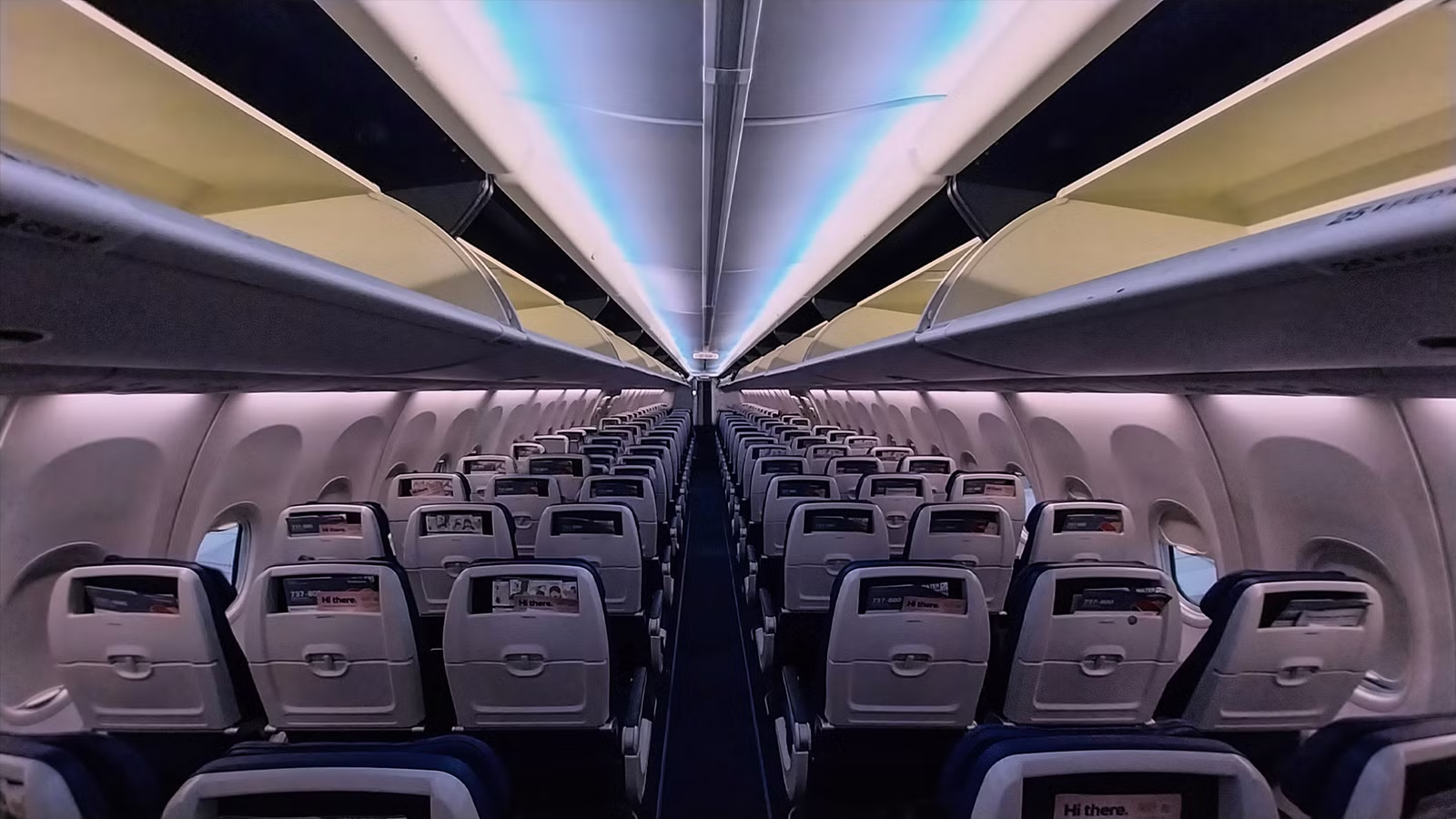
The Boeing 737 is one of the most popular narrowbodies in service, essentially offering the same economics and capabilities as the rival Airbus A320. It’s the second-most successful commercial jetliner of all time (behind only the A320), and the two types have become ubiquitous on short-range routes, while later models are now becoming popular on medium-to-long-range routes.
However, while the two aircraft types are nearly identical from an airline’s perspective, passengers notice one notable difference between the 737 and the A320. On average, economy seats in the 737 are only 17 inches (43.18 cm) wide, or about the same as a nine-abreast Boeing 787 or a ten-abreast Boeing 777.
These widebodies were originally designed to seat one fewer passenger per row, while the Airbus A320’s economy seats are roughly 18 inches (45.72 cm) wide. This has to do with the fact that the 737 is the oldest commercial airliner on sale, and more specifically, with decisions that Boeing made during the 737’s initial development in the 1960s.
The Boeing 737 In Today’s Market

Today,  Boeing currently sells the aircraft family as the 737 MAX, which debuted in 2017. This family features four variants (737 MAX 7, 737 MAX 8, 737 MAX 9, 737 MAX 10) and features new CFM LEAP-1B engines, the Boeing Sky Interior as standard, updated cockpit displays, an updated tailcone, and new split-tip winglets.
In addition, the 737NG family is still widely used (highly similar to the 737 MAX), while there are fewer 737 Classics and original 737s still in service. However, the 737 first debuted in 1968 as the 737-100, roughly 58 years ago. Unlike the 737 MAX, which is capable of transatlantic flights in some variants, the 737-100 and improved 737-200 were essentially designed as large regional jets.
These served smaller destinations and short routes while also being capable of serving under-developed airfields. Boeing’s initial two 737 variants were low to the ground, featured Pratt & Whitney JT8D low-bypass engines, and were designed to seat between 100 and 120 passengers. The 737 MAX still retains the original 737’s fuselage cross-section, and the 737 MAX 10 is over 50% longer than the 737-100 while being certified to seat up to 230 passengers.
The wings on the 737 MAX are entirely different from those on the original 737 (Boeing redesigned the wings when developing the 737NG), while its engines produce nearly double the thrust of the original 737’s JT8D engines. However, the fuselage remains the same, and the design traces its origins to an even earlier aircraft.
Sharing The Cross-Section

The 737 was the manufacturer’s third jet-powered airliner, after the 707 and the 727. All three were extremely different from one another, optimized for different sizes while performing different missions. The 707 was a large, long-range quadjet, whereas the 727 was designed for medium-range missions and was a medium-sized trijet. The 737 was a smaller short-haul twin-jet crewed by only two pilots.
However, despite the mission and design differences, all three were narrowbodies that could accommodate six seats per row in economy. Because the 707, 727, and 737 were meant to be similar regarding their fuselages, Boeing reused many elements of the 707 onto the later models.
Aircraft | Entry Into Service |
|---|---|
Boeing 707 | 1958 |
Boeing 727 | 1964 |
Boeing 737 | 1968 |
Boeing 747 | 1970 |
Boeing 767 | 1982 |
Boeing 757 | 1983 |
Boeing 777 | 1995 |
Boeing 717 (McDonnell Douglas MD-95) | 1999 |
Boeing 787 Dreamliner | 2011 |
All three feature highly similar ‘Section 41’ designs, or essentially, the forward nose/cockpit part of the aircraft, with some changes to accommodate different nose gears. In addition, the 707’s upper-lobe fuselage section was carried over to the 727 and the 737, while all three aircraft have unique lower-lobe designs.
In the 1960s, Boeing was experiencing tremendous success with the 707 and aimed to capitalize on growing demand for jetliners. By reusing elements of the 707’s design, Boeing cut development time and reduced costs, allowing it to bring the 727 to market earlier. When developing a smaller narrowbody for shorter routes, Boeing again reused elements of its prior two aircraft to deliver the 737 quicker and cheaper, and the plane is still in production with most of its original fuselage design elements.
Seat Widths & Configurations On Other Jetliners

The 737’s economy seat width is considered tight today, but this is shared with the 727 and the 707 as these aircraft share the same upper lobe design. At the time, 17 inches (43.18 cm) was a common economy seat width. The McDonnell Douglas DC-9 debuted with wider seats in economy, but also featured a narrower fuselage that could never accommodate more than five seats per row.
It wasn’t until the dawn of the widebody that economy seats truly became wider on an industry-wide level, although this was temporary. The Boeing 747 was originally intended to seat nine passengers per row in economy, while the McDonnell Douglas DC-10 and Lockheed L-1011 TriStar were designed to fit eight passengers per row. Post-deregulation, all three types gained an extra seat per row in economy with 17-inch (43.18-cm) wide seats.
Aircraft | Typical Economy Layout | Aircraft | Typical Economy Layout |
|---|---|---|---|
Airbus A300 | 2-4-2, 3-3-3 | Boeing 747 | 3-4-3 (main deck) 3-3 (upper deck) |
Airbus A310 | 2-4-2, 3-3-3 | Boeing 767 | 2-3-2, 2-4-2 |
Airbus A330 | 2-4-2, 3-3-3 | Boeing 777 | 3-3-3, 3-4-3 |
Airbus A340 | 2-4-2, 3-3-3 | Boeing 787 | 2-4-2, 3-3-3 |
Airbus A350 | 3-3-3, 3-4-3 | McDonnell Douglas DC-10 | 2-4-2, 2-5-2, 3-4-3 |
Airbus A380 | 3-4-3 (main deck) 2-4-2 (upper deck) | Lockheed L-1011 TriStar | 2-4-2, 2-5-2, 3-4-3 |
The Airbus A300, A310, and Boeing 767 were notable exceptions, as these three planes largely retained their originally intended configurations with 18-inch (45.72-cm) wide seats. Airbus has continued to optimize the width of its cross-sections around an 18-inch (45.72-cm) wide economy seat, while Boeing’s latest widebodies have been designed with even wider seats.
However, airlines found that there was enough space to add an extra seat per row on the 777 and 787, achievable through narrower aisles, smaller armrests, and a seat that’s roughly 17 inches (43.18 cm) wide. Some airlines have added an extra seat per row on Airbus widebodies, but those seats tend to be even smaller and are less accepted by the flying public.
The Relationship Between Seat Width & Economics

For economy seats, 17 inches (43.18 cm) is generally considered tight, but acceptable, while 18 inches (45.72 cm) is comfortable. Airbus widebodies with an extra seat per row are generally installed with seats that are only 16.5 inches (41.91 cm) wide, which is usually only considered acceptable for budget airlines.
Airlines do care about seat width since passenger comfort reflects positively or negatively on the airline, but it can be a challenging issue for manufacturers. A wider fuselage is heavier and creates more drag than a comparably designed fuselage that’s narrower. Given how crucial fuel efficiency is, this means that aircraft manufacturers need to balance cabin requirements while keeping the fuselage as aerodynamic and lightweight as possible.
An Airbus A320 and Boeing 737 both feature six seats per row in economy, but the 737’s fuselage is slimmer, making it lighter. In fact, one of the reasons why the aging 737 has remained competitive with the A320 is due to its low empty weight. As a whole, the current 17-to-18 inches (43.18 to 45.72 cm) will remain the standard, since these seat widths are accepted by passengers and they’re not so wide as to hamper the plane’s economics.
Recently, Boeing and Airbus have widened the interiors of the 777X and A350, respectively, to enable wider seats in a ten-abreast layout. This improves the comfort of the 777X, but also serves to make a ten-abreast layout more appealing on the A350, as this was previously only selected by budget airlines.
Other Uses Of Legacy Cross Sections

The 737’s decades-old design, which used some elements from even earlier Boeing models, has effectively capped how wide its seats can be. Newer aircraft are generally designed with wider seats in mind, both to facilitate added comfort and to improve interior movement by incorporating wider aisles. However, while the 737 is the most notable example today, it’s far from the only aircraft to reuse design elements from prior aircraft models.
While the Boeing 757 doesn’t look like its predecessors, this aircraft also features the same upper lobe design as the 707, the 727, and the 737. Once again, this cut down on development time and cost, while the upper lobe itself is perfectly functional. However, this does mean that the 757’s cabin is about as narrow as Boeing’s older narrowbodies. Meanwhile, the lower lobe design was new to the 757, while the aircraft’s Section 41 was redesigned to boost cockpit commonality with the 767.
Airbus, meanwhile, has been reusing the same fuselage cross section and Section 41 first seen on the A300 for decades. The later A310 is closely related to the A300, but the A330 and A340 are essentially clean-sheet designs that share almost nothing with the A300. However, they do feature the same cross-section and Section 41, since the A300’s design was already perfectly functional. Once again, this sped up the development of the A330 and A340, with the A330 still being produced today as the A330neo.