dailynewsnblog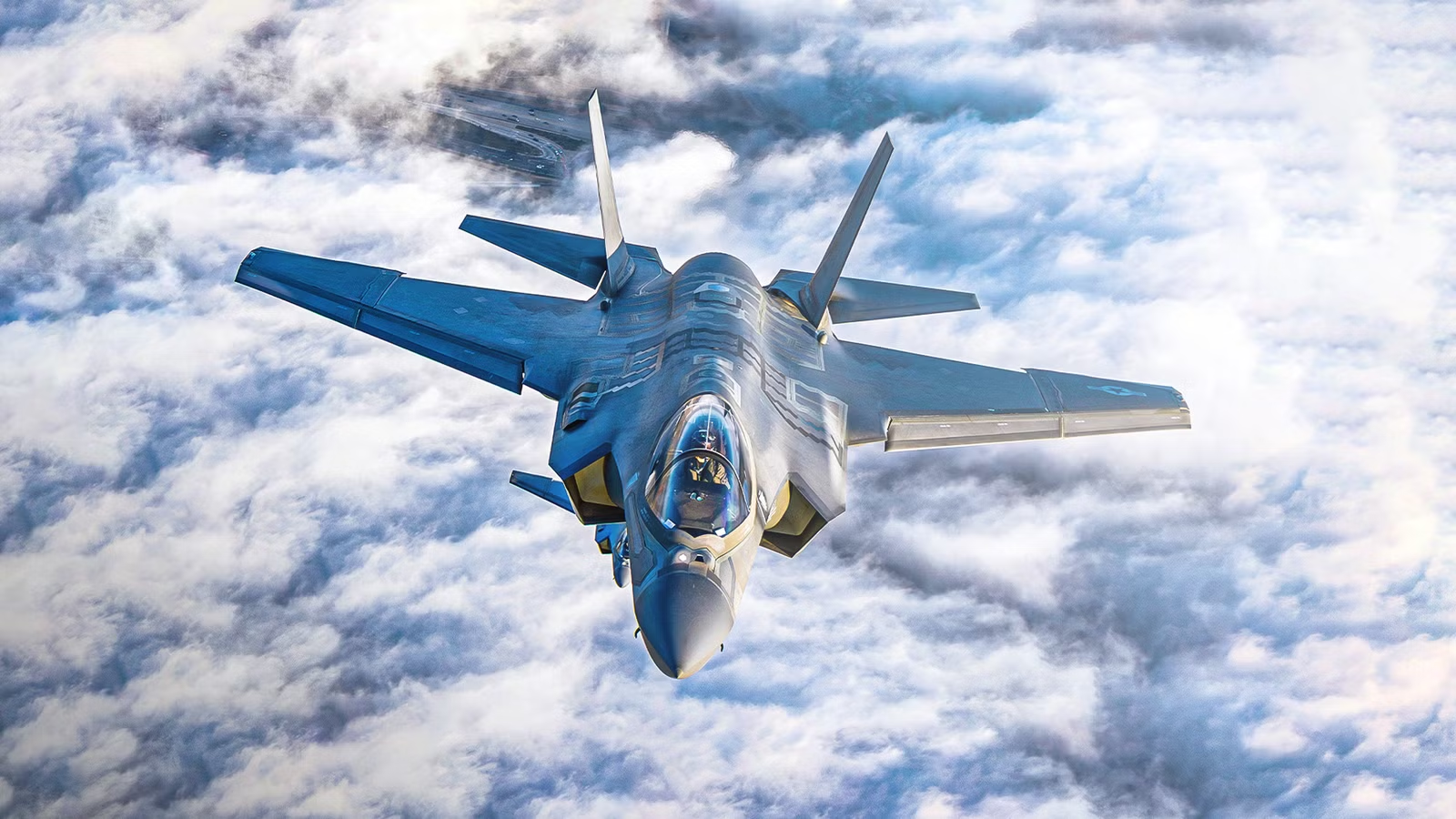
When many articles discuss the cost of fighter jets, they tend to discuss the initial flyaway cost of the jets. But while these costs are significant and important, they are also only one part of the total acquisition costs. If focus is given to them to the exclusion of other costs, they are arguably more unhelpful than they are helpful. Flyaway costs are easy-to-understand figures and are commonly used by companies to market their jets as “affordable.” The true costs of having a fighter jet capability are extremely complicated, and this article will only scratch the surface.
Very important aspects are industrial offsets, worksharing, and technology transfer, which are beyond the scope of this article. Also beyond the scope is resale value, as is seen with Norway, Denmark, Belgium, and the Netherlands all having useful F-16s retiring that could be sold to Argentina and Romania as well as donated to Ukraine. Argentina paid $300 million for the 24 old F-16s ($12.5 million each) and around $700 million for the total package.
Flyaway Costs Of Fighter Jets

Lockheed Martin’s F-35.com website states, “For Production Lots 15 through 17, the average flyaway cost of an F-35A was $82.5 million; $109 million for an F-35B, and $102.1 million per F-35C.” These Lots were finalized in 2022 with deliveries beginning in 2025 and continuing through 2026. Future Lots increase the base price somewhat.
Ballpark estimates for the new lighter-weight Saab Gripen E is around $70 to $80 million, around $95 to $105 million for the heavy F-15EX, around $95 to $110 million for the Rafale F4, approximately $105 to $120 million for the Eurofighter Typhoon Tranche 4, about $75 to $85 for the lighter Super Hornet, while the light/medium weight F-16 Block 70 has the lowest Western mainline fighter jet per unit cost of around $60 to $70 million each.
On the face of it, the F-35A is not only a heavier, 5th-generation stealth fighter with sensor fusion, networking, electronic warfare capabilities, and more far exceeding anything else on the market, but it is also cheaper than any other Western heavy-medium/heavyweight frontline fighter jet on the market. But if this sounds too good to be true, that’s because it is. Flyaway cost is just a beginning point in assessing the cost of a fighter jet capability.
Flyaway Fighter Jets Are Not Ready For Combat

Fortunately for this article, “flyaway cost” is fairly consistent in meaning across the industry (with some differences), allowing a more apples-to-apples comparison. The underlying concept is the cost to produce one additional fighter and deliver it ready to leave the factory, but not the cost to introduce it into service. These aircraft generally include all permanently installed systems on the aircraft, like avionics, engines, AESA radar, etc.
However, they exclude support equipment, simulators and training equipment, engine and other spares, weapons, ground support equipment, targeting pods, electronic attack pods, external fuel tanks (sometimes), and more. For the F-35A, the per-unit cost may be $82 million, but the procurement cost (with weapon systems, training, program management) may be $100 to $120 million, while the total export package may be $150 to $220 million, depending on the buyer.
A useful analogy is buying a high-performance computer workstation. The flyaway cost is comparable to purchasing the computer itself, complete with its processor, graphics card, and internal hardware, but without monitors, software licenses, peripherals (e.g., a mouse), an extended warranty, training, and other supporting equipment, all of which increase the total cost significantly.
The Package Deals

A package deal for 24 fighters could cost $6 billion, of which only around $2.5 billion is for the jets themselves. Depending on the package, the fighter jets may be 35% to 60% of the total cost. These deals typically include engine spares, weapons (around 10-30% of the package), other spares, ground support equipment, simulators, training, technical documentation, contractor support, infrastructure, and more.
In 2026, Militarnyi reported that the US was offering Peru a 50% discount on the F-16 Block 70s by doubling the offer from 12 jets to 24 without materially changing the total package cost of $3.5 billion. However, this was misleading. The “discount” was mostly achieved by gutting the support parts of the package, like munitions. Peru was offered more jets, but with fewer munitions and less capacity for each jet to be sustained and otherwise useful.
Customer (per Saab, etc.) | Fighter jet | Quantity | Total package value | Estimated flyaway cost per aircraft (approximate) | Aircraft share of package |
|---|---|---|---|---|---|
Colombia | Gripen E/F | 17 | $3.6 billion | $75 million | 35-38% |
Thailand | Gripen E/F | 4 | $550 million | $75 million | 53-58% |
Peru | F-16 Block 70 | 12 | $3.5 billion | $67 million | 22-24% |
Romania | F-35A | 32 | $6.5 billion | $82 million | 40-42% |
Bulgaria (2nd batch) | F-16 Block 70 | 8 | $1.3 billion | $67 million | 38-43% |
Turkey | Eurofighter Typhoon | 20 (+20 options) | $7.2 billion | $110 million | 30% |
Indonesia | Rafale | 42 | $8.1 billion | $104 million | 50-55% |
US Air Force | F-15EX | 24 | $3 billion | $125 million | Possibly 100% including spares |
In the case of Peru, there was another interesting aspect of fighter jet acquisition: financing. While a country like Canada has little issue financing F-35 and Gripen purchases, the same is not true for a country like Peru. One of the sweeteners the US offered was Major Non-NATO Ally status that would give it access to preferential financing.
Cost Of Munitions

The cost of munitions is one of the biggest sources of expense for fighter jets. For its Fiscal 2027 budget, the US Air Force is requesting a total of $11.38 billion for missile procurement, up from $6.3 billion in 2026. By comparison, when it comes to procuring the aircraft to launch those missiles, the United States Air Force is requesting $5.3 billion for its F-35As (38 aircraft), $3 billion for F-15EXs (24), and around $4 billion for the B-21 (undisclosed quantity).
This means the Air Force’s proposed Fiscal 2027 missile and fighter jet/bomber procurement budgets are similar. Saab writes of the new Gripen E, “Air supremacy is achieved with the carriage of up to seven Meteor Beyond Visual Range Air-to-Air Missiles and two Within Visual Range IRIS-T missiles.” The Meteor missile is considered the best in the world, or at least in the very top tier. But it is also one of the most expensive.
The cost per missile is around €2 million (roughly $2.1–2.3 million) per unit. Brazil paid approximately €200 million ($210–230 million) for 100 missiles in 2019, equivalent to €2 million per missile. Current procurement costs are likely to be somewhat higher, although exact contemporary pricing is not public. A single Gripen E with a flyaway cost of $70+ million could theoretically expend over $15 million worth of missiles in a single sortie. Five of these sorties, and the missiles would be more expensive than the base flyaway cost of the jet. The share of the base cost of the jet shifts significantly in a high-intensity conflict relative to peacetime.
Other Less Obvious Factors

Different fighter jets have different capabilities and require different levels of support. For example, it is much easier and cheaper for an Air Force squadron to transition from legacy F-15Cs to new F-15EXs than to F-35As. Transitioning to the F-35 requires the base to install a different set of ground infrastructure (e.g., hangars) and train maintenance crew and pilots more extensively. At the same time, one type of jet is not the same as another.
In 2021, the Swiss Government announced the F-35A was the winner of its competition and noted “the F-35A is comparatively easy to operate and is able to provide information superiority; it requires less training and has a better ratio of flight to simulator hours. Because of this, the F-35A requires about 20% fewer flight hours than other candidates, and about 50% fewer take-offs and landings than the Air Force’s current jet aircraft, which the F-35A will be replacing.”
Simple Flying has previously reported it costs around $5.6 million in 2018 dollars to train an F-15E Strike Eagle and F-16 Fighting Falcon pilot (around $7.2 to 8.7 million in 2026 dollars). The cost to train an F-35A pilot was around $10.2 million in 2018 and likely around $13 to 15.7 million in 2026. This is in addition to training the maintenance crew and purchasing specialized tooling for maintenance.
Risk & Other Supporting Assets Are Important

A country may assess that it will need 24 5th-generation jets to meet its requirements or 36 4.5th-generation jets to fill the same role. A fighter jet like the F-16 [with a 400 nautical mile (740 km) combat radius] may require A330 MRTT tanker support to meet a country’s requirements, while an F-35A with a 670 nautical mile (1,241 km) radius on internal fuel may be sufficient without tanker support.
Aircraft longevity and upgrade potential also influence value for money. For example, while essentially all the world’s once-numerous MiG-21 Fishbeds are now retired, grounded, or scrapped, many of the world’s contemporary upgraded Northrop F-5s continue flying. Some countries remain content with their F-5s.
Risk is another important cost often glossed over. The deterioration in Canada’s confidence in the United States has added a risk cost to the F-35s. Meanwhile, newer fighter programs such as Turkey’s Kaan and South Korea’s KF-21 carry different forms of risk associated with aircraft that have yet to build decades-long operational track records, as well as the ability of their manufacturers to provide sustained upgrades and support over several decades. The advertised per-unit price of an aircraft is only one component—often a relatively small one—of a fighter jet program’s total life-cycle cost.
Catch what other trackers miss
Emergency squawks, holds, NOTAMs — live signals, no signup.
Open tracker
Catch what other trackers miss
Emergency squawks, holds, NOTAMs — live signals, no signup.
Open tracker