dailynewsnblog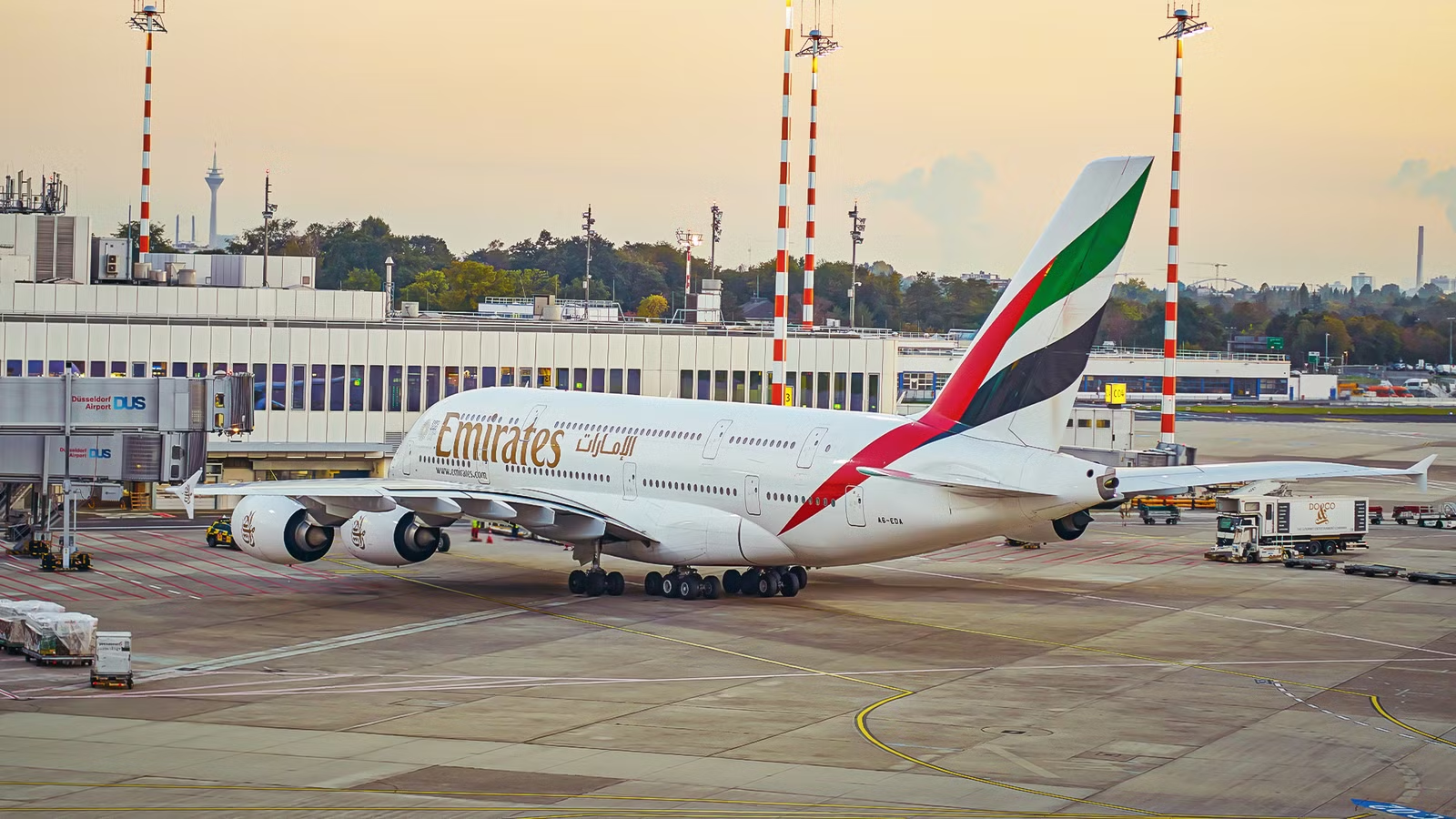
Operating the world’s longest Airbus A380 route is an achievement that demands far more than simply assigning the aircraft with the greatest passenger capacity. Every flight between  Dubai International Airport (DXB) and
  Auckland Airport (AKL) requires careful planning, significant fuel reserves, favorable weather conditions, and enough operational flexibility to cope with changing winds across thousands of miles of ocean and remote airspace. While the nonstop service often attracts attention because of its remarkable duration, the supporting strategy behind it is equally noteworthy.
Since launching the route in 2016,  Emirates has quietly maintained an alternative network that allows passengers to reach New Zealand even when the airline adjusts nonstop operations. Rather than relying exclusively on a single ultra-long-haul flight, the Dubai-based carrier has preserved one-stop connections through Australia, creating a practical fallback that strengthens resilience while giving planners greater freedom to respond to operational challenges and changing market demand.
Auckland Remains Emirates’ Longest Nonstop Airbus A380 Route

The nonstop route between DXB and AKL has occupied a unique position within Emirates’ network since its introduction in March 2016. Covering approximately 8,800 miles (14,162 km), the flight represents the airline’s longest scheduled A380 operation and remains among the longest commercial flights operated anywhere in the world.
Although the eastbound journey from Auckland to Dubai is lengthy in its own right, the westbound flight usually presents the greater challenge because of prevailing winds across the Indian Ocean and Southeast Asia. Under favorable conditions, the journey can be completed in a little over 17 hours, but strong headwinds have regularly extended block times to around 17 hours and 25 minutes, making every departure a carefully planned balancing act involving payload, fuel, weather forecasts, and air traffic considerations.
These operational realities mean that dispatchers cannot simply schedule the same aircraft performance every day throughout the year. Seasonal wind patterns influence fuel requirements, while unexpected weather systems may require revised routings that add additional flying time. Even relatively small changes become significant on flights lasting well over 17 hours, where every additional minute increases fuel consumption and operational complexity.
Despite these challenges, Emirates has continued to assign the A380 exclusively to the route, highlighting the carrier’s confidence in the aircraft’s capabilities. The double-decker provides substantial passenger capacity across premium and economy cabins while also offering the range needed for one of commercial aviation’s most demanding missions.
Australia Provides An Established Alternative To The Nonstop Service

While the nonstop route receives the majority of public attention, Emirates has never depended on it as the sole means of serving Auckland. Instead, the airline has continued operating extensive services into Australia’s largest cities, allowing passengers to connect onward to New Zealand whenever necessary.  Sydney Kingsford Smith Airport (SYD) has traditionally played the most prominent role within this strategy thanks to its extensive schedule from Dubai and its large volume of connecting passengers. Emirates also maintains significant operations into Melbourne Airport (MEL) and Brisbane Airport (BNE), creating multiple pathways for travelers heading toward Auckland without requiring the airline to depend entirely on the nonstop service.
This approach gives Emirates an established backup within its broader network rather than requiring special contingency planning whenever operational conditions become less favorable. If schedules change or nonstop frequencies are reduced, passengers can still travel between Dubai and Auckland through Australian gateways using connections that have long been integrated into the airline’s system.
The arrangement also benefits customers originating outside Dubai, as Emirates carries passengers from across Europe, the Middle East, Africa, and Asia through its Dubai hub before distributing them across its long-haul network. Having several onward routing options increases flexibility throughout the reservation system and helps minimize disruption when demand patterns shift.
Ultra-Long-Haul Flying Requires Constant Operational Flexibility

Flights lasting more than 17 hours leave little room for operational uncertainty. Airline planners must consider aircraft performance, passenger loads, cargo demand, weather forecasts, alternate airports, and regulatory fuel requirements before every departure. Unlike shorter international routes, adjustments cannot easily be absorbed once the aircraft is airborne because diversion options remain limited across large stretches of ocean.
Headwinds represent one of the most important variables affecting Dubai-Auckland operations, and strong winds opposing the aircraft increase fuel burn and can reduce operational margins, particularly on the westbound sector. As a result, planners continuously evaluate expected atmospheric conditions before finalizing payload and fuel calculations.
Maintaining one-stop alternatives through Australia provides an additional layer of flexibility within this process, as rather than insisting that every passenger travel nonstop regardless of operating conditions, Emirates can adapt schedules according to seasonal requirements while continuing to offer reliable service between Dubai and New Zealand.
The strategy also supports efficient fleet utilization. A380 examples represent valuable assets that must be allocated carefully across the airline’s global network. Having multiple routing options allows Emirates to deploy aircraft where demand is strongest while preserving connectivity even when operational priorities evolve during different times of the year.
Demand Has Supported More Frequent Nonstop Operations

Although the Australian connection strategy remains in place, passenger demand has increasingly favored the nonstop option. As international travel continued to recover and long-haul markets strengthened, Emirates gradually expanded nonstop operations between Dubai and Auckland. A significant milestone arrived in last month when the airline increased the route to daily A380 service. The schedule expansion reflected confidence in sustained demand while demonstrating that the economics of operating one of the world’s longest flights remained attractive despite its considerable operating costs.
Even with daily nonstop flights, however, the underlying network philosophy has not changed. The Australian gateways continue serving an important role by providing additional capacity, supporting passengers whose itineraries involve Australian destinations, and preserving operational resilience whenever circumstances require adjustments. Rather than replacing the connecting model, the expanded non-stop schedule complements it. Together, both options create a network that can accommodate different passenger preferences while allowing Emirates to respond to changes in demand without sacrificing connectivity across the region.
The result is a system that balances efficiency with redundancy, ensuring that one of the airline’s most ambitious routes remains supported by a broader operational framework rather than existing in isolation.
The Airbus A380 Continues To Play A Central Role

Emirates | Simple Flying
Many airlines have reduced or retired A380 fleets over the past decade, yet Emirates has remained firmly committed to the type as the flagship of its long-haul operation. No carrier operates more A380s, and the aircraft continues serving numerous high-demand destinations throughout Europe, Asia, Australia, and North America.
The Dubai-Auckland route showcases many of the aircraft’s strengths. Its combination of long range and high seating capacity allows Emirates to transport hundreds of passengers on a single flight while offering premium products that include onboard lounges and shower spas for first-class travelers.
Operating such a large aircraft on an ultra-long-haul route also improves efficiency when passenger demand supports high load factors. Instead of scheduling multiple smaller aircraft, Emirates can concentrate capacity into a single daily departure while maintaining a consistent onboard product across the route. The airline’s continuing investment in cabin refurbishment programs further reinforces the importance of the A380 within its future plans. Updated interiors, refreshed premium cabins, and modernized economy seating help ensure that the aircraft remains competitive despite its age, particularly on flights where passenger comfort becomes increasingly important after more than 17 hours in the air.
Emirates currently has a total of 116 Airbus A380s in its fleet, according to ch-aviation.
Aircraft | Number In Fleet | Number On Order |
|---|---|---|
Airbus A350-900 | 24 | 49 |
Airbus A380 | 116 | – |
Boeing 777-200LR | 10 | – |
Boeing 777-300ER | 117 | – |
Boeing 777-8 | – | 35 |
Boeing 777-9 | – | 235 |
Boeing 787-8 Dreamliner | – | 20 |
Boeing 787-10 Dreamliner | – | 15 |
Network Planning Often Matters More Than Individual Flights

From a passenger perspective, the non-stop Dubai-Auckland service appears to be a single record-setting flight linking two distant cities. Behind the scenes, however, it functions as one component within a much larger network built around flexibility, redundancy, and efficient aircraft utilization. The continued availability of Australian connections demonstrates that successful ultra-long-haul operations depend as much on network planning as aircraft performance. By maintaining multiple routing options through Sydney, Melbourne, and Brisbane, Emirates reduces dependence on any single schedule while preserving service continuity across the broader region.
This philosophy has allowed the airline to adjust non-stop frequencies over time without abandoning the market or compromising connectivity. Whether operating fewer non-stop flights during certain periods or increasing the service to daily A380 departures when demand supports expansion, Emirates retains an established fallback that has been part of its strategy since the route first launched in 2016.
Rather than viewing the Australian services as competitors to the non-stop flight, Emirates has positioned them as complementary components of a broader network. That combination enables the airline to continue operating one of commercial aviation’s most demanding Airbus A380 routes while maintaining the operational resilience needed for flights that regularly spend well over 17 hours in the air.
Catch what other trackers miss
Emergency squawks, holds, NOTAMs — live signals, no signup.
Open tracker
Catch what other trackers miss
Emergency squawks, holds, NOTAMs — live signals, no signup.
Open tracker